

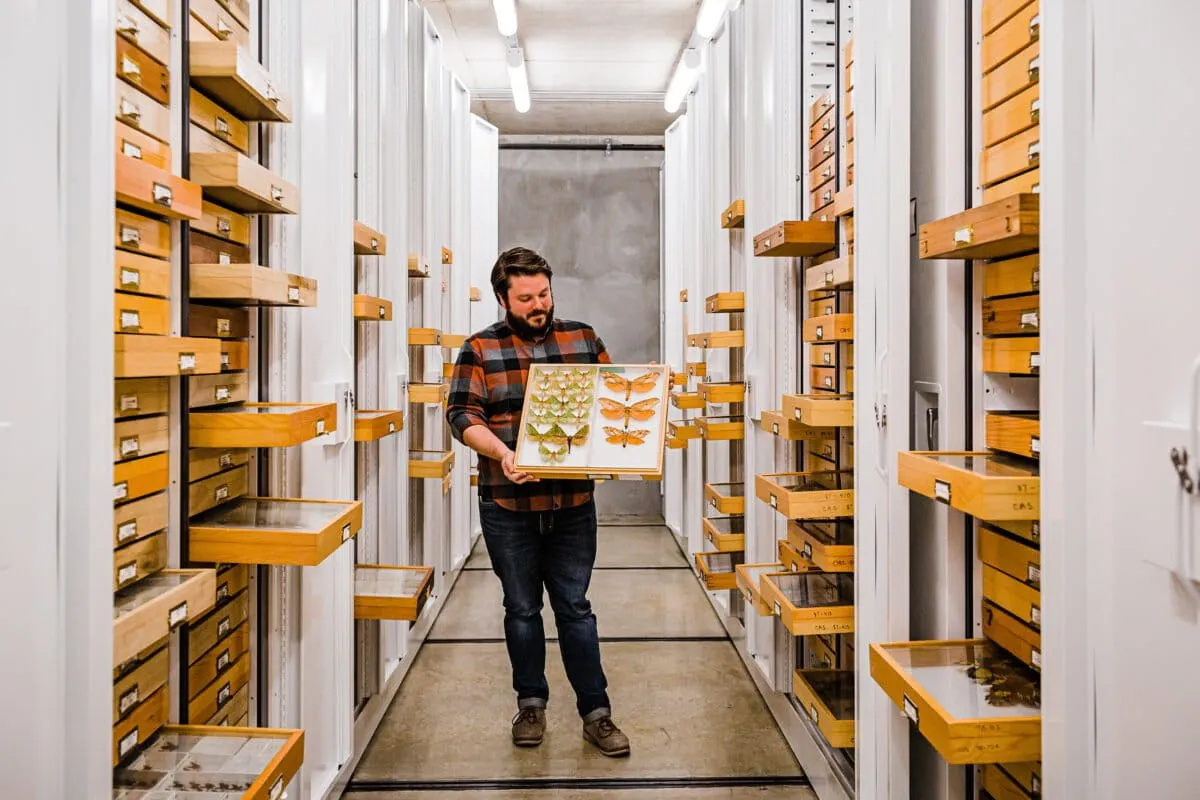
Christopher Grinter remembers the moment he became obsessed with insects. He was a kid in suburban Chicago, watching butterflies drift through his backyard, and he wanted to know their names. His parents took him to the Field Museum one night, and he saw a real insect collection for the first time. "I had my mind blown," he recalls.
That childhood wonder turned into a life's work. Now, as Senior Collection Manager of Entomology at the California Academy of Sciences, Grinter oversees one of the world's largest scientific archives of insects—millions of specimens stretching from the smallest moth to the largest butterfly. But his real mission is far more urgent: to document every insect species in California before they vanish.
The California All-Taxa Biodiversity Inventory (CalATBI) is exactly what its name suggests—an attempt to create a complete record of every living species in the state. It sounds impossible. It probably is. But Grinter and his team are trying anyway.
We're a new kind of news feed.
Regular news is designed to drain you. We're a non-profit built to restore you. Every story we publish is scored for impact, progress, and hope.
Start Your News DetoxThe work behind the collection
Butterflies led Grinter deeper into the insect world. He learned that moths—far more numerous and largely invisible to most people—are where the real mystery lies. "An urban backyard probably has at least a few species of microlepidoptera that still need a scientific name," he says. Unnamed species, living in the spaces we pass through every day.
When CalATBI launched, Grinter's team received funding for fieldwork at a scale rarely seen in recent decades. They collected hundreds of thousands of insects across California, covering tens of thousands of miles. The effort produced both scientific breakthroughs and the occasional misadventure—the kind of stories that come with any ambitious field research.
The work matters because we're losing insects at a pace that alarms scientists. Without a baseline record of what species exist, what they look like, and where they live, conservation efforts become guesswork. Every specimen Grinter's team catalogs and databases becomes part of a permanent record—a snapshot of California's biodiversity at a specific moment in time.
For Grinter, the work connects back to that kid in Chicago who wanted to know the names of butterflies. Except now, the stakes are higher. He's not just satisfying curiosity. He's racing against time to document life that might otherwise disappear without ever being formally recognized by science.
The collection grows every year, and so does the urgency behind it.





