

NASA's Perseverance rover has picked up something unexpected in the Martian air: the crackling sound of electricity. Researchers analyzing two years of audio recordings found 55 instances of small electrical discharges zipping through the atmosphere near the rover, the strongest packing about as much energy as an electric bug swatter.
For decades, scientists suspected lightning might flash across Mars's sky. Now they may have caught it — though not in the way Earth's thunderstorms work.
What Mars lightning actually looks like
Unlike the jagged bolts that split open Earth's skies during storms, Martian lightning comes as tiny sparks. Think of the static shock you get after shuffling across carpet, then touching a doorknob. That's closer to what's happening in the Martian atmosphere.
We're a new kind of news feed.
Regular news is designed to drain you. We're a non-profit built to restore you. Every story we publish is scored for impact, progress, and hope.
Start Your News DetoxThe culprit is dust. When particles whirl around during Martian dust storms, they rub against each other and build up electrical charge — some atoms lose electrons and become positive, others gain them and become negative. Eventually the imbalance gets too great, and negatively charged particles leap across the gap, creating a small electrical arc. It's the same physics that produces sparks in Earth's sandstorms and volcanic ash plumes.
NASA / JPL-Caltech
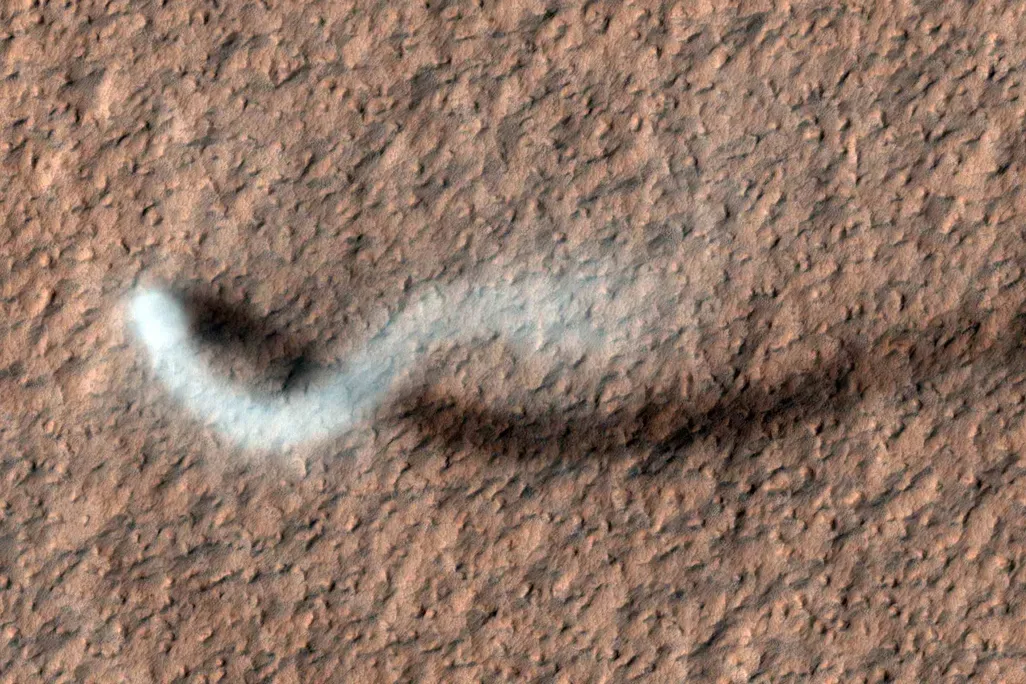
The discovery came almost by accident. Three years ago, researchers were reviewing audio from a dust devil that had passed over Perseverance when they heard a mysterious clicking sound. Their first thought: a grain of sand hitting the rover's microphone. But simulations suggested something else — electrical interference. So the team went back through 28 hours of recordings collected over two Martian years and found the pattern. Most of the zaps occurred during intense wind events, including when dust devils swept across the rover's location.
What this means for future Mars missions
The good news for future astronauts: a bolt of Martian "lightning" won't strike them down. The bad news is more mundane. These frequent small discharges could interfere with sensitive electronics and instruments. That means spacecraft and equipment designed for Mars will need protection against electrical interference — a practical engineering challenge, but not an impossible one.
Ralph Lorenz, a planetary scientist at Johns Hopkins University who co-authored the study published in Nature, describes what Perseverance recorded as "a small spark, perhaps a few millimeters long" that "sounded like a spark or whip-crack." Not the dramatic lightning of Earth, but real electrical activity nonetheless.
The research community is cautiously convinced. Giles Harrison, an atmospheric physicist at the University of Reading, calls the evidence "quite compelling" and notes it's "the most direct observational evidence we've got of electrical activity in Mars' atmosphere." Still, scientists want more confirmation. Perseverance's microphone wasn't designed to detect electrical discharges, and no one has actually seen the lightning yet — only heard it.
Baptiste Chide, another co-author, sees the discovery as a starting point. He's calling for the next generation of Mars instruments to measure electric fields directly at the surface, which would give researchers a clearer picture of how often these discharges occur and how strong they can get. The mystery of Martian lightning is starting to unfold, one small spark at a time.