A neutron star 10 million light-years away just gave astronomers their clearest look yet at how the universe's most extreme objects consume matter.
NGC 7793 P13, a rapidly spinning neutron star, suddenly brightened by more than 100 times between 2021 and 2024. That's not just a flicker — it's the kind of dramatic shift that forces scientists to rethink how they understand these objects. The surprise wasn't just the brightness change itself, but what happened to the star's rotation at the same time.
Researchers led by Marina Yoshimoto and her team at Japanese institutions spent over a decade tracking P13 using four separate space telescopes — XMM-Newton, Chandra, NuSTAR, and NICER. What they found was a hidden connection. When the neutron star began rebrightening in 2022, its rotation started accelerating twice as fast as it had been. That acceleration held steady all the way through 2024. For the first time, scientists could link the star's feeding rate directly to how fast it was spinning.
We're a new kind of news feed.
Regular news is designed to drain you. We're a non-profit built to restore you. Every story we publish is scored for impact, progress, and hope.
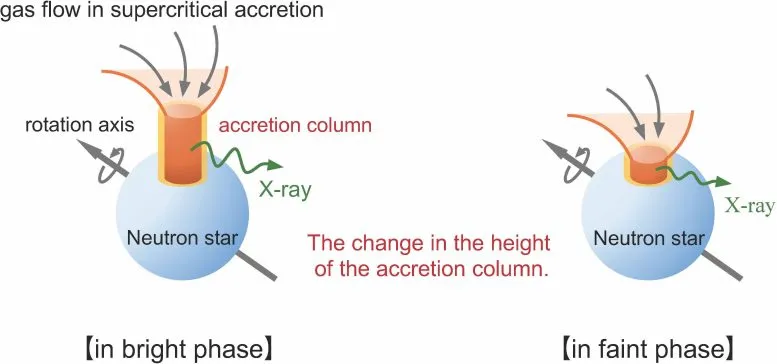
Start Your News DetoxHere's what's actually happening: A companion star nearby is dumping gas onto P13 through its gravitational pull. The neutron star's intense magnetic field channels that incoming gas toward its poles, creating towering structures called accretion columns. These columns are where the X-rays come from — they're the cosmic equivalent of a star being fed at maximum capacity.
The mystery that kept astronomers puzzled was why the brightness and spin rate didn't seem connected. For years, those two measurements seemed to move independently. But the 2021–2024 cycle cracked it open. When more material poured onto the star, the accretion columns actually changed shape — they got taller. That geometric shift explains why both the brightness and the spin acceleration increased together.
This matters because P13 is undergoing what physicists call supercritical accretion — it's swallowing material so fast that conventional models struggle to explain how it stays stable. The physics involved is extreme: gravity this intense, magnetic fields this strong, matter moving this fast. Understanding how it works could reshape how astronomers think about feeding black holes and neutron stars across the universe.
The research team's next step is to use these new insights to build better models of supercritical accretion. P13 has handed them a Rosetta Stone — a decade of data that shows, for the first time, how the internal structure of these systems responds when they're being fed.