For decades, physicists have hunted for a ghost particle that shouldn't exist — or at least, shouldn't exist in the way some experiments suggested. The sterile neutrino, a hypothetical fourth type of neutrino that barely interacts with anything, would be a game-changer for physics if real. It would explain anomalies in other experiments and potentially solve the dark matter mystery. Now, after sifting through 36 million electron decays with extraordinary precision, an international collaboration has dealt that possibility a significant blow.
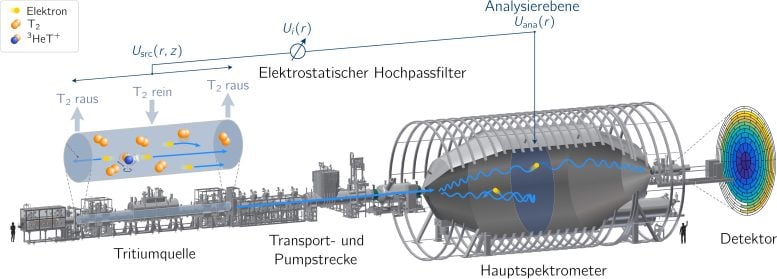
The KATRIN experiment, a 70-meter-long detector buried in the Karlsruhe Institute of Technology in Germany, has completed its most sensitive search yet for sterile neutrinos. The results, published in Nature in December 2024, found no evidence for the particle — ruling out a large swath of where physicists thought it might hide.
The invisible becomes slightly less invisible
Neutrinos are among the most abundant particles in the universe, yet they're fiendishly hard to catch. Trillions pass through your body every second without leaving a trace. We know three types exist — the Standard Model of particle physics accounts for them. But in the 1990s, experiments began finding hints of a fourth type: one so weakly interactive that it barely touches anything else, earning it the name "sterile."
We're a new kind of news feed.
Regular news is designed to drain you. We're a non-profit built to restore you. Every story we publish is scored for impact, progress, and hope.
Start Your News DetoxIf sterile neutrinos were real and light enough, they'd show up in tritium decay — the process where a tritium nucleus emits an electron and an antineutrino. KATRIN works by measuring the energy of those electrons with exquisite precision. If a sterile neutrino were being produced alongside the standard neutrino, it would leave a tiny dent in the energy spectrum — a "kink" that the detector could theoretically spot.
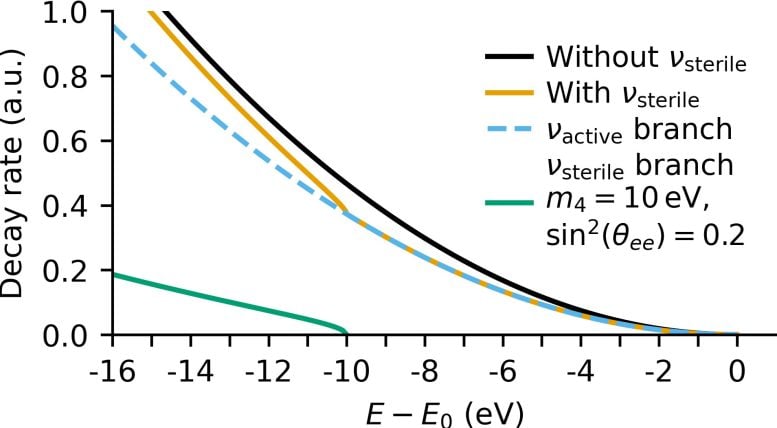
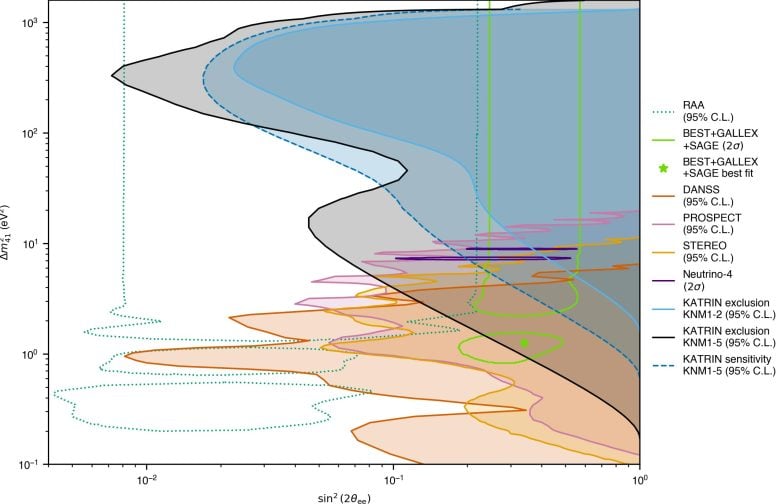
Between 2019 and 2021, KATRIN recorded those electron decays 36 million times over 259 days, achieving measurement precision below one percent. No kink appeared. The experiment's sensitivity was so sharp that it ruled out the parameter space suggested by earlier anomalies, including deficits from reactor-neutrino experiments and the claims from the Neutrino-4 experiment, which had reported seeing signs of a fourth neutrino.
This doesn't mean sterile neutrinos don't exist. It means if they do, they're either heavier or interact even more weakly than the experiments that hinted at their existence had suggested. "Our new result is fully complementary to reactor experiments," explains Thierry Lasserre of the Max-Planck-Institut für Kernphysik, who led the analysis. "Together, the two approaches now consistently rule out light sterile neutrinos that would noticeably mix with the known neutrino types."

The search gets sharper
KATRIN isn't done. Data collection continues through 2025, and by then the experiment will have recorded more than 220 million electrons — a sixfold increase in statistics. That means even tighter constraints on where a sterile neutrino could hide.
More intriguingly, in 2026 KATRIN will be upgraded with a new detector called TRISTAN, which will measure electron energies directly without passing them through the main spectrometer. This opens the door to searching for much heavier sterile neutrinos — ones in the keV mass range. That's significant because sterile neutrinos at those masses could theoretically make up the universe's dark matter, the invisible stuff that holds galaxies together.
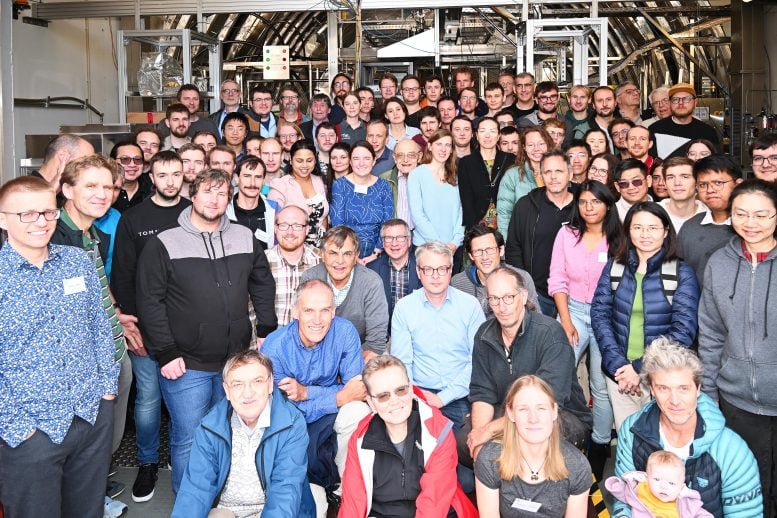
"This next-generation setup will open a new window into the keV-mass range, where sterile neutrinos might even form the Universe's dark matter," says Susanne Mertens, another KATRIN co-spokesperson. The precision physics frontier keeps moving. We haven't found the sterile neutrino yet — but we're narrowing down exactly where not to look, which is often how discovery works.