Imagine a blood test that could catch cancer or heart disease before it really gets going. That's the holy grail of diagnostics, and it might just be delivered by something you've never heard of: extracellular vesicles, or EVs.
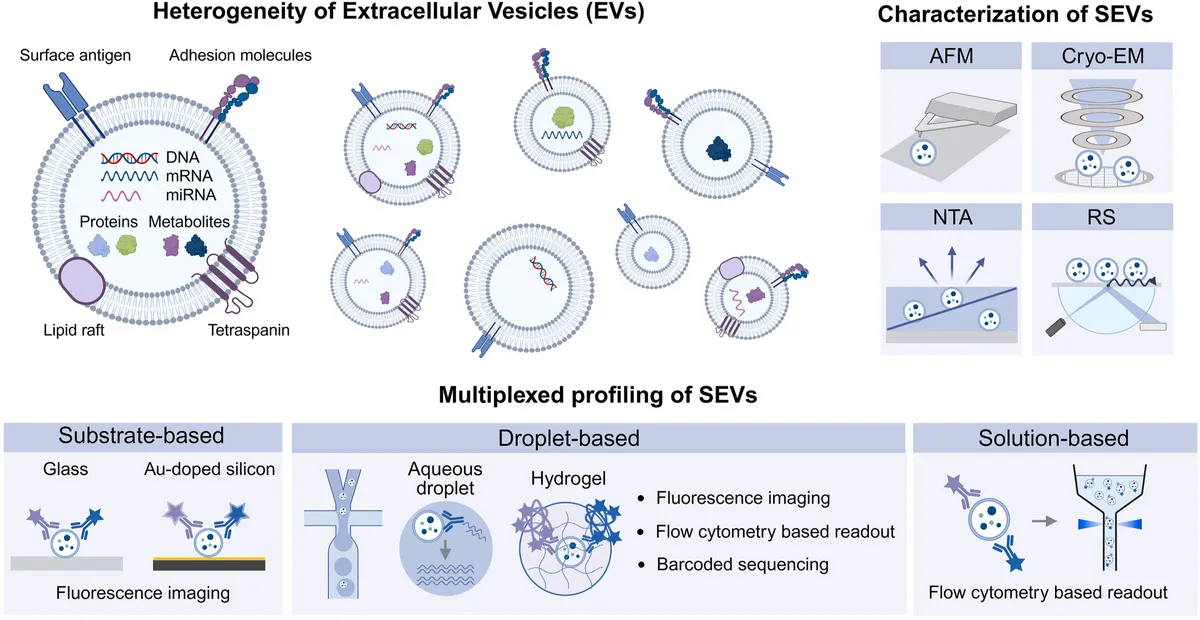
These are essentially microscopic packages released by your cells, full of biological intel like proteins and RNA. Think of them as tiny, cellular Amazon Prime deliveries, reflecting the health (or lack thereof) of the cells they came from. And because they float around in your blood and urine, they're prime candidates for diagnosing diseases without, you know, actually cutting you open.
Here's the rub: traditional lab tests analyze EVs in bulk. Millions of these little guys get mashed together, and their individual signals get averaged out. It's like trying to find a specific whisper in a stadium full of shouting fans. That means crucial, rare EVs — the ones screaming "DISEASE!" — often get missed.
We're a new kind of news feed.
Regular news is designed to drain you. We're a non-profit built to restore you. Every story we publish is scored for impact, progress, and hope.
Start Your News DetoxThe Micro-Detectives Are On It
Enter the micro-detectives from Incheon National University and the University of Pennsylvania. Led by Assistant Professors Yoon Ho Roh and Jina Ko, they've been reviewing the latest tech that can isolate and analyze individual EVs. Their findings, published in TrAC Trends in Analytical Chemistry, are basically a roadmap to making these tiny packages spill their secrets.
They found that modern systems are combining physical separation (think: tiny sorting machines) with molecular tagging. These tags are like microscopic glowing barcodes, allowing researchers to pick out specific EVs and amplify their faint signals. We're talking fluorescence, DNA barcoding, and even nanoplasmonic surfaces that boost weak biomarkers with insane sensitivity.
Suddenly, instead of a blurry average, scientists can profile tens of thousands of vesicles from a single sample. Dr. Roh puts it simply: looking at vesicles one by one reveals biological differences that bulk tests just can't see. More sensitive, more accurate screening? Yes, please.
Your Future Blood Test Just Got an Upgrade
This isn't just lab-bench theory. Clinical studies are already showing these tools can differentiate healthy folks from patients with pancreatic cancer, cholangiocarcinoma, and lung adenocarcinoma — all by sniffing out those rare, tumor-derived EVs in blood plasma. But it's not just cancer. We're talking cardiovascular disease, neurodegenerative disorders, and inflammatory conditions. Since EVs are stable and easy to collect, they could become as routine as your yearly physical. Dr. Ko envisions a future where they can pull all the info from a single vesicle – proteins, RNA, lipids, even how stiff it is. This "multi-omic" profiling is basically giving diseases nowhere to hide.
And the cherry on top? Artificial intelligence will be the brain sifting through the mountains of data. Soon, platforms might analyze a million vesicles per test, making it almost impossible for even the rarest disease signals to slip by. Expect to see single-EV profiling move from specialized labs to your local clinic within the next decade. Earlier diagnosis, better treatment, and truly personalized medicine? Sounds like a future worth getting excited about.