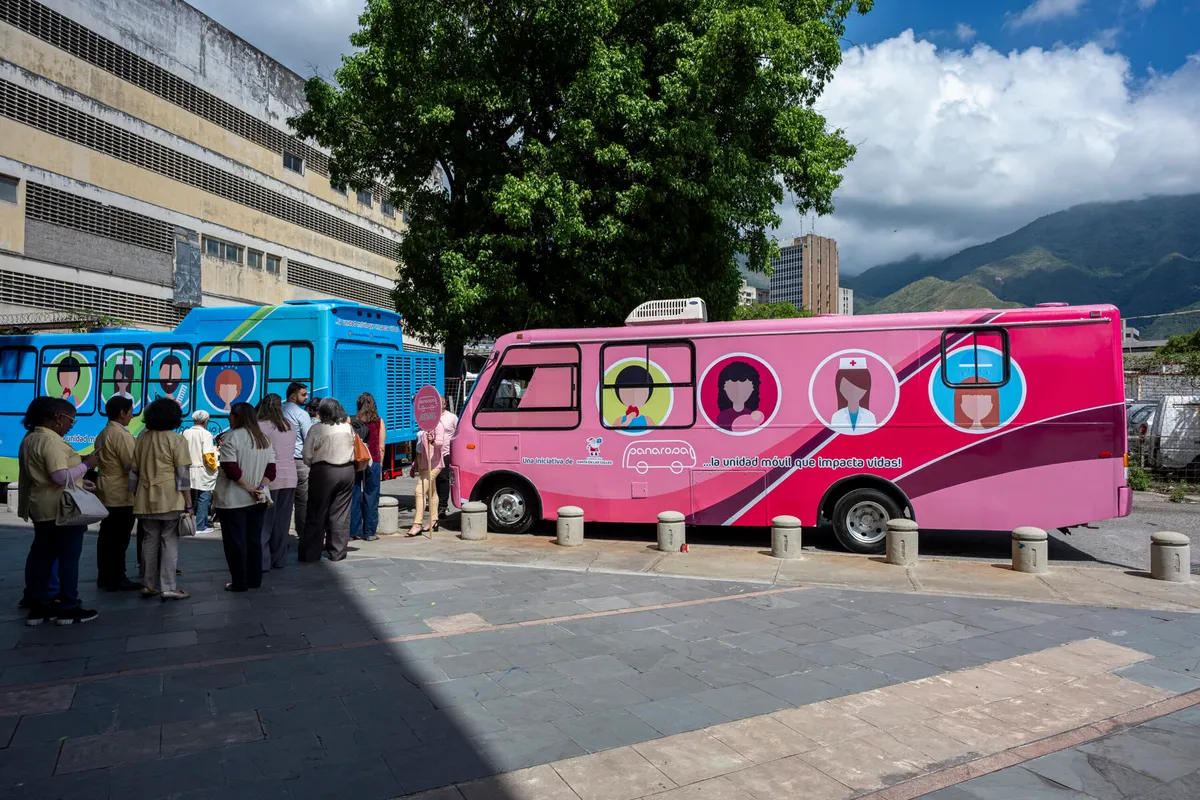
Mariannys Quintero greets women boarding the Panarosa bus in Caracas. She is a nursing assistant who helps homeless women get gynecological care. Quintero explains what to expect and assures them they are not alone.
Less than a year ago, Quintero was homeless herself. She was one of nearly eight million Venezuelans who left the country. After struggling in Colombia, she returned to Venezuela with her 10-year-old daughter while pregnant with twins. She ended up on the streets of Caracas.
A doctor told her about the Panarosa bus. Quintero sought medical help there for her high-risk pregnancy. The staff supported her through a difficult time. She received medical and psychological care during her pregnancy and after losing her babies. A social worker helped her find a home for herself and her daughter. Then, she started working for the organization.
We're a new kind of news feed.
Regular news is designed to drain you. We're a non-profit built to restore you. Every story we publish is scored for impact, progress, and hope.
Start Your News Detox"He was like that walking stick, that support, at a moment when I was saying, wow, I’m never getting out of this, you know?" Quintero said. "There came a point where I felt — I imagine it’s the same thing those women feel... when we say we have no one to help us. But there’s always that person who offers you support, who listens to you, who understands you, who doesn’t judge you."
Aid on Wheels
The Panabus is a modified bus. "Pana" is Venezuelan slang for friend. The idea is that homeless people move around, so services should too. Fundación Santa en las Calles, a nonprofit, launched Panabus in 2016. It offers full care to homeless people. This includes interviews, hygiene kits, clean clothes, medical checks, basic dental care, and treatments for common illnesses.
Social workers search the city for homeless encampments. When they find one, they park the bus there for the day. Since it started, the program has provided over 6,000 care visits.
In November 2022, the team noticed that while more women needed help, Panabus mostly saw men. This led to the creation of Panarosa, Panabus's "sibling." María Angélica ‘Maru’ Rodríguez, general manager of Santa en las Calles, joked about their relationship.
The Panarosa program works similarly to Panabus. However, Panarosa has a gynecology and obstetrics specialist. This specialist provides the same level of care found in a private health center. Services include physical exams, Pap smears, family planning, and ultrasounds.
Alejandra Ceballos, the medical coordinator, said they have three staff doctors. The specialist joins the Panarosa route. Panabus can treat seven patients a day, while Panarosa can treat five. "We return to the same areas as many times as necessary until we’ve reached 100 percent of the people there," Rodríguez said.
 Courtesy of Fundación Santa en las Calles
The team was careful during Panarosa's first route. Gynecological care can be a sensitive topic for women. Rodríguez explained they would be proud even if they only treated one woman. They believed they would build on it "little by little."
Their doubts disappeared quickly. They saw five women on the first day. So far, they have treated 77 women. The number of patients is limited by the bus's water tank. Ceballos noted that this limit also allows for better care. "You can have a real doctor-patient relationship with each person, connect with their story, and in some ways help them even more than you would in a hospital," she said. Hospital patient loads are often very high, and time is limited.
Beyond the Bus
Quintero is a clear example of successful reintegration. She now works for Santa en las Calles. If a patient wants to stop living on the streets and the organization can help, they start a reintegration program.
 Courtesy of Fundación Santa en las Calles
For both Panabus and Panarosa, this means restoring health, family bonds, and a sense of identity. Rodríguez explained that Panarosa often helps entire families. "In those cases, the reintegration program activates for the entire family, not just the mother, but the children, too," she said. They also help children enroll in school and catch up academically.
The effective reintegration rate is between two and three percent. While this seems small, it is considered high-impact. Each individual represents helping an entire family. So far, 200 people have been successfully reintegrated through Panabus.
Rodríguez said their main goal is to restore dignity to people living on the street. "It’s extremely important to us that every single visit we provide meets that standard and represents the best care these people could possibly have access to," she said.
 Courtesy of Fundación Santa en las Calles
She also hopes to destigmatize homelessness. She wants to raise awareness that everyone can help someone living on the street or in a vulnerable situation.
Ceballos is grateful for how Santa en las Calles changed her life and career. "My dream was to become a doctor," she said. "I think that, in some way, being part of the foundation allows me to be an instrument for helping all these people."