


In 2009, paleoanthropologists digging in Ethiopia's Afar Rift pulled eight small bones from the ground—the scattered remains of a foot that would spend years in scientific limbo. The Burtele foot, as it came to be known, didn't fit neatly into what researchers thought they understood about our earliest ancestors. Now, after more than a decade of fieldwork and analysis, scientists have finally placed it: it belonged not to Lucy's famous species, but to a different early human relative that walked the same landscape at the same time.
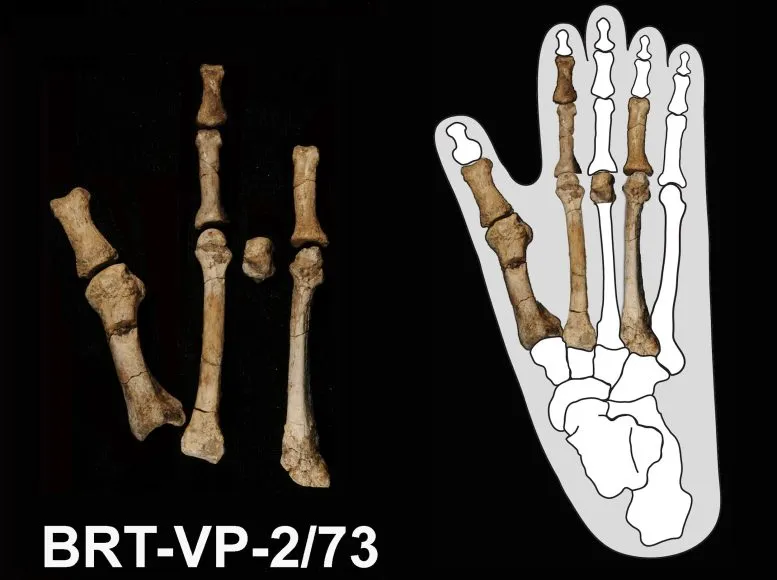
When the foot was first announced in 2012, researchers knew it was unusual—different from Australopithecus afarensis, Lucy's species, which dominated the fossil record from that era. But connecting it to other finds from the same site proved tricky. Teeth had been recovered nearby, but scientists couldn't be certain they came from the same layer of sediment. In 2015, the team identified a new species in the region, Australopithecus deyiremeda, yet they still hesitated to link the foot to it. Over the next decade, repeated excavations at the Woranso-Mille site in Ethiopia yielded enough new evidence that the connection became clear. The foot belonged to A. deyiremeda—and it tells a story about how our ancestors moved that challenges everything we thought we knew.
The Foot That Walked Differently
The Burtele foot is strange by modern standards. It had an opposable big toe—the kind of toe that would let you grip a tree branch, the kind our primate ancestors used for climbing. Yet A. deyiremeda walked upright on two legs, pushing off mainly from the second toe rather than the big toe the way we do. This wasn't a fully modern gait, but it wasn't the knuckle-walking shuffle of apes either. It was something in between, something we'd never seen before.
We're a new kind of news feed.
Regular news is designed to drain you. We're a non-profit built to restore you. Every story we publish is scored for impact, progress, and hope.
Start Your News DetoxThis matters because it rewrites how we think about bipedality—walking on two legs—in early human ancestors. A million years before the Burtele foot was laid down, Ardipithecus ramidus at 4.4 million years ago still had an opposable big toe. Then, a million years later, A. afarensis (Lucy's species) had evolved fully bipedal walking with an adducted big toe, the modern configuration. The Burtele foot sits in that gap, suggesting there wasn't one pathway to upright walking but many. Different species found different solutions to the same problem.
Two Species, One Landscape
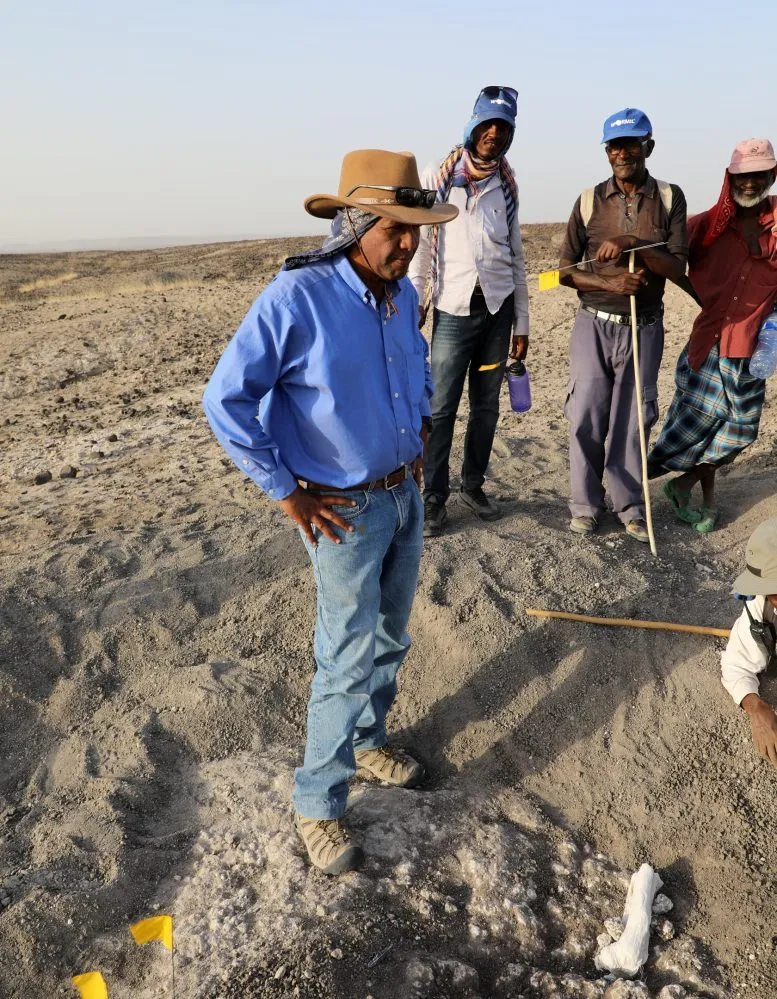
Woranso-Mille is now the only known site where direct evidence shows two closely related hominin species living in the same place at the same time. That alone is significant. It means A. deyiremeda and A. afarensis didn't simply replace each other in a linear march toward modern humans. They coexisted, which raises an obvious question: how did they avoid competing each other into extinction.
The answer appears to be diet. When University of Michigan researcher Naomi Levin analyzed 25 teeth from the Burtele area using isotope testing—a technique that reveals what plants an animal ate based on chemical signatures—the results were stark. A. afarensis ate a mixed diet: tree and shrub resources alongside tropical grasses and sedges. A. deyiremeda relied much more heavily on forest vegetation. They were eating different things from the same landscape, which allowed both species to thrive.
The team also found the jaw of a young A. deyiremeda individual who had died around age 4.5. CT scans of the developing teeth showed a growth pattern more similar to living apes than to modern humans—a reminder that these creatures were still deeply rooted in our primate past, even as they began experimenting with upright walking.
What emerges from the Burtele foot and the evidence surrounding it is a picture of early human evolution far more complex than a simple chain of improvement. Our ancestors didn't follow a single path. They experimented. They diversified. Different species found different ways to walk, different foods to eat, different niches to occupy. Some of those experiments led nowhere. Others, eventually, led to us. Understanding how multiple species navigated the same changing climate millions of years ago may offer perspective on how we navigate ours today.





