You're constantly scrolling, swiping, and maybe even talking to an AI that sounds suspiciously like a human. Feeling a little… unmoored? Turns out, the antidote to our hyper-digital, increasingly isolated lives might just be humanity's oldest trick: rituals.
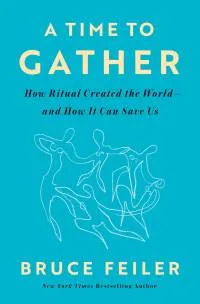
Author Bruce Feiler spent three years globetrotting for his book, A Time to Gather: How Ritual Created the World—and How It Can Save Us. His mission? To figure out why people still insist on gathering, mourning, and celebrating together, even when a perfectly good emoji exists for every emotion. He calls what's happening now a "ritual renaissance," and honestly, it sounds like a much-needed comeback.

Feiler, who's also written about life's wonderfully messy, non-linear timeline, argues that the more chaotic and unpredictable our world gets, the more we desperately need to mark those big, wobbly moments. Because apparently, just letting life happen isn't cutting it anymore.
We're a new kind of news feed.
Regular news is designed to drain you. We're a non-profit built to restore you. Every story we publish is scored for impact, progress, and hope.
Start Your News DetoxThe Original Social Network
Feiler isn't shy about it: rituals are the answer to pretty much everything. Loneliness? Rituals. Political division? Rituals. The impending AI takeover? You guessed it. "Whatever the enemy is, ritual gatherings are the answer," he says. Which, if you think about it, is both impressive and slightly terrifying in its simplicity.
He realized this firsthand when his twin daughters flew the nest for college. Suddenly, his home felt empty, and he was "homesick in my own home." The man needed a ritual to help him cross that threshold, because apparently, just waving goodbye from the driveway isn't quite enough to process 18 years of parenthood.

Humans, it turns out, have been doing this for 300,000 years. We were burying our dead before we even had fully modern human anatomy. So, while your phone might feel like an extension of your hand, group gatherings are the original social network. We gather when someone joins (weddings, births), when they leave (coming-of-age, death), or when life just generally throws a curveball (new job, new city).
But here's the kicker: we're doing it less. Birth rituals are down. Coming-of-age ceremonies? Plummeting. Marriage rates have dipped below 50% of American adults. And only one in three Americans get any kind of ceremony after they pass. It seems we've been quietly opting out of togetherness, one life event at a time.
Yet, people are pushing back. Feiler saw it in 16 countries: everyday folks are creating new ways to gather, resisting the digital deluge, the loneliness epidemic, and the algorithms designed to pull us apart. Because, as he puts it, ritual gatherings are the "oldest human algorithm," and they're the glue holding society together. And frankly, we could use some industrial-strength glue right about now.
How to Build Your Own Togetherness
Feiler even led a ritual at TED, proving you don't need ancient texts or a secret society. All you need are three acts: a beginning, a middle, and an end.
Act I: The "Wow" Opening
First, make it special. Create a boundary. A circle, a garden, a beach spot. This tells everyone: "Outside we were that, inside we are this." At TED, he used flameless candles and a simple question: "What's bringing you joy today?" The goal is to welcome with joy, whether it's a flower, a candle, or a particularly catchy song. Then, state your purpose, like, "We're here to send these kids off to college," or "We're here to comfort someone facing a double mastectomy." No lectures, no fixing – just marking the moment.
Act II: The Peace Plan
The middle is where you tackle the problem, or as Feiler unromantically calls it, an "unromantic" compromise rehearsal. When his dad died, his mom wanted yellow roses at the funeral, his sister insisted on throwing dirt on the coffin. His solution? Three dozen yellow roses and small bags of sand (his dad loved the beach). Everyone felt heard, and the conflict dissolved into something deeper. The goal is to calm divisions and make everyone feel welcome.
At TED, people paired up, ate bitter chocolate while sharing challenges, then sweet chocolate while defining a "sweet outcome." Then, they stuck water-activated candles into bowls of water, offering a wish for their partner's outcome. The room lit up, illustrating that "we’re all going through difficulty. Let’s do it together."
Act III: A Shot of Hope
Every ritual needs to end on a high note, focusing on the best version of the group. At TED, people wrote hopes on pebbles, then swapped and read each other's. The idea? To create a "web of hope" where everyone works to make their own and others' dreams come true. Because who doesn't need a little shared optimism?
From kindergarten circles to sports team huddles, these small moments calm us, synchronize our heartbeats, and align us with others. It's the human equivalent of rebooting the system. And the good news? People across generations are getting wise to it. They're tired of "top-down, institutionally mandated, meaning-free life rituals" and are creating their own, from the bottom up. So, go ahead. Reclaim your community. Your family, your book club, your yoga class — they're all waiting for their moment. And probably, a good story to tell after.