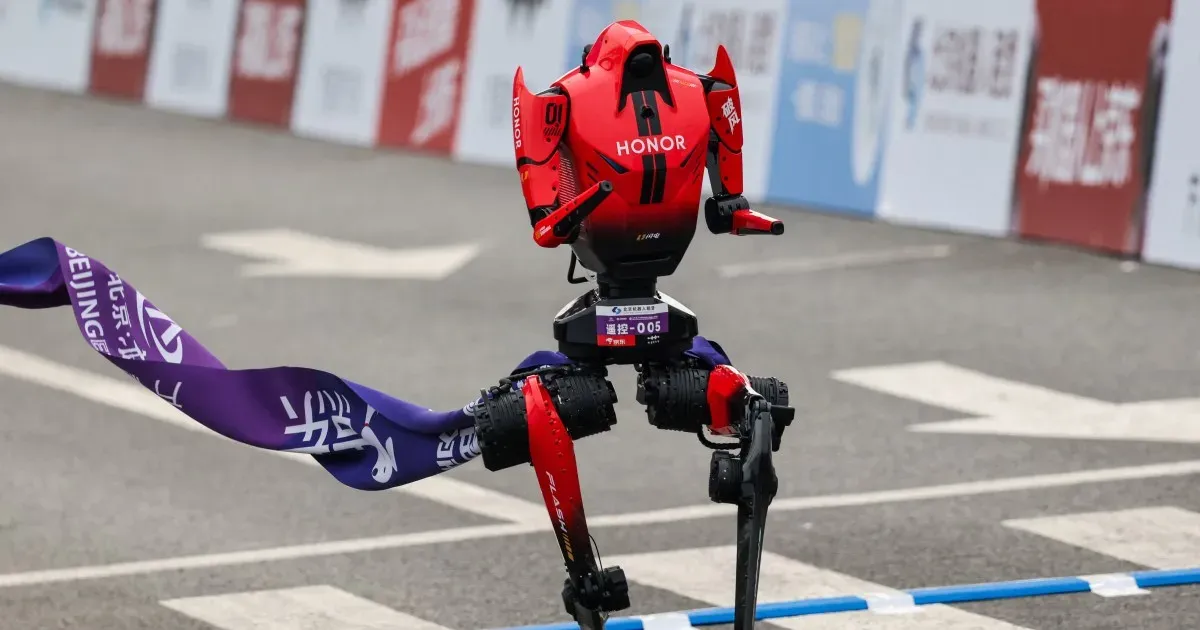
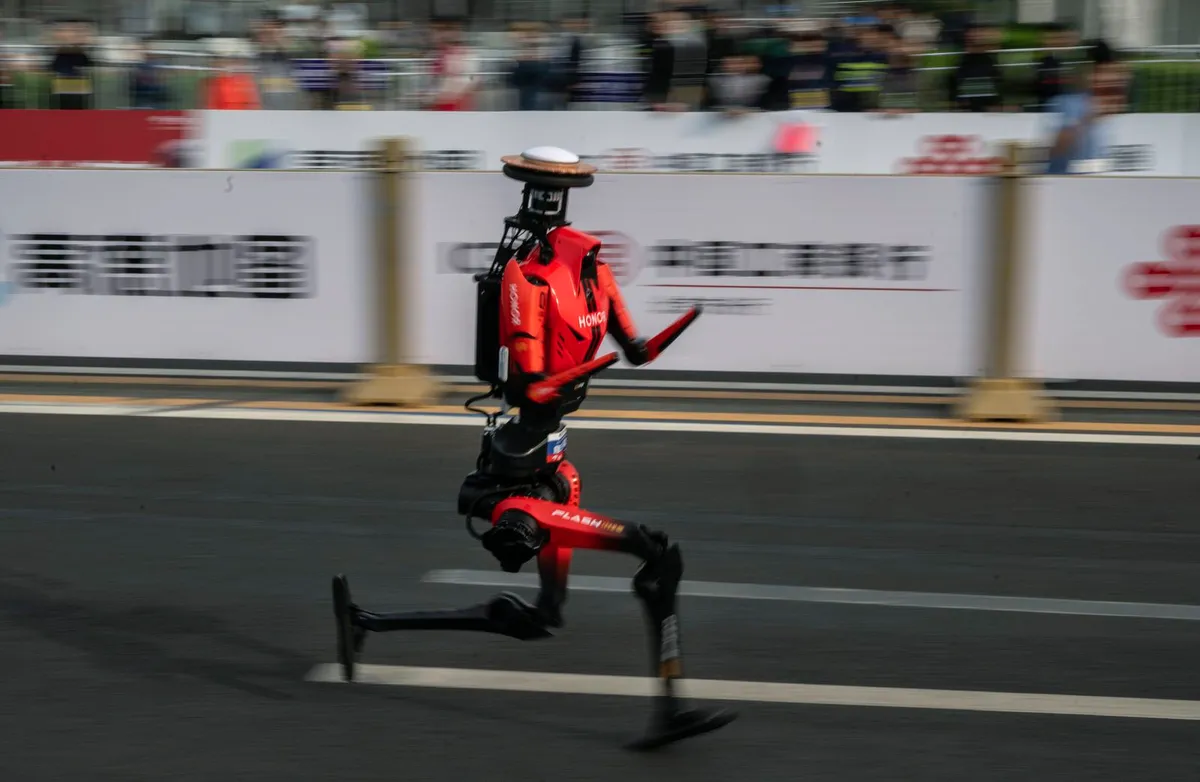
On April 19, 2026, a humanoid robot named Lightning set a new record. It ran a half-marathon faster than any human ever has. This happened during the Beijing E-Town Humanoid Robot Half-Marathon in China.
Lightning, developed by the Chinese company Honor, finished the 13.1-mile race in 50 minutes and 26 seconds. This time beat the human world record by several minutes.
Robots Show Big Improvements
This year's race was a huge step up from last year's event. In the first race, only six out of 21 robots finished. Many fell or lost control. Sun Zhigang, who watched both races, told the Associated Press he saw "enormous changes" this year. He never imagined robots would surpass humans.
We're a new kind of news feed.
Regular news is designed to drain you. We're a non-profit built to restore you. Every story we publish is scored for impact, progress, and hope.
Start Your News DetoxThe 2026 half-marathon had two lanes: one for humans and one for robots. Robots were split into two types: self-navigating and remote-controlled. Race officials gave more weight to self-navigating robots.
A remote-controlled robot actually finished first in 48 minutes and 19 seconds. However, Lightning, a self-navigating robot, was named champion. It completed the race in 50 minutes and 26 seconds.

Lightning even fell during the last part of the race, hitting a barricade. Humans helped it get back up. Both Lightning and the faster remote-controlled bot were made by Honor. Their times were much better than last year's fastest robot time of 2 hours, 40 minutes, and 42 seconds.
Beating Human Records
The Honor robots also outran the human competitors. The fastest man, Zhao Haijie, finished in 1 hour, 7 minutes, and 47 seconds. The fastest woman, Wang Qiaoxia, finished in 1 hour, 18 minutes, and 6 seconds.
Most notably, the two Honor robots beat the human half-marathon world record. That record was 57 minutes and 20 seconds, set by Jacob Kiplimo of Uganda. The China Global Television Network noted this result brings robots closer to matching elite human endurance.
Honor designed Lightning to look like top human athletes. Du Xiaodi, an engineer at Honor, said the robot has long, three-foot legs and a special liquid-cooling system. He believes these technologies could be used in other areas, similar to how car racing helped develop the automotive industry.
The Bigger Picture
The competition also recognized other achievements. Awards were given for completion, best endurance, best gait control, and best design. This encourages new ideas in humanoid robot technology.
Roboticist Alan Fern from Oregon State University thinks the race shows China's strong robot hardware manufacturing. He questions how these racing abilities will lead to practical uses and profits.
This year, teams from 11 Chinese provinces and countries like Germany, France, Portugal, and Brazil took part. Robots also helped as cheerleaders, photographers, pacers, and supply assistants.