Scientists have created "neurobots," which are living machines with their own nervous systems. These neurobots are an advanced version of xenobots, tiny living structures first developed in 2020 using frog cells.
Building Living Systems
Researchers at Tufts University and the Wyss Institute developed the original xenobots. These microscopic organisms could move, repair themselves, and even gather loose cells to form new xenobots.
Now, scientists have added nerve cells to these biological machines. The new versions, called neurobots, can take on different shapes and move in new ways. These findings were published in Advanced Science.
We're a new kind of news feed.
Regular news is designed to drain you. We're a non-profit built to restore you. Every story we publish is scored for impact, progress, and hope.
Start Your News DetoxThe research is led by Michael Levin, a biology professor, and Haleh Fotowat of the Wyss Institute. Their goal is to understand how groups of cells organize into complex structures. This knowledge could help in synthetic biology and regenerative medicine. Studying neurobots might reveal how nervous systems form, which could help scientists design new biological structures or repair damaged tissues.
The team started with cells from Xenopus laevis, the African clawed frog. When skin cells from these embryos are isolated, they naturally form small, round structures. These structures are covered in tiny hair-like parts called cilia. The cilia's movement allows xenobots to swim. These biobots are entirely biological and are made without scaffolds or genetic changes. They can heal themselves and live for about nine to ten days using stored nutrients.
Creating Neurobots with Neurons
To make neurobots, scientists put clusters of neural precursor cells into the center of developing biobots. These precursor cells then grew into neurons, extending branching structures called axons and dendrites.
Michael Levin explained that neurobots offer a new way to study how neurons organize and affect movement. Haleh Fotowat added that the work aims to uncover the basic rules of nervous system formation. She wants to see what happens when neurons are placed in a completely new setting.
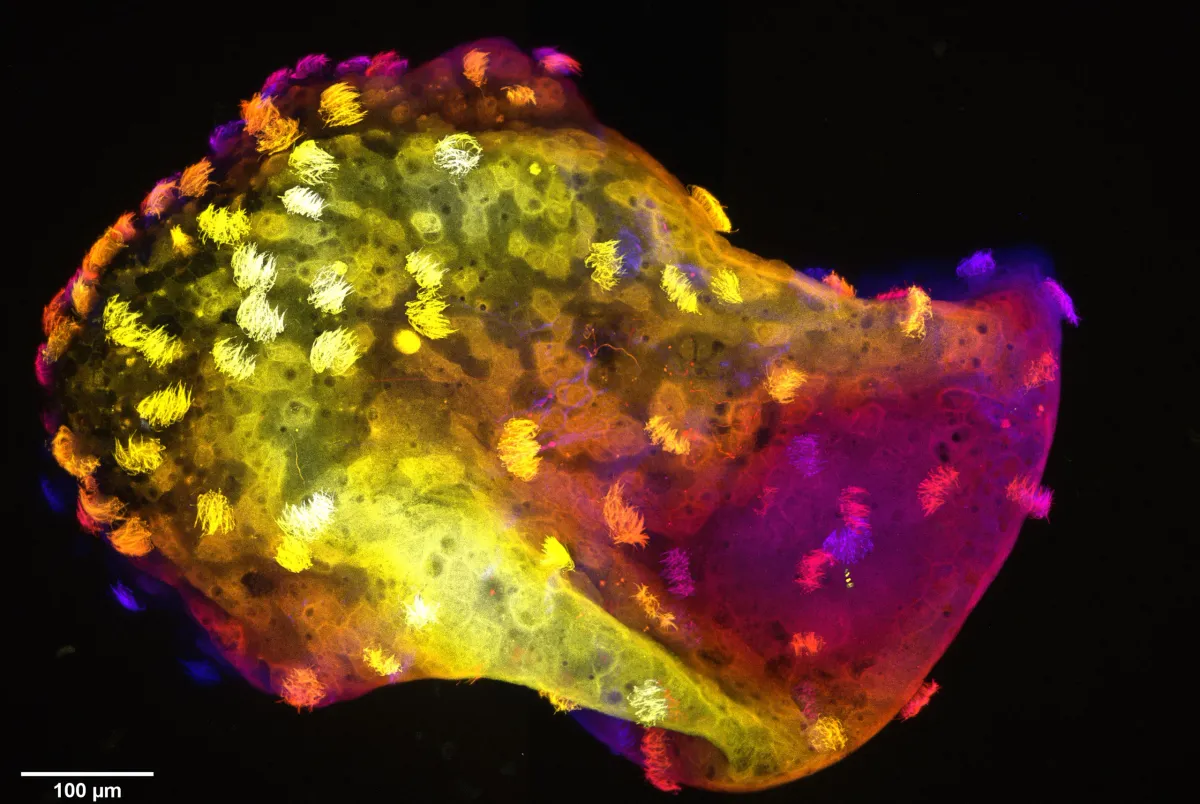
Microscopy showed that neurons in neurobots developed features like axons and dendrites, similar to natural nervous systems. Researchers also found protein markers for synapses, where neurons communicate. Using calcium imaging, they confirmed that these neurons were electrically active within simple neural networks.
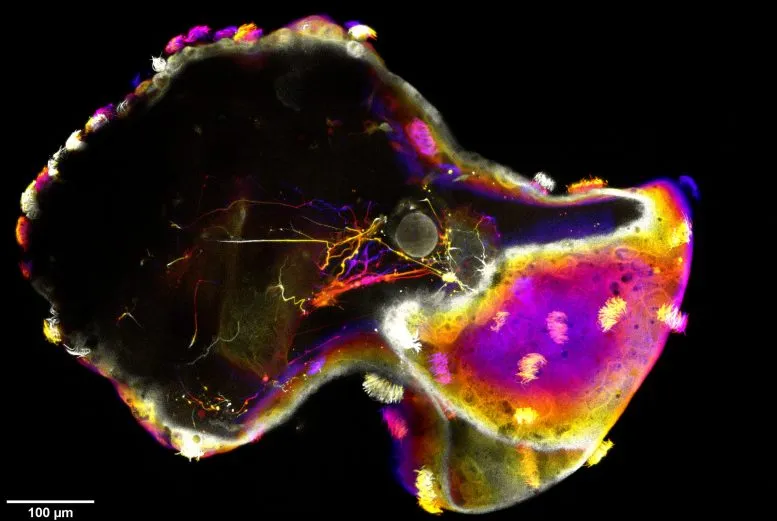 A neurobot stained to highlight multiciliated cells and the neuronal extensions of dendrites and axons. Credit: Haleh Fotowat
The neurobots were generally larger and more elongated than biobots without neurons. Their movement also became more complex. Neurobots were more active and showed repeating movement patterns.
To see how neural activity affected behavior, scientists used a drug called pentylenetetrazole, which affects brain activity. The drug changed the movement of neurobots differently than non-neural biobots. This suggests that the new neural networks were actively shaping behavior.
Future Possibilities
Haleh Fotowat noted that to build new things with biology, scientists must first learn how cells solve problems.
Researchers also found unexpected gene activity. Besides genes linked to brain receptors, they saw activation of genes involved in visual processing. These genes are associated with light-sensitive cells found in eyes. This suggests neurobots might eventually respond to light.
Levin hypothesized that neurobots might be activating parts of their genetic code that could be useful for new functions later on. He wonders if they would develop photoreceptors if they lived longer. This is a question they are actively studying.
Deep Dive & References
Engineered Living Systems With Self-Organizing Neural Networks: From Anatomy to Behavior and Gene Expression - Advanced Science, 2026