Researchers have found a new way to make fiber-optic sensors much more precise. These sensors are used to check the temperature and stress in big structures like bridges and pipelines. The new method allows them to pinpoint changes with millimeter-scale accuracy.
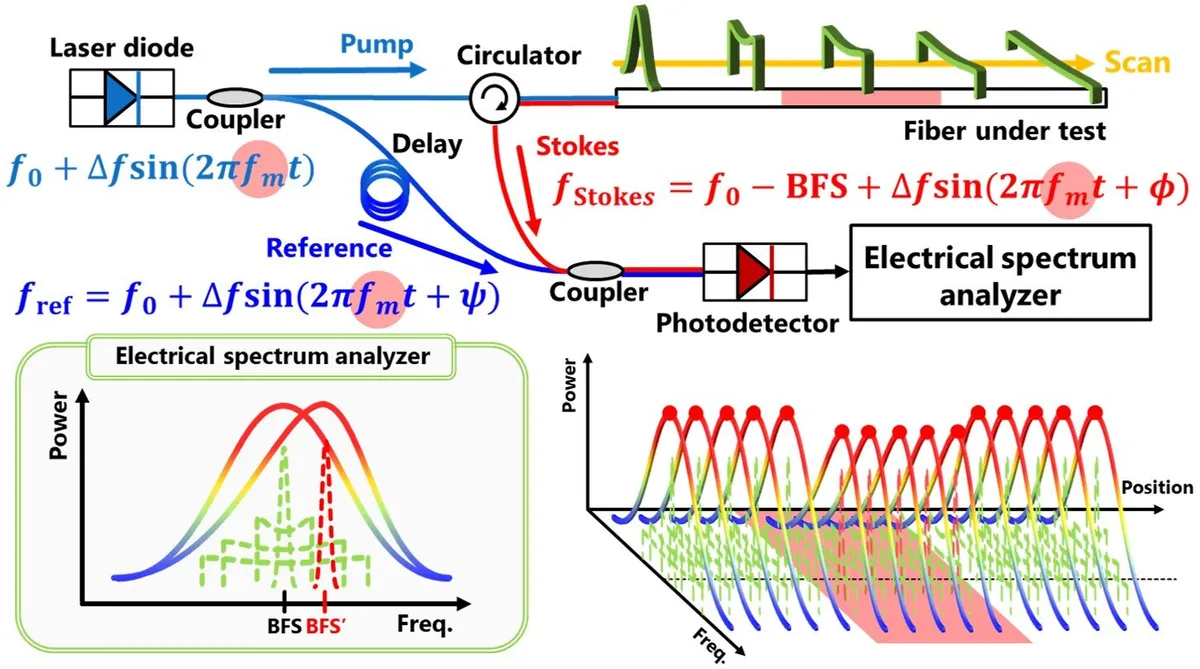
This breakthrough comes from a team at Shibaura Institute of Technology and Yokohama National University in Japan. They achieved a world-record spatial resolution of six millimeters using a technique called Brillouin optical correlation-domain reflectometry (BOCDR).
Boosting Sensor Accuracy
Fiber-optic sensors are important for monitoring large structures. They can detect problems early by continuously measuring temperature and strain along their entire length. However, a big challenge has been improving their spatial resolution. This means making them better at showing the exact spot where a change happens.
We're a new kind of news feed.
Regular news is designed to drain you. We're a non-profit built to restore you. Every story we publish is scored for impact, progress, and hope.
Start Your News DetoxBOCDR is a promising method because it only needs light injected from one end of the fiber. This makes it easier to install and allows it to work even if the fiber is damaged. But BOCDR had a limitation: scientists avoided operating it at frequencies close to the "Brillouin bandwidth." They thought this would cause unstable signals.
Overcoming Old Limitations
Professor Heeyoung Lee from Shibaura Institute of Technology and Professor Yosuke Mizuno from Yokohama National University, along with Keita Kikuchi, decided to test this assumption. They experimented with BOCDR at modulation frequencies close to the Brillouin bandwidth. Their findings are in the Journal of Lightwave Technology.
Professor Lee explained that they wanted to see if the Brillouin bandwidth limit was truly fundamental. They found that this "forbidden" operating region could actually boost spatial resolution.
The team noticed that at higher frequencies, the signals showed periodic distortions. These distortions made it hard to get accurate temperature and strain data. Instead of avoiding them, the researchers studied where these distortions came from. They then developed a way to remove them using signal processing.
By doing this, they made the Brillouin signal stable and accurate again. This allowed BOCDR to work reliably in a frequency range previously thought to be unusable.
Real-World Impact
Using their new strategy, the researchers achieved a spatial resolution of six millimeters. This is the highest ever for single-ended Brillouin sensing. In tests, the system successfully found temperature changes in tiny fiber sections. It also detected sudden strain changes in short fiber segments.
This research has big implications for real-world applications. As infrastructure ages and faces more natural disasters, better sensors are needed. These sensors must detect small, localized changes before they cause major damage.
Achieving millimeter-scale resolution with a simple, single-end-access fiber makes these sensors more practical. They could be used in civil engineering, energy, transportation, and robotics.
Professor Lee noted that their study helps overcome the limits of older sensors that might miss subtle changes. The new approach could monitor optical waveguides, sense the shape of flexible structures, and improve future robotic systems.
This work opens new possibilities for distributed sensing systems. These systems could act like a "nerve network," constantly checking the health of important structures.
Deep Dive & References
BOCDR Achieving 6-mm Spatial Resolution at Modulation Frequencies Close to Brillouin Bandwidth - Journal of Lightwave Technology, 2026