

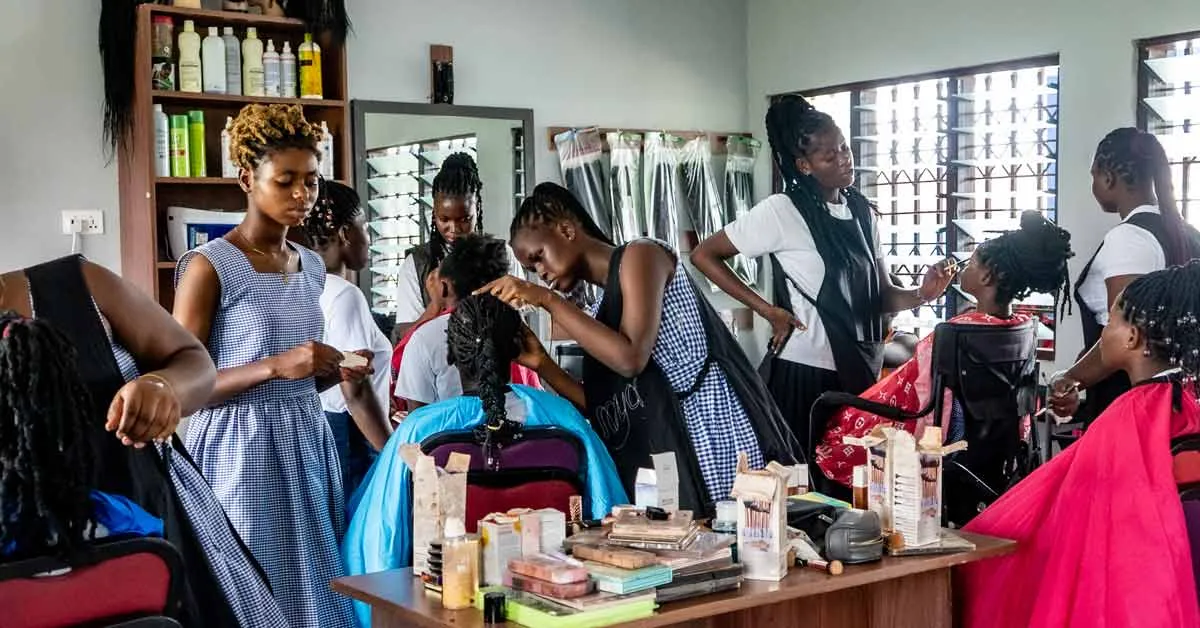
At any given moment, 27.6 million people are trapped in human trafficking worldwide. In Ghana, the numbers are devastating — forced labor and sexual exploitation are woven into the lives of thousands. But at the Max Steinbeck Women's Empowerment Center, run by nonprofits Many Hopes and Challenging Heights, a different story is unfolding.
Since 2021, the center has taken in 54 young women and their 12 children — all survivors of trafficking — and given them something most thought they'd lost: a future. They enroll in a two-year program choosing between beauty school, fashion training, or university prep. The beauty school track teaches hair, nails, skincare. But the curriculum doesn't stop there.

Students learn business basics. The center helps them open their first bank account. Donors provide microloans so graduates can open their own salons. "Most of these girls come from situations of extreme poverty," says Madeline Pahr, creative director at Many Hopes. "Learning a trade gives them a skill where they can earn a stable income after graduation. Most girls graduate and become the highest earners in their families, and are the first to break cycles of generational poverty."
We're a new kind of news feed.
Regular news is designed to drain you. We're a non-profit built to restore you. Every story we publish is scored for impact, progress, and hope.
Start Your News DetoxThat shift ripples outward. Many students arrive as young mothers. When they learn a trade, their children benefit too. "There is a high probability that those children will become the most educated in their families because their mom learned a trade," Pahr explains. One student, 13 when she arrived with her baby, described the weight of that isolation: "I thought my life was over. I was alone. I don't even know how to be a mum. My mum was never around. I had no future." Then she arrived at the center. "But coming here I am not alone. We are raising our babies together. We are building futures together."

The model is straightforward: trauma-informed care, practical skills, economic access. What's remarkable is how quickly it works. Graduates don't just find jobs — they become breadwinners, educators, proof to their children that escape is possible. In a country where trafficking feeds on poverty and powerlessness, the center is quietly dismantling both.



