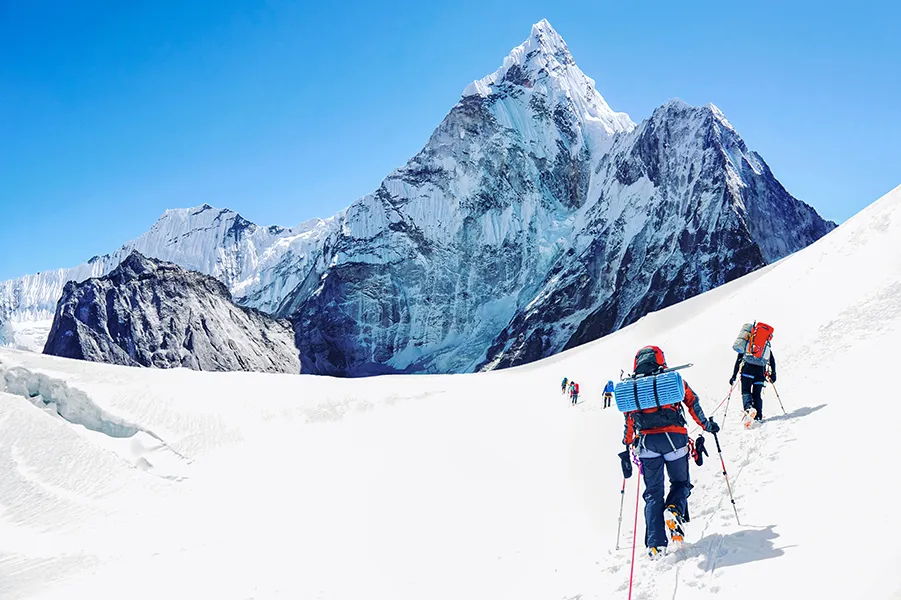
Mount Everest. It’s still the world’s highest, most glamorous rock. And it still wants to kill you. But, good news! It’s gotten slightly less effective at it.
According to a new study co-authored by Harvard Medical School professor and experienced mountaineer Paul Firth, the mortality rate for climbers has been cut in half since 2007. It dropped from a chilling 1.4% to a slightly less chilling 0.7%. So, now only about 1 in 143 climbers don't make it home. Let that satisfying number sink in.

Less Death, More Tech
Firth's research, published in The Journal of Physiology, credits some surprisingly mundane improvements for this shift. Turns out, better weather forecasting, advanced communication systems, and fixed ropes along the known routes have made a huge difference. Because apparently, even at 29,032 feet, a good Wi-Fi signal and a reliable weather app can save your life.
We're a new kind of news feed.
Regular news is designed to drain you. We're a non-profit built to restore you. Every story we publish is scored for impact, progress, and hope.
Start Your News DetoxEquipment has also gotten an upgrade, making cold, hunger, and thirst less likely to be your final complaints. And fewer people are just... falling or getting left behind. Firth believes improved teamwork plays a role, which means not every climber is a lone wolf battling the elements. Some are just, you know, being decent humans and helping each other.
But let's not get ahead of ourselves. Everest is still a giant, frozen deathtrap. Over half of the 426 recorded deaths have occurred in the infamous "death zone," above 26,200 feet, where the air has only one-third the oxygen of sea level. Most deaths now happen on good weather days, thanks to oxygen deprivation and extreme cold. The mountain, it seems, has simply shifted its preferred methods of dispatch.

His Own Personal Everest
Firth's interest isn't purely academic. In 2004, he was leading an expedition when seven people died on the mountain. His own oxygen equipment failed, and he started showing signs of cerebral edema — fluid leaking into the brain, causing confusion and poor coordination. The very thing his prior research identified as a major killer.
Recognizing the danger, Firth turned his group back. No one on his team died. The one climber who continued on, with a borrowed oxygen tank, became the first Norwegian woman to summit Everest. Which, if you think about it, is both impressive and slightly awkward for the guy who had to turn around.
Firth admits he was disappointed not to summit. But seeing the deaths that day, and continuing his research, cemented his choice. He now calls his work on high-altitude mortality his "personal Everest in research," which is a much safer, albeit less Instagrammable, achievement. He's also happy his studies have actually helped the climbing community. Because sometimes, the biggest climb isn't up a mountain, but through a stack of data.

The study also highlighted a grim disparity: while climbers mostly die high up on summit day, Sherpas (native guides and porters) are more likely to die lower down, preparing routes for clients. A stark reminder that even as technology makes the impossible slightly less so, some risks remain stubbornly unequal.