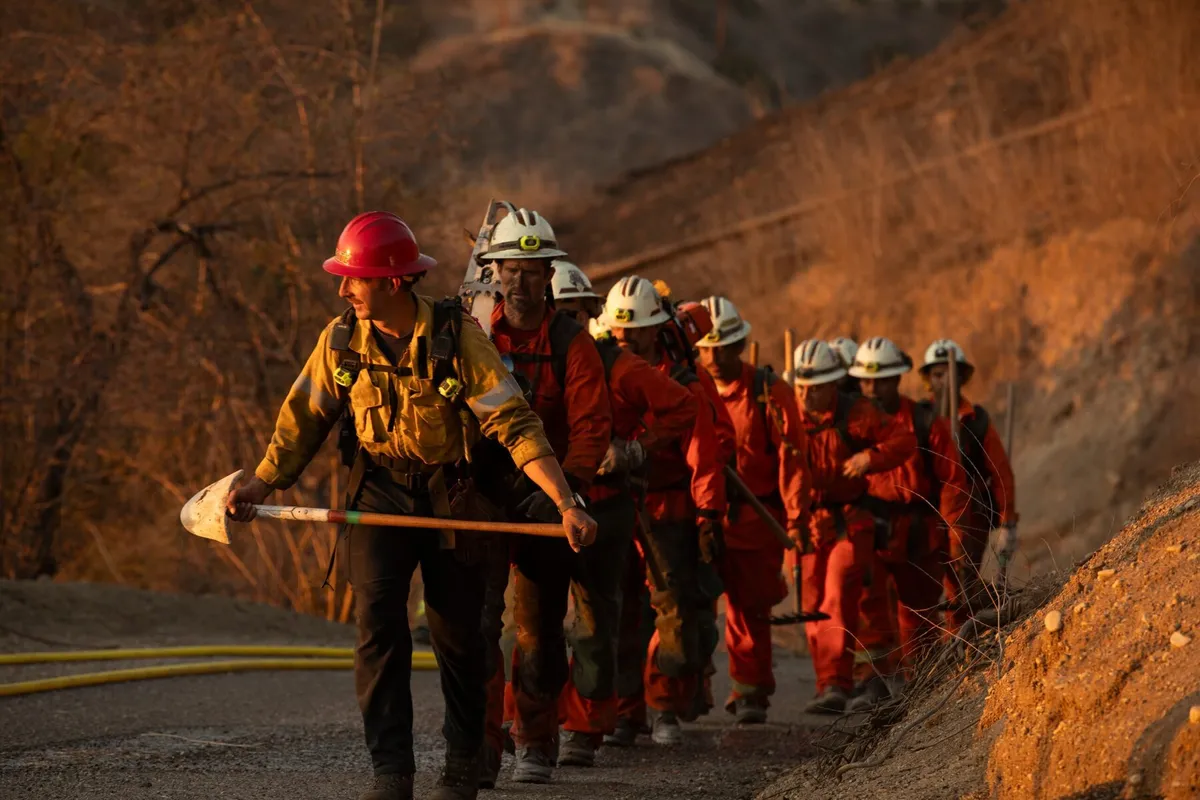
A year after the Los Angeles fires burned for weeks and killed 31 people, the smell of smoke still clings to parts of L.A. County. Residents remain displaced. Rebuilding continues. But for hundreds of incarcerated firefighters who battled those flames, the fires marked something different: a moment when their work was finally seen as what it actually was — essential, dangerous, heroic.
Jose Angel Amezcua, now a formerly-incarcerated firefighter from Salinas, spent weeks on the fire lines as part of California's inmate firefighting program. In a piece for CalMatters, he wrote about what it felt like to be recognized differently, even briefly. "When people think of incarcerated people, they often see us as a danger, with our past mistakes magnified," he reflected. "Amid the smoke, ash, and destruction of the L.A. fires, people saw us as heroes, recognizing the good we could achieve when given a second chance."
The practice of training incarcerated people to fight wildfires has always stirred unease. Critics reasonably ask: Is it ethical to ask someone with no leverage, no power, to pursue one of the most dangerous jobs available? The answer isn't simple. But what Amezcua's story reveals is that these re-entry programs can offer something rarely available inside: meaningful, skills-based work that translates directly into employment after release. For people cycling back into communities with limited job prospects, that matters.
We're a new kind of news feed.
Regular news is designed to drain you. We're a non-profit built to restore you. Every story we publish is scored for impact, progress, and hope.
Start Your News DetoxThe fires also exposed another kind of work happening in the aftermath — work that happens in soil and spores, not on the fire line.
Fungi as Healers
While incarcerated firefighters were containing flames, environmental toxicologist Dr. Danielle Stevenson was thinking about what comes after. Fire leaves behind more than ash. It leaves contaminated soil, heavy metals, toxins embedded in the earth. Stevenson's solution involves something most people overlook: mushrooms.
The practice is called mycoremediation — using fungi and their fruiting bodies to rehabilitate nature. It's still nascent, but the results are striking. Mushrooms can break down toxins in oil spills, nuclear waste, and fire-ravaged landscapes. Stevenson leads the SoCal Post-Fire Bioremediation Coalition, a collective of scientists, mycologists, environmental advocates, and community organizers working to heal fire-impacted landscapes across Southern California.
"I've seen amazing reductions in contaminants in relatively short times with very few inputs," Stevenson has said. The fungi do the heavy lifting. Plant native species alongside them, and the land begins to recover on its own.
Two different paths forward, then. One visible — firefighters in yellow gear cutting firebreaks and saving homes. One quiet — fungi breaking down toxins, roots rebuilding soil, landscapes healing from the inside out. Both are happening now in L.A. County. Both suggest that even after devastation, there are people and organisms already working on what comes next.