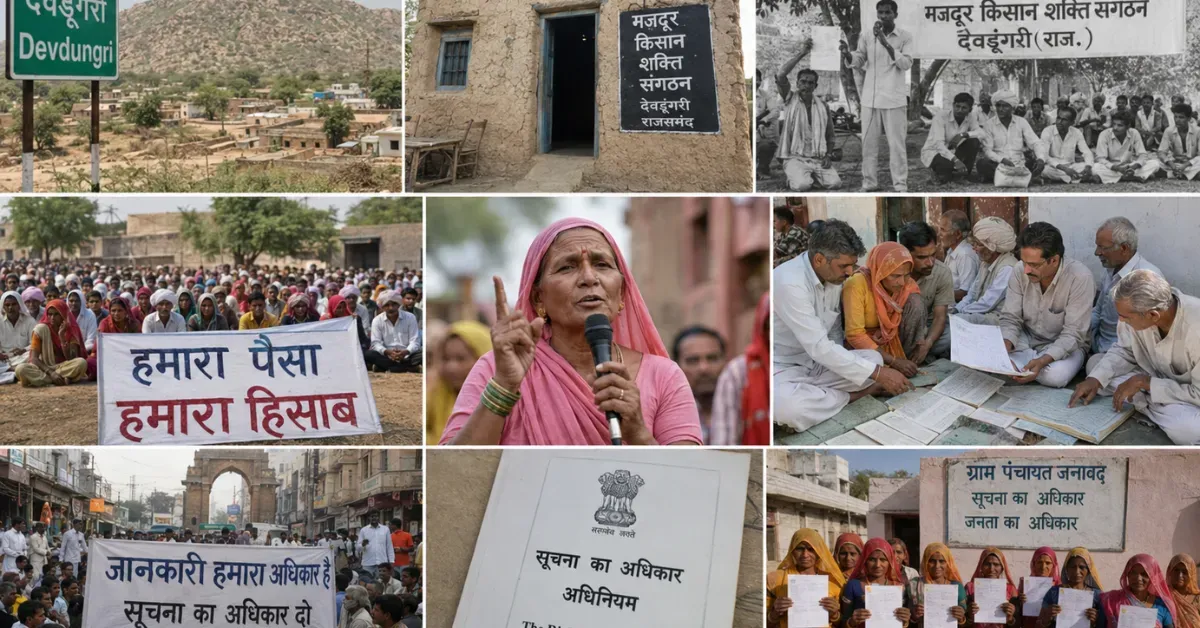
Imagine a small village in the middle of nowhere, tucked into the Aravalli hills of Rajasthan. Now imagine that village becoming the unlikely birthplace of a national movement, one that redefined democracy for over a billion people. That's Devdungri for you.
It all started in 1987 when three activists — Aruna Roy, Shankar Singh, and Nikhil Dey — decided to live among rural workers. Their mission? To truly understand what a community needed. They quickly realized that getting basic information about government projects and wages was a Herculean task for villagers. The core question, as Roy put it, was simple: if public money belongs to the people, why can't they see how it's spent?
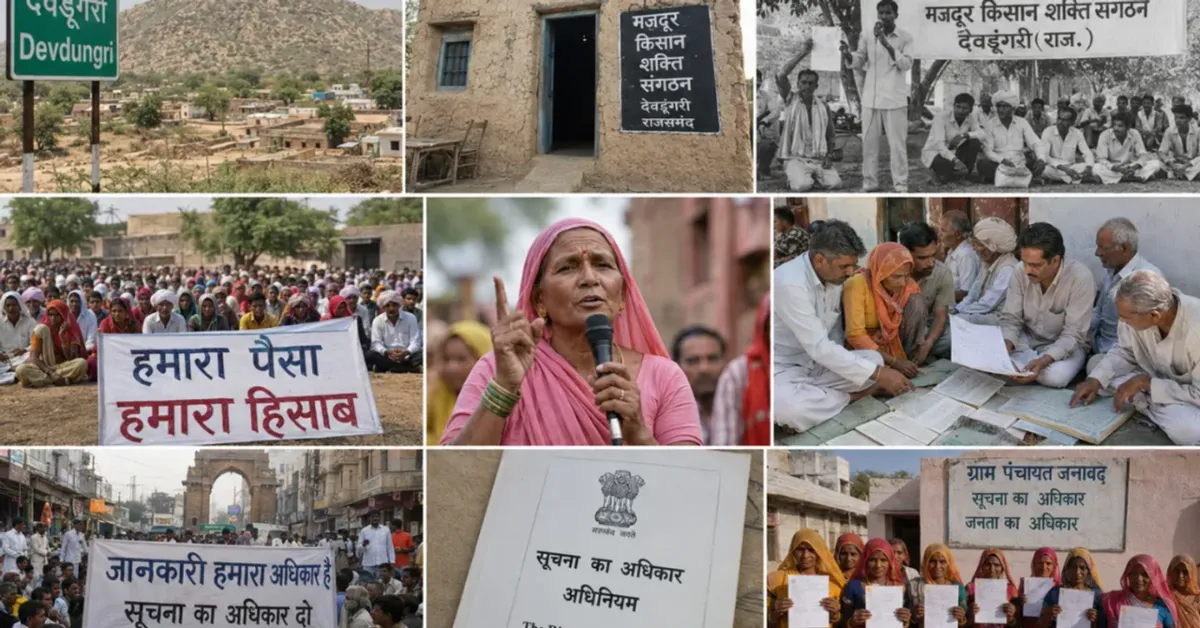
The “Our Money, Our Accounts” Revolution
Years of grassroots organizing led to the formation of the Mazdoor Kisan Shakti Sangathan (MKSS) in 1990. Their secret weapon? The jan sunwai, or public hearing. The idea was elegantly simple: invite government officials, have them read their account books aloud in public, and let the villagers verify the details. Did the work listed on paper actually get done? Did they receive the wages recorded for them? Suddenly, official records met lived reality. And let's just say, the discrepancies were… enlightening.
We're a new kind of news feed.
Regular news is designed to drain you. We're a non-profit built to restore you. Every story we publish is scored for impact, progress, and hope.
Start Your News DetoxThese hearings proved that ordinary citizens, even those who were semi-literate, could, and would, scrutinize official documents when given the chance. MKSS didn't just stop there; they used art, puppetry, and street theater to engage people, with Shankar Singh's satirical “Ghotala Rath Yatra” (Corruption Chariot Journey) traveling through villages, using humor to talk about accountability. Because apparently, sometimes the best way to fight corruption is with a puppet show.
When the state government dragged its feet on promised transparency, MKSS launched a 40-day protest in 1996. It was here that the movement found its rallying cry. A journalist, perhaps a bit dismissively, asked Sushila, an MKSS member who'd only studied up to Class 4, why an “uneducated” woman cared about the Right to Information.
Her response became legendary: "When I send my son to the market with ten rupees, I ask him to account for how he spent it. The government spends crores of rupees in our name. Why can we not ask for an accounting? Hamara paisa, hamara hisaab (our money, our accounts)." Mic drop.
From Village Squares to Parliament Halls
This powerful, undeniable logic resonated. The testimonies from Devdungri's public hearings were presented to parliamentary committees, arguing that transparency wasn't a privilege, but a fundamental right. As a former Chief Justice of the Delhi High Court later observed, the idea for RTI "was born from the soil, from the struggle of ordinary workers and farmers, in villages more than in cities."
Rajasthan passed the first state-level RTI law in 2000, and by October 2005, the Right to Information Act became national law. Let that satisfying number sink in: 1.75 million RTI applications were filed across India in 2023–24 alone. That's a lot of people asking, "Hey, what's up with that?"
The impact was immediate. In Janawad Panchayat, over 70 villagers used the new law to examine local records, uncovering misused funds and prompting government inquiries. This led to a state rule for annual social audits of local funds, a reform that continues to shape governance in Rajasthan to this day. Because sometimes, all it takes is a few dozen people with a ledger and a keen eye to keep things honest.
The movement understood that lasting change required educating future generations. They created student volunteer networks, set up RTI kiosks, and even got a chapter on the RTI movement included in high school textbooks. Imagine your history class covering the time a vegetable vendor's logic changed the country. That's a lesson we can all get behind.
Shankar Singh vividly recounts a volunteer using a small projector to show the government's online portal on a village wall. He asked a child for their family's ration card number, typed it in, and poof — the father's photo appeared, followed by their complete ration record: how much wheat, when. In that moment, the abstract idea of government information became tangibly real. "The demand for transparency stems from our fundamental right to a dignified life," Aruna Roy affirmed.
Devdungri's legacy isn't just a law; it's the radical idea that came before it. That reading a government file aloud in public is a legitimate act of citizenship. That ordinary people, starting in a village square, can demand the right to know and use that knowledge to shape their world. Which, if you think about it, is both impressive and slightly terrifying for anyone trying to pull a fast one.