
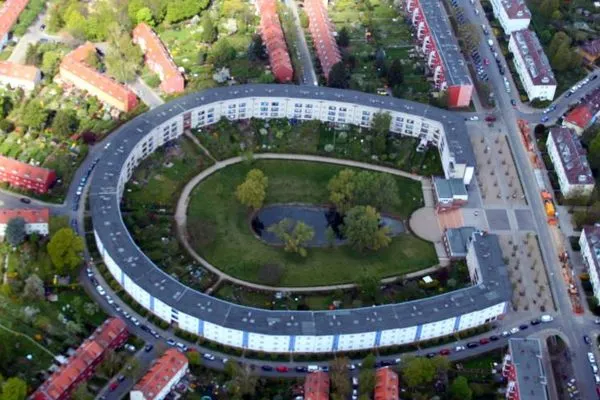
From above, Berlin's Hufeisensiedlung neighborhood looks like a giant horseshoe curving around a pond. Which, if you think about it, is a pretty charming way to organize a city block. But this isn't just a quirky aerial view; it's one of the 20th century's most ambitious social housing projects, still going strong.
Built between 1925 and 1933, right when the Weimar Republic was doing its last hurrah, architects Bruno Taut and Martin Wagner faced a problem that sounds eerily familiar: a massive housing crisis. Berlin was bursting at the seams with overcrowded tenements, terrible sanitation, and the kind of growing inequality that makes people start asking uncomfortable questions. Their solution? Don't just house people. Improve their lives.
The star of the show is, naturally, that sweeping horseshoe-shaped building. It's a continuous arc of apartments wrapped around a central pond, giving off major "communal yet cozy" vibes. Residents get shared views of the water and plenty of green space, feeling enclosed but definitely not trapped.
We're a new kind of news feed.
Regular news is designed to drain you. We're a non-profit built to restore you. Every story we publish is scored for impact, progress, and hope.
Start Your News DetoxThis wasn't just about making things pretty. The design was a social statement. Apartments were built with actual light, fresh air, and functionality in mind — a revolutionary concept compared to the dark, cramped boxes of 19th-century Berlin. Every unit got access to green space, be it a communal garden or their own private plot. Open courtyards replaced dense blocks, balancing privacy with a sense of shared community.
And then there was the color. Taut splashed the facades with soft but distinct reds, blues, and yellows, because why should city housing be dull? The subtle goal: inject dignity and identity into everyday living. Because apparently, even your apartment building should have a personality.
More Than Just a Pretty Curve
Today, the Hufeisensiedlung is part of the Berlin Modernism Housing Estates, recognized by UNESCO for their game-changing impact on architecture and city planning. But here's the kicker: it's not a museum piece. People still live there. It's a living, breathing landmark, continuing its original purpose of housing ordinary people without losing an ounce of its historical cool.
It stands as a testament to a time when architecture wasn't just about structures, but about big political and social goals. Part of the "Neues Bauen" movement, it saw housing as infrastructure for a better society, not just something you buy. That kind of ambition hit a wall with the rise of the Nazi regime, which put a swift end to many progressive projects. But the Horseshoe Estate, both physically and ideologically, survived.
Which, if you think about it, is a rather satisfying twist for a neighborhood built on optimism.