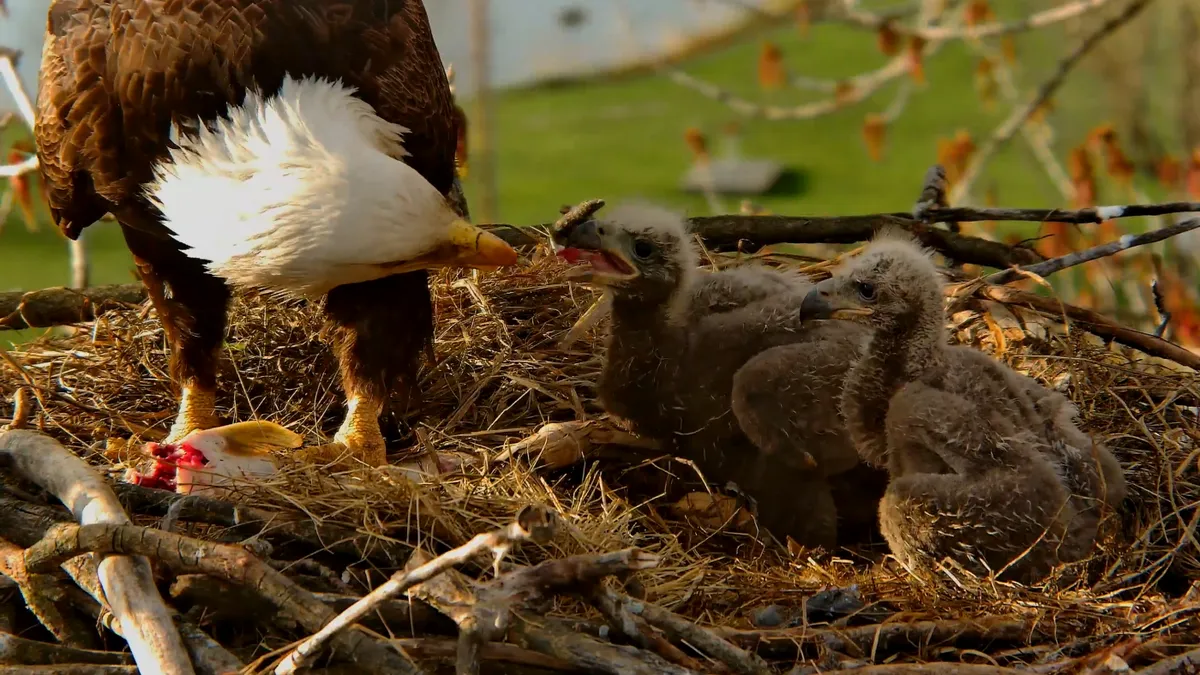
Gloria Gajownik, a woman who's spent the last 15 years glued to eagle nest cameras, has a theory: people could learn a thing or two from bald eagles. For starters, eagles don't yell. They're just… kind. Which, if you've ever been to a family reunion, sounds pretty refreshing.
Since 2011, Gajownik has been a nightly fixture watching a Decorah, Iowa, nest livestream. Now, she helps manage the chat room, a sort of avian fan club where she tracks every feather flutter and answers questions. This, she says, is her passion. Sorry, insurance career.
"Eagle people — we're different," she explains, with the kind of knowing smile usually reserved for secret societies. She feels a deep bond with both the birds and her fellow viewers, calling them her "extended family." Which, honestly, is probably less dramatic than actual family.
We're a new kind of news feed.
Regular news is designed to drain you. We're a non-profit built to restore you. Every story we publish is scored for impact, progress, and hope.
Start Your News DetoxSpring, of course, is prime time for eagle drama. Mating, egg-laying, and then the delightful chaos of eaglets taking flight around 12 weeks post-hatch. And thanks to these livestreams, anyone can tune in. From DMV waiting rooms to classrooms, these feathered families are racking up views.
The Original Reality TV Stars
Millions across the U.S. are watching over 50 bald eagle nest cameras. They're sharing photos, videos, and updates like proud parents on Facebook groups and chat rooms. Many eagles even get names, because of course they do. "We watch through thick and thin," Gajownik declares, and she means it. These fans donate to support the nests and act as round-the-clock security, often spotting trouble before anyone else.
It’s a far cry from the 1960s, when the insecticide DDT nearly wiped out bald eagles. By 1963, a mere 417 nesting pairs remained in the entire U.S. Tina Morris, who literally wrote the book on eagle return (Return to the Sky), remembers them being almost entirely gone from the Northeast and Southeast. She even started New York's first reintroduction program in 1976, using one of the very first eagle cameras. Because apparently, even then, we knew the best way to save them was to watch them like hawks.
Today, the population has soared to an estimated 71,400 nesting pairs in the Lower 48 states. Take that, DDT. Morris thinks the bald eagle was absolutely the right choice for the national symbol back in 1782. Hard to argue with the comeback story of the century.
So, how do you get a camera into an eagle's living room? Randy Robinson from the U.S. Fish and Wildlife Service says it offers the best view. To do it, a "knuckle-boom" truck with a 100-foot crane hoists a climber 95 feet into the air. That climber, harnessed in like a very determined Christmas ornament, then carefully places a small camera into the nest. Sometimes, if it's a cliffside abode, they even need a helicopter. Because apparently that's where we are now.
Citizen Scientists, Eagle Lifesavers
These online communities aren't just for gossip. Sometimes, they're for saving lives. Deb Stecyk from Alberta, Canada, who's been monitoring nests for two decades, once had to inform Robinson that high winds had destroyed the West Virginia nest, killing three four-week-old eaglets. The community mourned together, because when you've named them, it hits different.
More recently, eagle-eyed viewers helped save a Pennsylvania eaglet that had swallowed a fishing hook. And another time, when a Fraser Point eaglet took an unscheduled tumble from its nest, fans alerted the Institute for Wildlife Studies. The eaglet was safely returned, proving that sometimes, human intervention is exactly what's needed. Wildlife experts are careful, but Robinson says eagle parents usually accept their young back, despite what old wives' tales might suggest.
Next year, the Institute for Wildlife Studies plans to tap into this army of citizen scientists, asking them to track what prey eagles bring to their nests. Because with thousands of people watching every single minute, why not put them to work?
"It's like watching a soap opera," Morris admits, "except they're birds." There are "cheating scandals," fertility issues, early deaths, and fights over territory. Much of the drama, naturally, revolves around whether the eaglets will make it. Morris points out the similarities: "They're monogamous. They're very loyal to their nest sites. They're incredibly good parents." Sounds like a pretty high bar for human reality TV.
John Howe, who runs the Decorah cam, says it's natural to project our own family experiences onto the eagles. Jenny Voisard, who manages the Big Bear Valley nest, affectionately calls her local eagle pair, Jackie and Shadow, "an old married couple." They attract thousands of viewers daily, sometimes over 30,000 on a single morning. For many, it's a reminder of resilience, a dose of nature in urban landscapes, or even a comfort during tough times. Voisard herself has six monitors at home, just to make sure she doesn't miss a single plot twist.
Beyond the daily drama, it's about community. Jackie and Shadow have 2.6 million social media followers, and 35 contractors and volunteers watch their nest 24/7. Fans are even trying to raise millions to prevent development near the nest. And Gajownik, the superfan from Chattanooga, Tenn., travels annually to Iowa to meet her chat room friends and see the eagles in person. She plans to keep watching them, she says, "probably until I die." Which, if you think about it, is both impressive and slightly terrifying.