In 2017, Los Angeles artist Jayna Zweiman sat with a simple question: What if, instead of a wall, we built something that wrapped people in belonging?
She started the Welcome Blanket project as a direct response to proposed border walls — but her answer wasn't political rhetoric. It was yarn. Zweiman set out to hand-knit enough blankets to cover 2,000 miles, the length of the Mexico-U.S. border. Each one came with a handwritten note from its maker.
The response was immediate. Donors flooded in. Within months, she'd hit 6,000 blankets and realized the project could become something larger. She reset the goal to something almost audacious: 36,521 blankets — enough to circle the entire Earth at 24,901 miles. "That connect us all," she wrote.
We're a new kind of news feed.
Regular news is designed to drain you. We're a non-profit built to restore you. Every story we publish is scored for impact, progress, and hope.
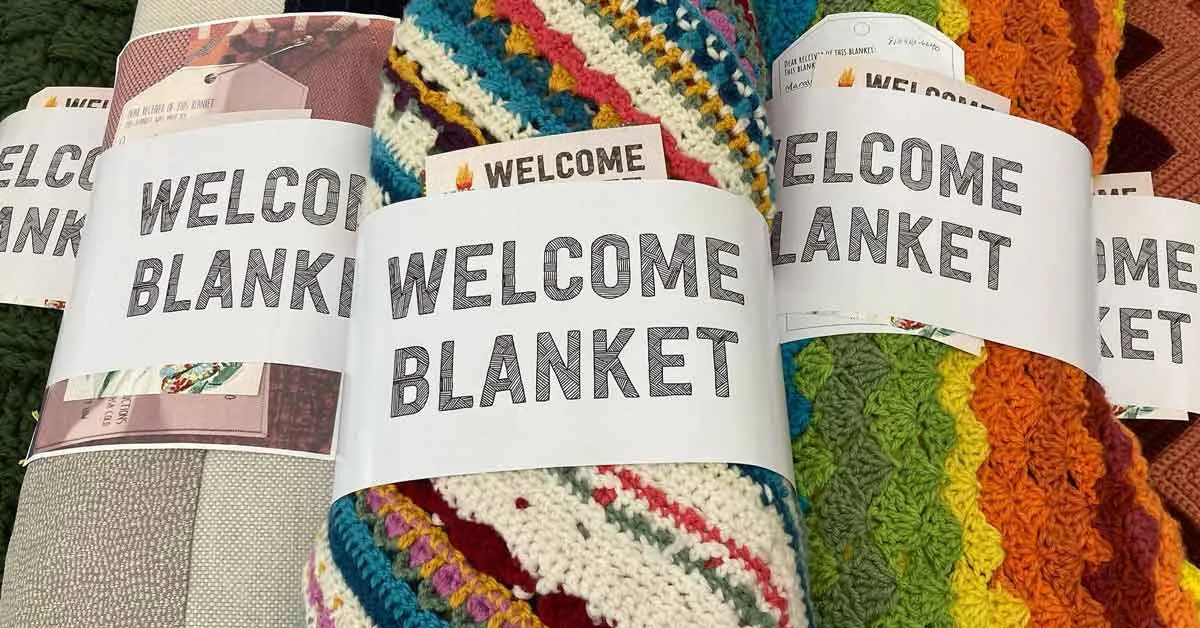
Start Your News DetoxSo far, 8,000 blankets have arrived. They come from knitters, crocheters, quilters — people working in their living rooms, community centers, and galleries across the country. Each is 40 inches by 40 inches, each carries a note. Some are displayed in exhibitions before being distributed through refugee resettlement agencies. Others go straight to a P.O. Box, waiting to be matched with someone arriving in a new country.
Zweiman isn't new to using craft as resistance. She co-founded the Pussyhat Project, where thousands of people knitted pink hats as an act of collective solidarity. But Welcome Blanket feels different — less about protest, more about the tangible work of welcome. It's what she calls "craftivism," using needles and thread to say: you belong here.
The project has grown into something bigger than one artist's vision. It's become a network of people choosing, stitch by stitch, to answer a different question than the one politicians were asking. Not "how do we keep people out," but "how do we wrap them in the knowledge that they're wanted."
With 8,000 blankets down and 28,000 to go, the needles keep moving.