Somewhere in the piles of forgotten roadside junk were the glowing bones of mid-century America. Vintage neon signs—hotel beacons, garage marquees, the iconic Route 66 shield itself—had been left to fade and crack. Then someone decided they deserved better.
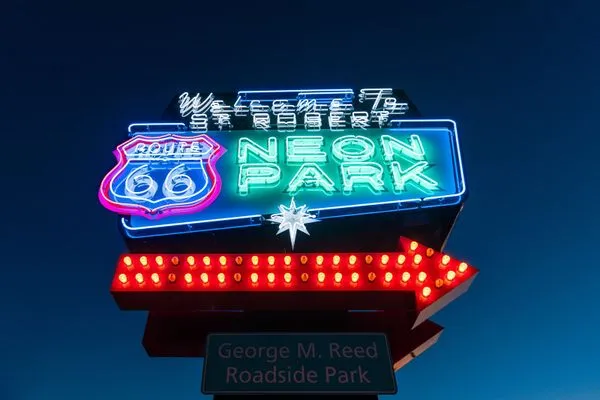
They were restored and donated to the City of Saint Robert, Missouri, where they now live in George M. Reed Roadside Park along Route 66. Story boards beside each sign explain where it hung, what business it called customers into, and why it mattered to the people passing through. It's a small act of preservation that feels quietly radical: we're choosing to remember the ordinary beauty of a road trip.
One sign carries an outsized piece of American history. The Stanley Cour Tel motel, built in 1950 by Stanley and Olivia Williams, housed astronauts training for Project Mercury—the first U.S. manned space mission. A modest St. Louis stopover became, without fanfare, part of the infrastructure that sent humans to space. The neon sign that once drew travelers off the highway is now a marker of that invisible importance.
We're a new kind of news feed.
Regular news is designed to drain you. We're a non-profit built to restore you. Every story we publish is scored for impact, progress, and hope.
Start Your News DetoxA second life for the Mother Road
The Neon Park is the first collection of its kind along Route 66, the 2,500-mile artery that connected Chicago to Santa Monica between 1926 and the interstate era. All the signs here originally hung somewhere along that stretch, mostly between the 1950s and 1980s. They arrived through a partnership with the Route 66 Association of Missouri and private donors—people who understood that letting these signs disappear would mean losing pieces of a shared story.
George M. Reed Park itself has been holding that story since 1952. The original concrete picnic tables from opening day still sit there. An M-60 tank remains in the park, a reminder that Route 66 once carried war material across the country. Now the neon signs join it, glowing proof that a road can be many things at once: a supply line, a getaway, a path to the stars, a place where ordinary people stopped for the night.
As more stretches of Route 66 fade from active use, parks like this one become archives of motion—places where the highway itself gets to rest and be remembered.