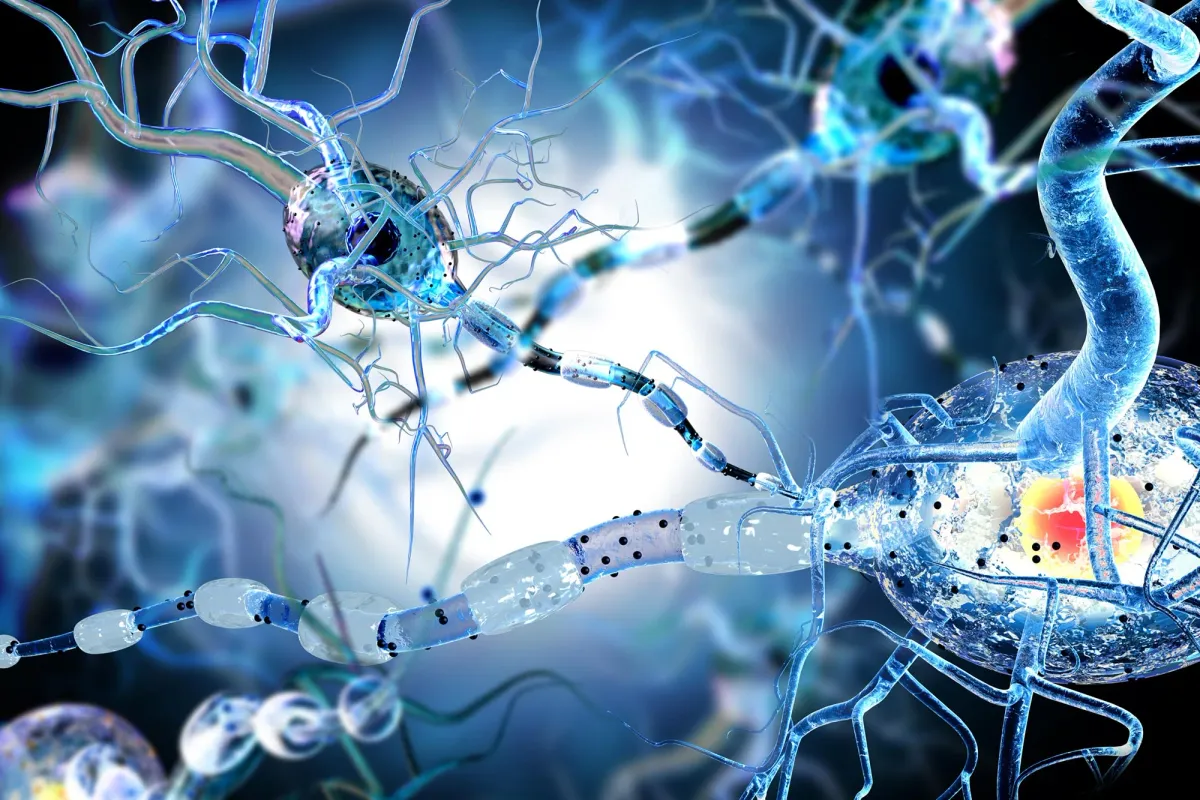
For decades, when doctors looked at Multiple Sclerosis (MS), their eyes were glued to myelin — the protective insulation around your nerve fibers. Makes sense, right? MS is known for munching on myelin. But while everyone was focused on the wiring, something else was quietly going wrong in the control room: the neurons in the brain's gray matter, where all the actual thinking and remembering happens, were dying off.
Now, a trifecta of researchers from UC San Francisco, the University of Cambridge, and Cedars-Sinai Medical Center has figured out why. Turns out, this neuron die-off is linked to DNA damage inside the neurons themselves, triggered by brain inflammation. It’s like discovering the house isn't just losing its insulation, but the very beams are rotting from the inside. This explains why MS scans show damage in both the 'white matter' signal cables and the 'gray matter' brain cells. And, more importantly, it opens up a whole new playbook for treatments.
Steve Fancy, a UCSF professor and co-author on two papers in Nature (yes, two), put it plainly: we need to protect these gray matter neurons directly. He noted that scientists now understand a key reason these vulnerable neurons are lost: DNA damage. Which, if you think about it, is both impressive and slightly terrifying.
We're a new kind of news feed.
Regular news is designed to drain you. We're a non-profit built to restore you. Every story we publish is scored for impact, progress, and hope.
Start Your News DetoxThe Brain's Canary in the Coal Mine
To understand this brain damage, doctors typically look for white matter lesions on MRI scans. These are the visible scars on the nerve fibers connecting different parts of your brain. But gray matter, where the main cell bodies reside, also gets hit. These lesions are tougher to spot but are strongly tied to the more advanced, disabling forms of MS.
The researchers zoomed in on a specific group of neurons, identified by a gene called CUX2. In the first study, they watched these neurons develop in mouse brains. This growth phase is a cellular marathon, full of dividing, spreading, and connecting. During this frantic period, cells rely on a DNA repair system controlled by a stress-response gene called ATF4. It's basically the quality control team for chromosomes.
When the team removed ATF4, those CUX2 neurons suffered severe DNA damage, halting the normal development of the frontal brain. Fancy explained that only a select few neurons were vulnerable to this kind of DNA damage, making ATF4 critical for their survival.
Then came the second study, which found similar DNA damage in gray matter lesions from actual MS patients. Surprise, surprise: those CUX2 neurons were hit again. Experiments in mouse models showed that inflammation caused chemical reactions that brutalized the DNA in these cells. The usual repair systems, which normally protect neurons during development, simply couldn't keep up. The result? Lasting brain injury.
These findings don’t just show how neurons in the brain's outer layers handle DNA stress; they explain precisely how that protection fails in MS. David Rowitch, another co-corresponding author, dramatically called CUX2 neurons a "canary in the coal mine" for brains with MS. His hope is that by protecting these specific neurons, we might just contain the damage before the disease spirals out of control. Because apparently, the future of MS treatment might just hinge on saving the canaries.