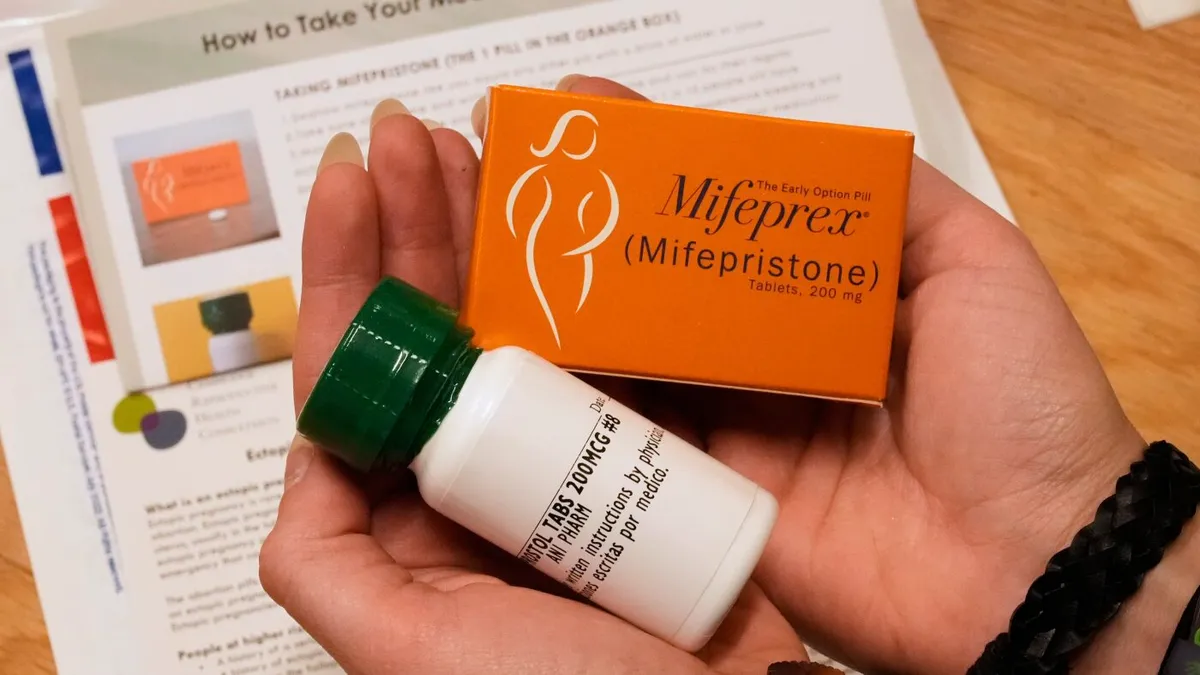
Imagine strolling into a pharmacy, grabbing a medication abortion kit off the shelf, and heading home. No doctor's visit, no clinic appointment. Just… that. According to a new study, this scenario might not be as far-fetched as it sounds.
Researchers at the University of California, San Francisco, just dropped a paper in JAMA Internal Medicine suggesting that people are perfectly capable of self-assessing their eligibility for medication abortion. Which, if you think about it, is both impressive and slightly terrifying for anyone who's ever tried to assemble IKEA furniture without the instructions.
Now, before you picture rows of "MiMi" kits (named for mifepristone and misoprostol, the two drugs involved) next to the Advil, there are a few caveats. For starters, OTC abortion medication isn't a thing yet. And with a dozen-plus states banning abortion outright and others trying to limit pill access, the political climate is, shall we say, unfriendly.
We're a new kind of news feed.
Regular news is designed to drain you. We're a non-profit built to restore you. Every story we publish is scored for impact, progress, and hope.
Start Your News DetoxDr. Daniel Grossman, who led the research, notes that most restrictions aren't based on actual evidence. Decades of research show the drugs are safe and effective. So, for him, seeing science point towards more access is genuinely exciting.
The MiMi Test Drive
For the study, 168 patients awaiting a clinician's visit for a medication abortion were shown a prototype OTC kit box. The researchers had spent considerable time crafting this box, ensuring all the necessary information was present.
Participants then used the box's info to decide if they were good candidates for the medication. Later, their self-assessments were stacked up against what their clinicians determined. The result? A solid 88% match. Meaning, most people correctly figured out if the medication was right for them.
Grossman admits it's a small study – not exactly the definitive proof that'll make the FDA snap to attention. But it's a strong hint that the science could make sense, and it definitely warrants more investigation.
Politics vs. Pills
Dr. Sonya Borrero, in a related commentary, echoed the sentiment: this research bolsters the case for OTC access. However, she also pointed out the obvious — FDA decisions on abortion medication often get tangled in political, not just scientific, considerations.
Julie Maslowsky, a developmental psychologist, wasn't surprised by the findings. She noted it’s not far off from how many already get medication abortion via telemedicine: remote clinician, at-home use. She believes these medications meet the FDA's safety and effectiveness benchmarks for OTC products. The only radical thing about it, she suggests, is the stigma around reproductive health itself.
Yet, the road ahead is less a smooth highway and more a legislative minefield. With politicians actively trying to restrict mifepristone (hello, Senator Hawley and Senator Cassidy), and the FDA doing yet another safety review, Grossman concedes it's "probably not the right political moment" for an OTC application.
He points to the 2023 approval of an OTC birth control pill as a blueprint: a long journey of early research showing interest and capability, which ultimately convinced pharmaceutical companies and the FDA that it wasn't a "crazy idea." For medication abortion, the next step would be expensive, complex "actual use studies." Because apparently, making a fundamental healthcare option easier to access needs to be harder than rocket science.