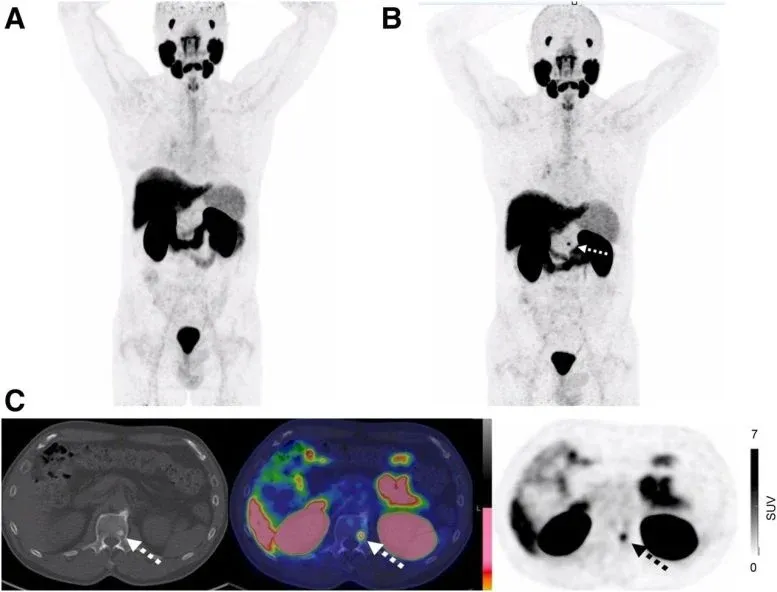
Imagine getting the all-clear, only to have a nagging feeling (and rising PSA levels) tell you otherwise. For over half of prostate cancer patients whose initial advanced scans came back clean, a second look unearthed previously invisible tumors. This isn't just a medical 'do-over'; it's a game-changer for treatment plans.
The findings, published in The Journal of Nuclear Medicine, offer a significant glimmer of hope for a tricky problem.
The Elusive Enemy
Prostate cancer has a knack for returning, even after what seems like successful surgery or radiation. The first alarm? A rising PSA (prostate-specific antigen) in the blood. It's like a smoke detector going off, but you can't see the fire. Doctors know cancer cells are still lurking, but where is the million-dollar question.
We're a new kind of news feed.
Regular news is designed to drain you. We're a non-profit built to restore you. Every story we publish is scored for impact, progress, and hope.
Start Your News DetoxKnowing if the cancer is localized, chilling in nearby lymph nodes, or has gone rogue to distant organs is crucial. Each scenario demands a different battle plan. Enter PSMA PET imaging, a high-tech detective that uses a special tracer to stick to prostate cancer cells, lighting them up like a Christmas tree on the scan.
But even with this molecular spotlight, some cancers remain stubbornly hidden. About 30% of patients with rising PSA levels get a 'negative' first scan. The tumors might be too tiny, not producing enough of that PSMA protein, or simply playing hide-and-seek too well.
So, Ur Metser, a professor of radiology at the University of Toronto, and his team wondered: What if we just... scanned them again? They tracked 210 patients from an Ontario registry who had a negative first PSMA PET scan but then underwent at least one more.
The Second Act
The encore scan delivered. A whopping 56% of these patients had cancer discovered on their second go-around. This fresh intel wasn't just interesting; it directly altered the treatment strategies for nearly 50% of them. The biggest impact was for those with 'oligometastatic disease' — a fancy way of saying they had a limited number of tumors, fewer than five.
Finding these small, specific clusters allows doctors to target them directly with radiation or surgery, which is often far more effective and less invasive than a full-body approach. The scan doesn't prescribe the treatment, of course, but it hands doctors the map they desperately need.
Unsurprisingly, repeat scans were more successful when PSA levels were higher, or when they doubled in less than a year. Because a quickly rising PSA isn't just a number; it's the cancer saying, "Surprise! I'm still here, and I'm busy."
Metser's takeaway? These findings underscore the vital role of PSMA PET scans in navigating prostate cancer recurrence. Sometimes, you just need to look twice. And that second glance can make all the difference.