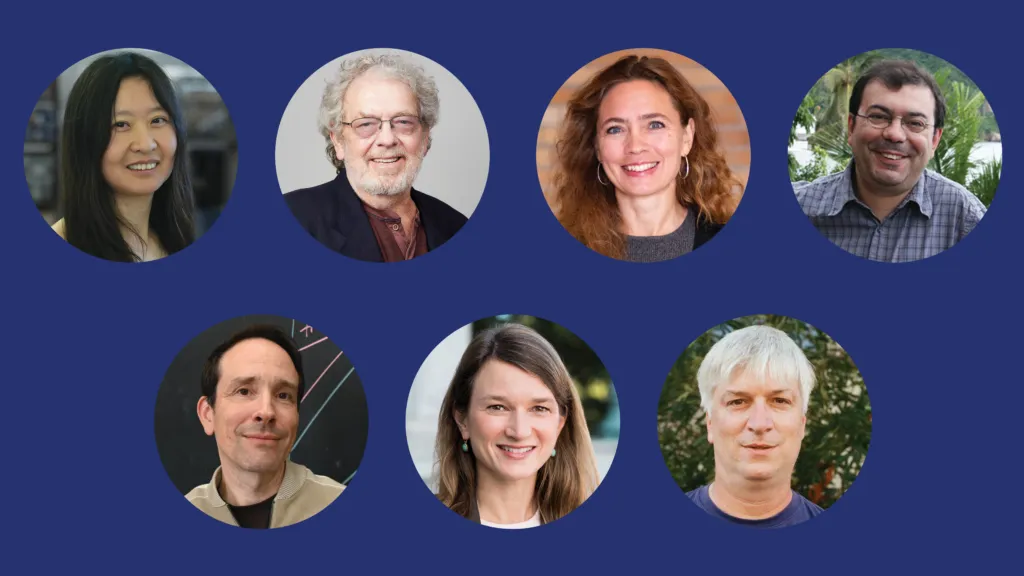
Seven brilliant minds from UC Berkeley just received a rather swanky invitation: membership in the American Academy of Arts and Sciences. Think of it as the intellectual equivalent of getting a golden ticket, but instead of chocolate, you get to help solve the world's thorniest problems. Because apparently, that's where we are now.
This isn't some new-fangled club. The Academy has been around since 1780, quietly recognizing folks who are, well, really good at what they do. This year's class of 252 new members includes everyone from actor Jodie Foster to author Barbara Kingsolver. So, if you're a UC Berkeley professor, you're officially in the same league as Clarice Starling and the author of The Poisonwood Bible. Not bad for a Tuesday.
President Laurie Patton noted that this recognition is a fitting way to mark the nation's 250th anniversary. The new members will be formally inducted in Cambridge, Massachusetts, in October 2026. Plenty of time to polish up those acceptance speeches.
We're a new kind of news feed.
Regular news is designed to drain you. We're a non-profit built to restore you. Every story we publish is scored for impact, progress, and hope.
Start Your News DetoxMeet the New Class
Sarah Anzia, a Chancellor’s Professor of Public Policy & Political Science, is basically the Sherlock Holmes of local government, figuring out why our cities do what they do. From public-employee pensions to women in politics, she's got it covered.
Then there's Raphael Bousso, a physics professor and Chancellor’s Chair, who spends his days trying to unify quantum mechanics and general relativity. You know, just a casual quest for a theory of everything. He's exploring black holes and how energy talks to quantum information. Light reading.
Michael Hutchings, a math professor, is famous for proving the double bubble conjecture. Which, if you think about it, is both impressive and slightly terrifying that someone needed to prove the optimal shape of two joined soap bubbles.
Paolo Mancosu, a philosophy professor, has been shaking up the philosophy of mathematics, insisting that we pay attention to how math is actually done. He also dug into the Cold War publication history of Doctor Zhivago. Because why not?
P. David Pearson, an Emeritus Chair in Instructional Science, started as an elementary school teacher and became a titan in teaching kids to read. He even advised the Children’s Television Workshop (yes, Sesame Street). So, if you learned to read with Big Bird, you might owe him a thank you.
Kristin Persson, a Distinguished Professor in Materials Science and Engineering, uses machine learning to design new materials for batteries and solar panels. She's basically building the future of energy, one algorithm at a time, and then sharing the data with everyone else. Generous, that one.
And finally, Doris Tsao, a professor of neuroscience, who found the "face patch" regions in macaque brains. Her team can actually reconstruct a face a monkey is looking at just by reading its brain activity. Which, again, impressive and slightly terrifying. Now she's mapping how brains represent the entire 3D world around us. So, if you feel like someone's watching, it might just be science.
Seven individuals, each doing something that makes you think, "Wait, they can do that?" It's a reminder that some people are just built different. And now they're officially part of a club that's been around longer than the United States itself.