
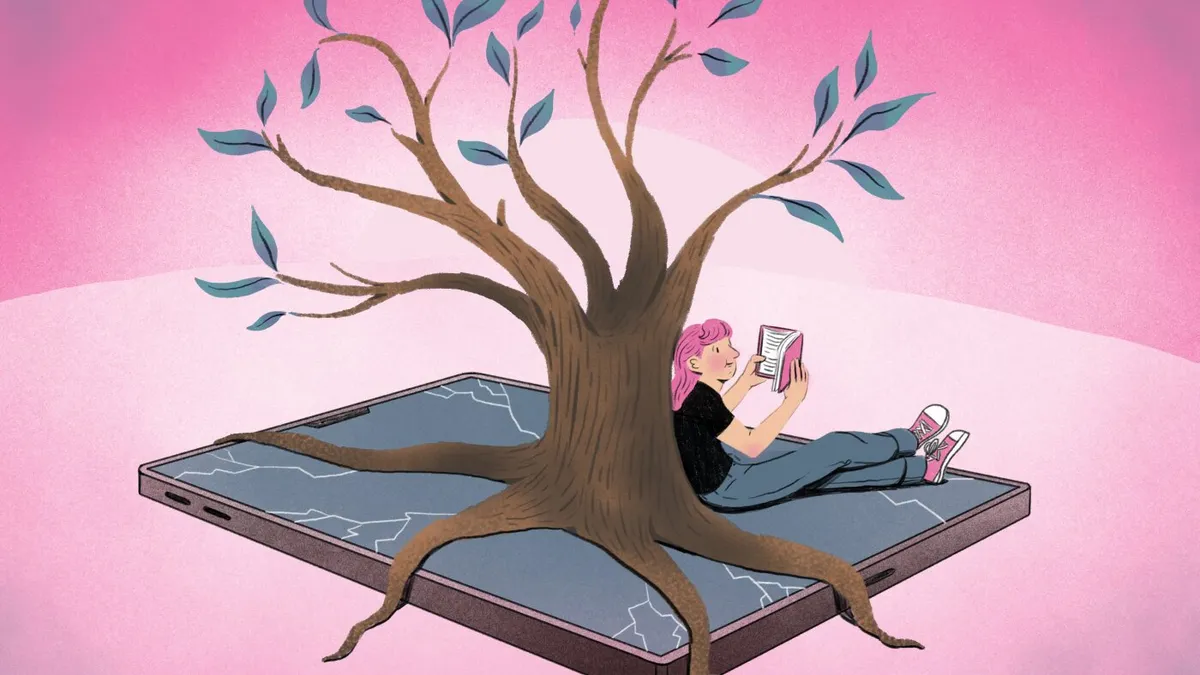
Remember when the biggest school-related tech debate was whether your kid had a Tamagotchi in their backpack? Good times. Now, we're talking about school-issued iPads that kids are penalized for not having, even in PE. Yes, really.
That's what happened to Lila Byock's son in Los Angeles. She, like many parents, started wondering why, post-pandemic, schools were still leaning so heavily into digital learning. Her conclusion? No good reason at all.
So, Byock did what any parent fed up with the status quo would do: She started an advocacy group. Schools Beyond Screens began in LA and quickly went national, because apparently, parents everywhere were asking, "This is an emergency — what can we do?"
We're a new kind of news feed.
Regular news is designed to drain you. We're a non-profit built to restore you. Every story we publish is scored for impact, progress, and hope.
Start Your News DetoxAnd it seems the message got through. Last week, the Los Angeles Unified School District (LAUSD) board voted to limit screen time for all students, starting this fall. The big headline? Elementary students are looking at a full-on screen detox. This is a massive shift for a district that, post-COVID, was all-in on classroom tech.
The Great Unplugging Spreads
LAUSD isn't alone in hitting the off switch. Since January, Alabama, Tennessee, Utah, and Virginia have all passed laws to rein in school tech. Ten more states are eyeing similar moves. T. Philip Nichols, a Baylor University professor who studies tech in public education, calls it a "pendulum swing." He finds the sudden pivot surprising, but, you know, good.
Nichols points out that laptops and tablets aren't just neutral tools. They fundamentally change how we think and communicate. Vermont even cited his work in a bill that would let parents opt their kids out of screen time entirely. His research found that widespread computer use hasn't actually boosted test scores. Plus, there's the whole data privacy thing. As Nichols dryly observed, "When you are reading a textbook, that textbook is not reading you back."
Of course, not everyone is ready to smash the tablets. Tracy Weeks, from education tech company Instructure (they make tools like Canvas, used by 30% of K-12 students), argues that a blanket ban is "throwing the baby out with the bathwater." She points out that there's a difference between passively watching videos and interactive, engaging activities.
Still, the momentum for less screen time is building. LAUSD has until June to hammer out the details of its new policy. Utah's "back-to-basics" law kicks in July 1, with its state board working on specifics. Even Missouri, a state not always known for its tech-skepticism, saw a bipartisan bill pass its House to limit screen time.
Initially, Missouri's bill was pretty strict: 45 minutes max of screen time daily, plus mandatory cursive writing (because apparently that's where we are now). But after some sensible tweaks, it now gives districts more freedom to craft their own policies. Which, if you think about it, is both impressive and slightly terrifying, given the original proposal.
Ultimately, it seems like the era of "more tech is always better tech" in schools might finally be dimming. And for parents like Lila Byock, that's probably a screen time win worth celebrating.