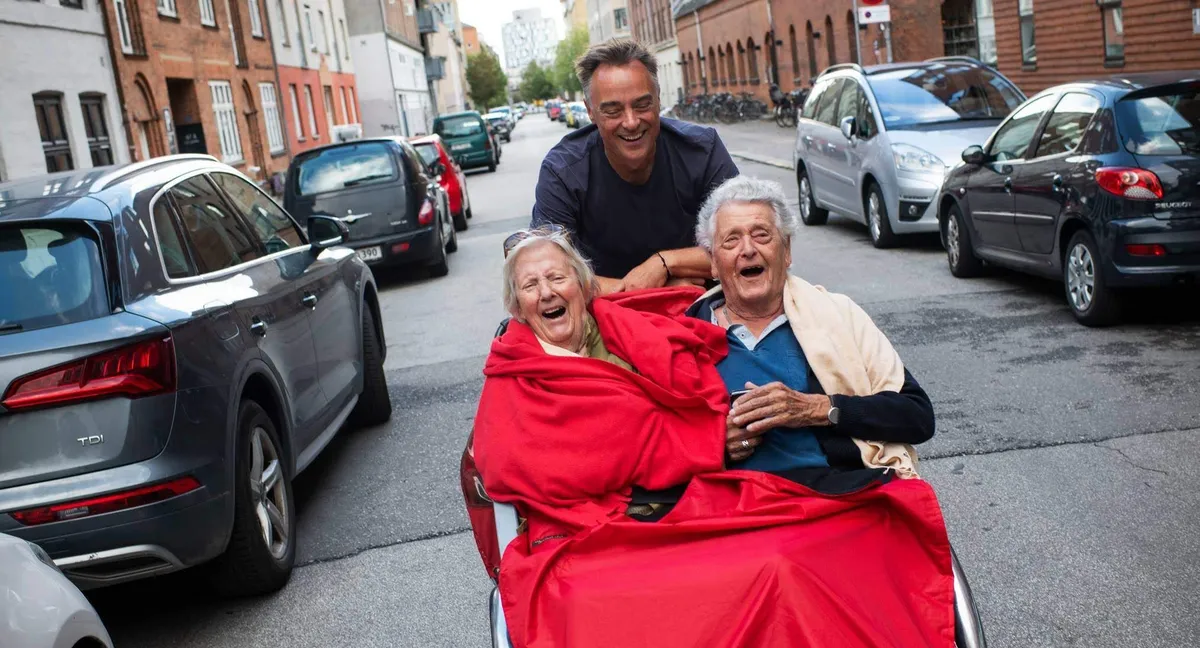
John Seigel-Boettner pulls up to the curb on his electric trishaw—a three-wheeled bike with two front seats—and something shifts in downtown Santa Barbara. Pedestrians wave. Children pause mid-stride. There's the silver mustache, the Mr. Rogers t-shirt, the motto stitched across his chest: "Believe there is good in the world."
It's a Tuesday morning, and his riding partner today is Elizabeth Wright, 97 years old, sharp-tongued and sharp-minded. "My name means I'm always right," she announces as they set off. They wind past palm trees and leafy neighborhoods toward the ocean. Wright points out the pub where she bartended decades ago, tugs her blanket against the breeze, and for a moment seems to fold back into her younger self. The ocean glints ahead.
Seigel-Boettner has been running the Santa Barbara chapter of Cycling Without Age since 2019. At 70, he's still ferociously fit, giving rides at least twice a week. He's careful about language—he doesn't call the people upfront "passengers." They're "riding partners." The distinction matters. It's the whole point.
We're a new kind of news feed.
Regular news is designed to drain you. We're a non-profit built to restore you. Every story we publish is scored for impact, progress, and hope.
Start Your News Detox"Cycling Without Age is about connection," he says. "It's about the conversations between pilot and partner, and the connection with everyone we meet along the way."
How a grief-stricken moment became a global movement
The organization itself began in Copenhagen in 2012, born from a management consultant's heartbreak. Ole Kassow watched his father, who had multiple sclerosis, grow increasingly isolated. As his father's world contracted, so did his sense of connection. Years later, working in a care home, Kassow saw the same pattern repeating: elderly residents moving in, their horizons shrinking until they stopped leaving their rooms.
One day, Kassow borrowed a rickshaw on impulse and offered an elderly man from the care home a ride. Something opened up. The man came alive. Kassow realized he'd stumbled onto something essential—not a service, but a restoration. The feeling of wind and movement and being seen by the world again.
Today, Cycling Without Age operates in 25 countries across five continents. Thousands of volunteers pedal hundreds of thousands of rides annually. The program has quietly become one of the world's most elegant solutions to a problem nobody talks about enough: the isolation that comes with aging in institutions designed to contain rather than connect.
Back in Santa Barbara, Wright settles into her seat as Seigel-Boettner pushes off. She's been riding with him for years. She knows the route, the street musician who plays her favorite songs, which neighbors will wave. It's a small geography, but it's hers again—not confined to four walls, but alive with wind and light and the knowledge that she matters enough for someone to show her the world.
The program continues to expand, with new chapters launching regularly in cities where isolation among older adults is finally being recognized as the public health issue it is.