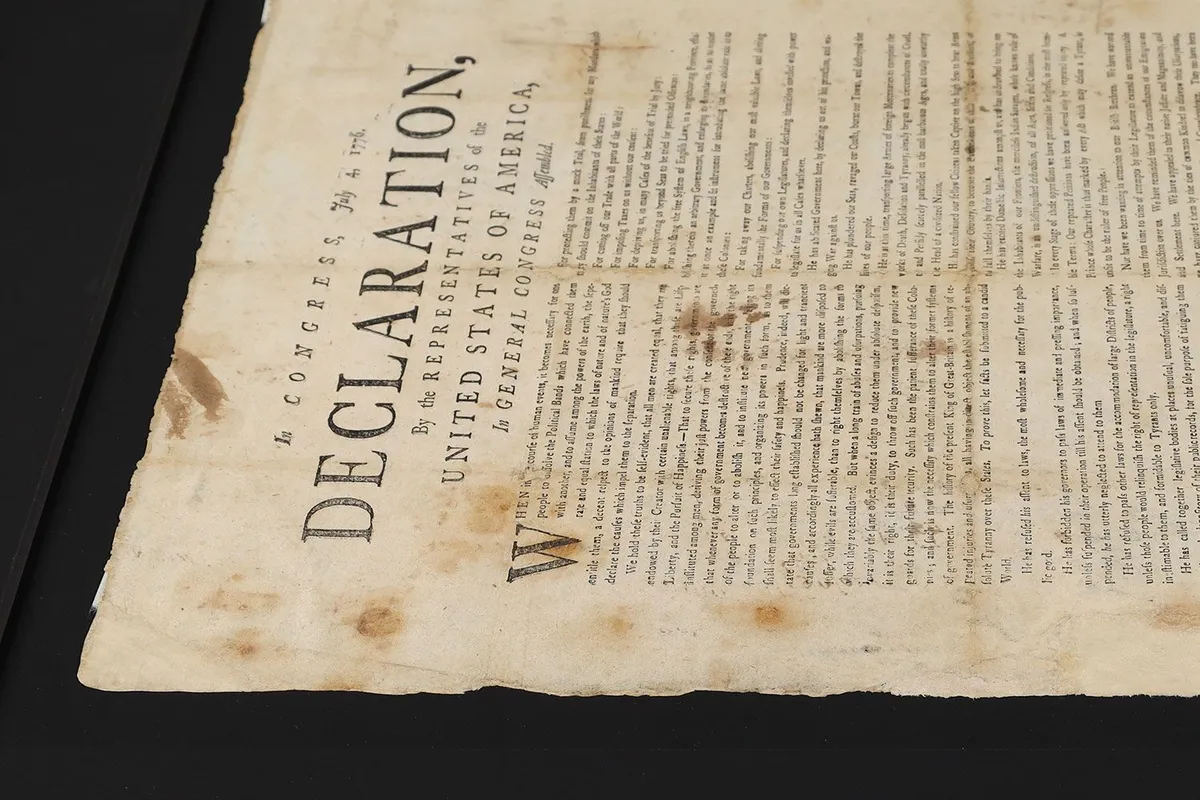
A broadside copy of the Declaration of Independence from July 1776 is heading to auction this May, and it's the kind of artifact that makes you understand why people camp out at museum doors.
Only about 125 broadsides from that first print run survived to today. Of those, just ten copies of this particular edition remain. The auction house Goldin will offer it as Lot No. 1 in a sale timed to the country's 250th anniversary, with Ken Goldin, the company's founder, calling it "one of the most historically significant and valuable documents of the American Revolution."
How ordinary people first learned the news
These broadsides—single sheets of paper printed on one side—were the social media of 1776. They got nailed to tavern walls, read aloud at town meetings, displayed in churches. This particular copy, likely printed in Exeter, New Hampshire, is in remarkably good condition for something that may have been tacked to a wooden post in a public hall 248 years ago. The fact that any survived at all is almost an accident of history.
We're a new kind of news feed.
Regular news is designed to drain you. We're a non-profit built to restore you. Every story we publish is scored for impact, progress, and hope.
Start Your News DetoxWhat makes this copy especially striking is how it represents the actual moment of dissemination. This wasn't a formal parchment signed by delegates—that famous version came later. This was how most Americans encountered the Declaration's words for the first time. A farmer in Connecticut or a merchant in Boston would have seen something that looked exactly like this.
The price question
Goldin hasn't released an estimate yet, but the market has spoken recently. Another broadside copy sold at Christie's auction just weeks ago for $5.7 million. That number gives some sense of what collectors and institutions are willing to pay for a document this rare and historically immediate.
The upcoming auction will feature over 400 items spanning American history—artifacts connected to Martin Luther King Jr., John F. Kennedy, Babe Ruth, and others. But the Declaration broadside will hold the place of honor as the first lot offered.
For anyone interested in how ideas actually spread in the pre-digital world—how information moved from decision-makers to ordinary people without television or newspapers or the internet—this is the physical proof. It's a reminder that revolutions aren't won in elegant halls. They're won when someone prints something on a sheet of paper and posts it where people will see it.