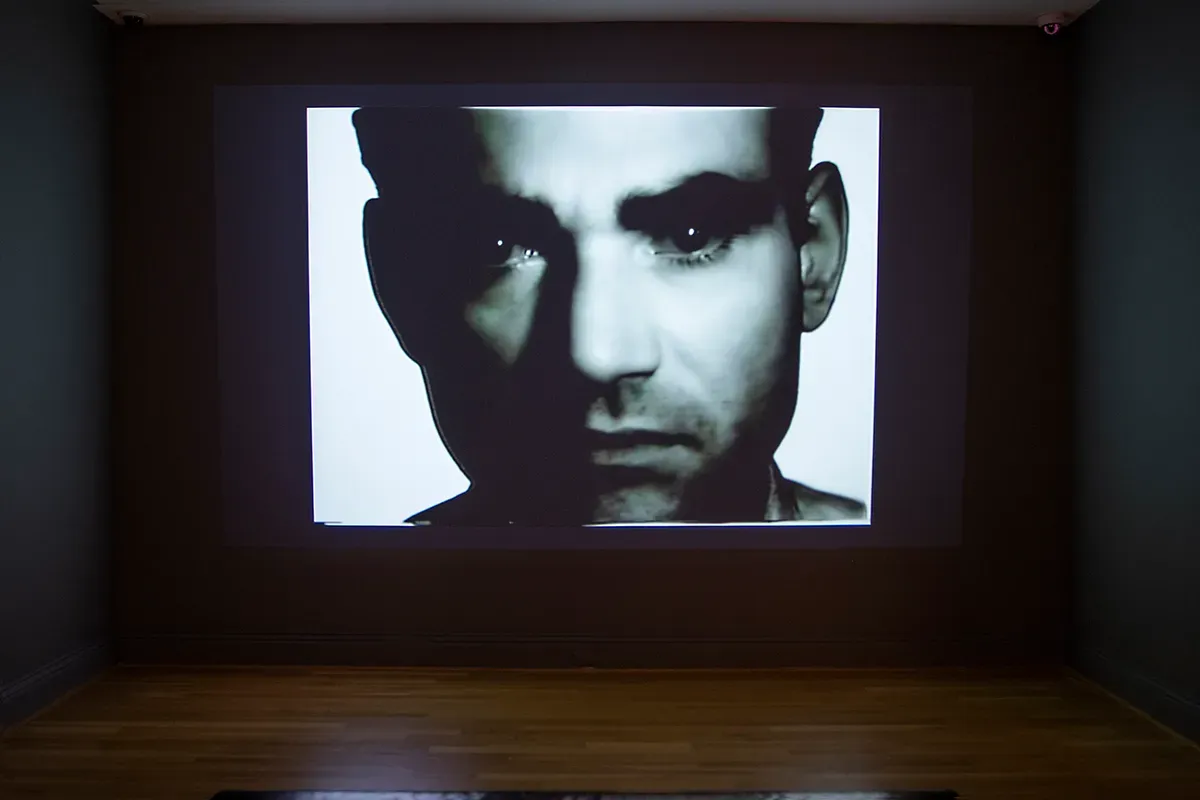
Peter Campus made his name by staring at himself. In Three Transitions (1973), the video pioneer appeared to erase his own face in real time. In Head of a Man with Death on His Mind (1978), he locked the camera on an intense, unflinching gaze — thick eyebrows, occasional swallows, barely a blink. The work was confrontational. It demanded attention. It was, in every sense, an ego project.
Now 88, Campus has stopped demanding anything.
His new exhibition at The Phillips Collection in Washington, D.C., shows a radical shift. The four videos that make up The Phillips Quartet (2023-24) are nothing like the self-scrutiny of his earlier work. Instead, they study the quality of light on the eastern tip of Long Island, where he now lives. The images move, but barely. Time unfolds differently here — not the confrontational intensity of a man staring you down, but something closer to attention itself, patient and observant.
"I started with a great ego eager to make my mark," Campus reflected recently. "Reflecting on it all today I feel profound modesty."
We're a new kind of news feed.
Regular news is designed to drain you. We're a non-profit built to restore you. Every story we publish is scored for impact, progress, and hope.
Start Your News DetoxThis isn't a retirement announcement or a sudden loss of conviction. It's something more interesting: a complete reorientation of what an artist thinks their work should do. For decades, Campus used video as a tool for self-examination — lowercase letters in his titles, his own face as the primary subject, the camera as a mirror. That approach defined video art in the 1970s and beyond. It was necessary. It was urgent.
But something shifted. The curator John G. Handhart, who organized the exhibition, describes Campus's late work as embodying a "profound modesty" — a term that would have seemed impossible applied to the younger artist. Yet it fits. The new pieces don't ask you to see the artist. They ask you to see what the artist sees: the specific quality of light at a specific time of day, in a specific place, the kind of observation that requires patience rather than ego.
This kind of transformation is rare in contemporary art, where the pressure to maintain a recognizable brand, a consistent "voice," only increases with age. Campus did the opposite. He spent a lifetime building a reputation as a rigorous, self-examining pioneer, then stepped back from the thing that made him famous.
The exhibition runs through early 2024, offering a chance to see what happens when an artist finally stops demanding to be seen and starts simply looking.