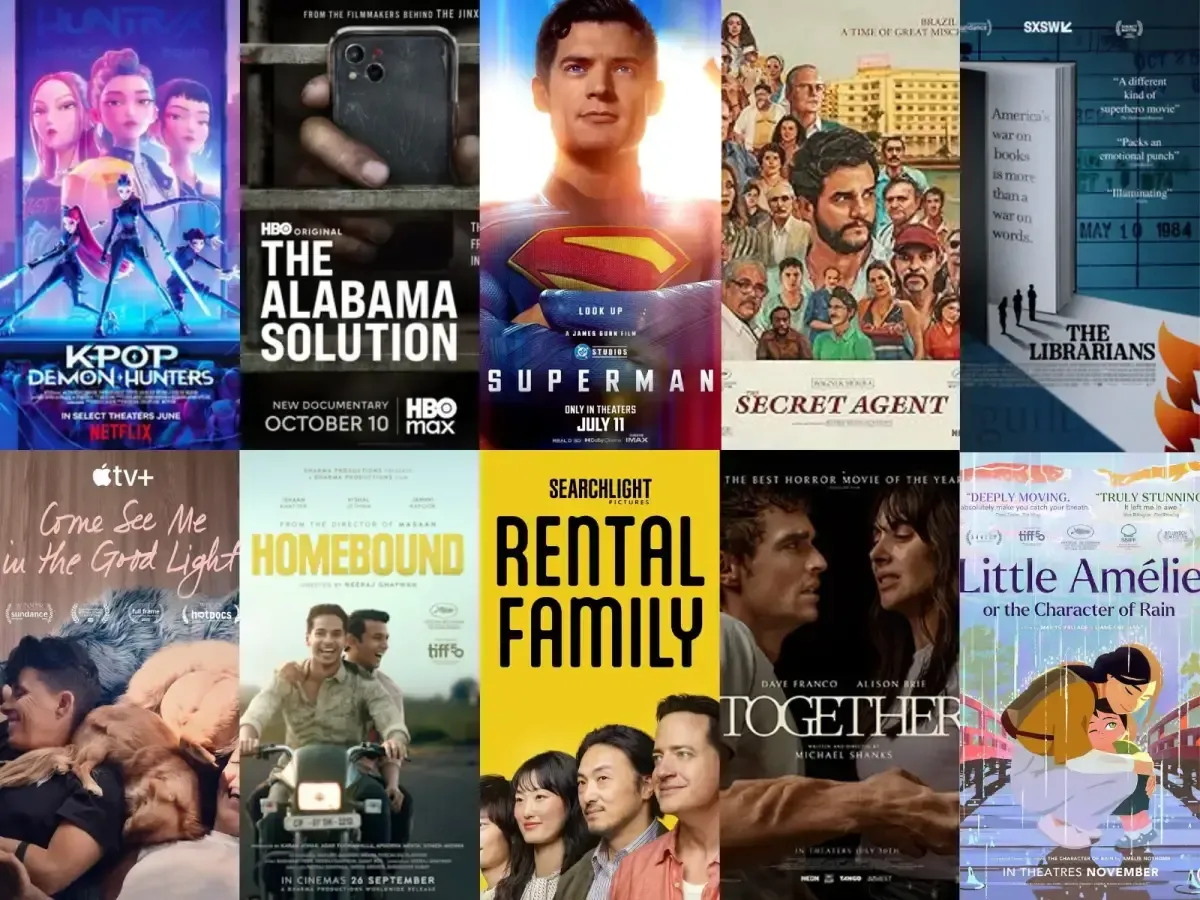
Every year, Greater Good celebrates movies that highlight human strengths. This year's list features films from around the world. Many focus on love, courage, and connection.
This might not be an accident. Artists worldwide may be trying to inspire these qualities during what sociologist Edgar Morin calls the "polycrisis." This term describes complex, linked political, social, and ecological problems. Or perhaps these movies are simply here to entertain. Either way, we hope this list helps you find something to become your best self.
Films Honoring Humanity
SYSTEM_DIRECTIVE:SOCIAL_EMBED:YOUTUBE:xRNND_uve8I
The Purpose Award: The Alabama Solution
This powerful documentary, directed by Andrew Jarecki and Charlotte Kaufman, takes viewers inside Alabama's prison system. It shows the system mainly through the eyes of inmates. Their secret phone footage reveals terrible conditions and violent abuse by guards.
We're a new kind of news feed.
Regular news is designed to drain you. We're a non-profit built to restore you. Every story we publish is scored for impact, progress, and hope.
Start Your News DetoxPrisoners and their families fight to hold the state accountable and create a fairer system. They face strong discrimination. Charles Dickens wrote in Little Dorrit that a prison "had no knowledge of the brightness outside." It is hard not to feel the pain of such darkness.
But in The Alabama Solution, the men find their own light. They find it through solidarity, knowledge, and a purpose in fighting for civil and human rights. It is humbling to see these men, even in solitary confinement, keep hope alive for each other.
Viktor Frankl, a Holocaust survivor and psychiatrist, argued in Man’s Search for Meaning that our main drive is to find purpose. This is true even in the worst situations. Later research has shown that purpose is vital for survival.
Sometimes, purpose can be self-improvement and education. The most successful rehabilitation program is earning a college degree while in prison. Inmates also find purpose by trying to change the prison system. We have other ways to see and treat people accused of crimes. Choosing these alternatives would mean including their well-being as part of our societal purpose.
SYSTEM_DIRECTIVE:SOCIAL_EMBED:YOUTUBE:t0B8sjxR7Mo
The Art-of-Surrender Award: Come See Me in the Good Light
Two poets, Andrea Gibson and Megan Falley, fell in love on a dance floor in Oakland, California. Andrea, a spoken-word poet, asked Meg to move to Colorado. Their relationship became difficult. Then, as they were about to break up, Andrea was diagnosed with ovarian cancer.
Come See Me in the Good Light shows the joys and struggles of life with Andrea's cancer. Big studios do not often fund documentaries about queer poets dealing with cancer. This film was made because Andrea and Meg's friends became Executive Producers. They gathered the money and connections needed.
Together, they created a subtle guide to surrendering. Throughout the film, Andrea and Meg show how a creative practice helps us accept life as it is. It teaches us to feel everything and let others be part of it. Andrea and Meg share how poetry helped them survive suicidal thoughts and the pain of anti-fatness. We see them use their creative skills to stay present and feel emotions, whether facing bad news, enjoying dance parties, or dealing with a broken mailbox.
This special collaboration proves that making art can help us accept mortality and stay alive until the very end.
SYSTEM_DIRECTIVE:SOCIAL_EMBED:YOUTUBE:WojNkusud84
The Extraordinary Courage Award: Homebound
Homebound tells the story of two childhood friends in a small North Indian village. They face the harsh realities of life with great courage and strong friendship. Shoaib, who is Muslim, and Chandan, who is Dalit (a highly oppressed caste), are tired of daily discrimination. They try to join the police force, seeing it as their only way to gain dignity.
But life changes their plans. A flawed examination system and the sudden COVID-19 lockdown stop their dreams. The film is inspired by a 2020 New York Times article by Basharat Peer. It shows the struggles of millions of migrant workers in India who were devastated by the lockdown. Work disappeared overnight. Many had no way to stay in cities, and transportation home was gone. With no other choices, many began walking back to their distant villages. They braved the hot summer on foot, much like Shoaib (Ishaan Khatter) and Chandan (Vishal Jethwa). The story reveals the painful uncertainty of trying to get home during a global pandemic.
Homebound is powerful because it shows many kinds of courage. It shows the courage to dream big despite huge problems. It shows loyalty across social divides. It shows the willingness to leave a familiar village for an unknown city. It shows the bravery to risk everything to return home with little hope of safety. It shows the strength to endure an unimaginable journey. And it shows the resolve to accept one's social identity and let go of undeserved guilt and shame. Even as the journey takes a huge toll, they keep going, one step at a time.
SYSTEM_DIRECTIVE:SOCIAL_EMBED:YOUTUBE:TbMEMCvFbZk
The Embrace-Your-Demons Award: KPop Demon Hunters
By day, they are a superstar KPop singing group. By night, they are demon hunters. This is the double life of the KPop trio HUNTR/X. Generations of women have held these roles, using their singing voices to fight demons that prey on human souls. Now, it is Rumi, Mira, and Zoey's turn to carry on this legacy.
When a new boy band, the Saja Boys, appears, HUNTR/X realizes they are more than just cute rivals. They are actually demons, stealing the souls of HUNTR/X fans! This starts a battle between good and evil, both on and off stage. But another battle is brewing. Rumi has a secret that could change everything. Keeping this secret strains her relationships with her friends, her fans, and most of all, herself.
As HUNTR/X continues its mission to take down the Saja Boys, Rumi's inner conflict also reaches a peak. Anxiety and shame cause her to lose her voice. She isolates herself from her friends, who become increasingly worried.
The film shows that hiding your messy parts works until it doesn't. Eventually, you break. Like Rumi, you have to decide if you will embrace all those broken parts or let them stay a mess. The ultimate message is that accepting yourself, demons and all, is how we thrive.
SYSTEM_DIRECTIVE:SOCIAL_EMBED:YOUTUBE:Ykll4MWltsQ
The Ordinary Courage Award: The Librarians
"I never imagined what’s happening right now could ever happen," says an anonymous librarian at the start of The Librarians. The documentary is directed by Kim A. Snyder. "We just never imagined we would be at the forefront. We’re not necessarily supposed to be seen and felt. We’re stewards of the space, stewards of the resources."
This film follows public and school librarians in Texas, Louisiana, Florida, and other states. They quietly and with principle fight against book bans and other forms of censorship. The targeted books include histories of slavery, the Ku Klux Klan, and desegregation. They also include any book about gender and sexuality.
I watched The Librarians with my partner Michelle, who is a public librarian. To her, book bans are just one part of the attack on libraries. Libraries face deep budget cuts at a time when they are dealing with every social problem in American society. Every day, librarians meet patrons with serious mental illness, children and elderly people needing social services, immigrants trying to navigate a complex system, and unemployed people seeking jobs without home computers.
Michelle told me, "Going into this field is like getting into any relationship: you never know how fierce you’re going to have to be." She added, "I have a ton of respect for the commitment of so many of my colleagues. And just as much respect for the ones who have had to walk away from the abuse to retain their health and their sanity." Many teachers, doctors, nurses, and journalists might say the same.
The Librarians ultimately shows the rise of fascism in America. But the most important thing is that it shows how many ordinary women (and some men) are drawn into a struggle they never expected. Their ordinary courage is an example many of us may need to follow in the coming years.
SYSTEM_DIRECTIVE:SOCIAL_EMBED:YOUTUBE:pQfevunCodU
The Connectedness Award: Little Amélie or the Character of Rain
Have you ever felt like you were the center of the world? Little Amélie or the Character of Rain explores this feeling through Amélie's life. It follows her from infancy through childhood, showing the inner world of a child who experiences everything with intense emotion.
Directed by Maïlys Vallade and Liane-Cho Han, and based on a novel by Amélie Nothomb, it portrays what it truly feels like to be a child. It's not a sentimental version, but the real experience of being the absolute center of the universe before learning otherwise.
I watched this movie with my kids and felt like a child myself, quickly moving through childhood phases. Amélie says, "When you are three, you see everything, and understand nothing." This is a lot to carry alone. Her first taste of white chocolate brings a powerful feeling of momentary self-annihilation. The first experiences of life are also powerful: being seen for the first time, the vibrant colors of spring, the wonder of animals, books, a spinning top, and learning your name and what you might become.
For much of the film, Amélie feels godlike and refers to herself as God. Don't we all feel like God at some point in childhood? Full of power, possibility, the absolute center of everything. It's a wonderful, terrible feeling, and it is linked to loneliness, anxiety, and depression. As Amélie experiences beauty, grief, love, and loss, she learns she is not the center of the world. She discovers that our connection with others gives life meaning.
SYSTEM_DIRECTIVE:SOCIAL_EMBED:YOUTUBE:sagIfV-Kk9Y
The Prosocial Deception Award: Rental Family
Rental Family is about a small company in Japan that creates fake family situations. These situations serve various emotional or practical needs. If this sounds strange, then "We sell emotion," explains the boss, Shinji Tada (Takehiro Hira). "We play roles in clients’ lives. Parents, siblings, boyfriends, girlfriends, best friends. And help them connect to what’s missing." He adds that mental health issues are stigmatized in Japan, so people turn to services like theirs.
Shinji tries to hire struggling actor Phillip Vandarpleog (Brendan Fraser) to be the "token white guy" on the team. Phillip accepts the job. One woman hires him to act as an affluent white dad so her biracial, "illegitimate" daughter can get into a good school. As Phillip and the child bond, the story becomes heartbreaking. It also raises questions about whether what they are doing is right.
As the story goes on, the characters make mistakes and some unethical choices. But what is most interesting is how Rental Family makes us accept that sometimes we need to lie to ourselves or others to find happiness. At the same time, the movie shows that lies can have serious consequences. Rental Family does not try to solve this contradiction. It simply lets us see that it exists.
The core question of the story is: How do we tell the difference between selfish, antisocial lies and prosocial, kind deception? As the characters search for answers, Rental Family asks the audience to find their own.
SYSTEM_DIRECTIVE:SOCIAL_EMBED:YOUTUBE:0nNAVGX8n7w
The Melancholy Love Award: The Secret Agent
Kleber Mendonça Filho is Brazil’s leading filmmaker. His latest work, The Secret Agent, is nominated for this year’s Academy Award for Best Picture.
The film is mostly set in Brazil in 1977. This was a time of "great mischief," as the film describes it, marked by corruption, state violence, and dictatorship. Armando, played brilliantly by Best Actor nominee Wagner Moura, is a research scientist with a kind heart.
At the start of the film, he is running from assassins for reasons we learn later. Marcelo’s son is obsessed with the poster for the 1977 hit film Jaws. The poster shows a giant shark rising from the depths towards an unsuspecting swimmer. This image represents the real violence and fear surrounding this family.
One of my favorite scenes is early in the film. Armando meets the residents of a house run by Dona Sebastiana (Tânia Maria). She is a wise, generous 77-year-old who has seen everything. As she takes him under her wing, Armando uses the name Marcelo to live under a false identity.
Even under stress, Marcelo greets everyone as precious. This highlights the loving, almost doting quality of Brazilian culture. It is mixed with saudade, a Portuguese word for tragic melancholy, longing, and acceptance.
Through many twists and turns, The Secret Agent reveals the true secret agent that grounds all our lives: love. Love can bring growth, rest, safety, and healing. This film will make you determined to love every person through difficult times.
SYSTEM_DIRECTIVE:SOCIAL_EMBED:YOUTUBE:o23Noye5410
The Greater Goodness Award: Superman
Over the past 25 years, it has been a trend to make Superman another violent, grim, dark superhero. In the 2013 movie Man of Steel, Superman battles General Zod over Metropolis, killing thousands. Superman ultimately murders his enemy.
To me, that is not what superheroes should be about. These stories are fantasies about powerful people being good. They are ideals of how powerful people in real life should behave. If you turn Superman into Donald Trump (like Homelander in The Boys), you are reflecting the real world. Then you should be making satire.
There is nothing satirical about the 2025 Superman movie, written and directed by James Gunn. It is simply sincere, good-hearted, silly fun.
For example, in the movie, Superman (David Corenswet) saves a squirrel from certain death. I have read that Gunn received pushback on this scene from test audiences, but he kept it anyway. He was right to do so because it clearly distinguishes his Superman from recent versions. Yes, it is ridiculous, but more than that, it is good. To this Superman, all life is precious.
Another example is Krypto the Superdog. Every scene with this dog, who has Superman's powers, is delightful. Krypto is a GOOD DOG, and is anything better than a good dog? Reader: No, there is not.
Do not expect an intellectually stimulating evening from this version of the Superman myth. Instead, you will get a deeply relatable vision of goodness that might make you feel a little better about the world.
As Superman says at the film’s end: “I’m as human as anyone. I love. I get scared. I wake up every morning and despite not knowing what to do, I put one foot in front of the other and I try to make the best choices I can. I screw up all the time, but that is being human. And that’s my greatest strength.”
SYSTEM_DIRECTIVE:SOCIAL_EMBED:YOUTUBE:aSR8mOPBa0I
The Braver Love Award: Together
Marriage rates are declining among Gen Z and millennials. You could say we are facing a generational struggle to commit. This is the theme of Together, a body-horror film from Australian director Michael Shanks.
This movie stars Tim (Dave Franco) and Millie (Alison Brie), a long-term couple who are not getting married. But when they move to a rural community to start a new life, they find a supernatural force. This force seems determined to bring them together in a frighteningly literal way.
On the surface, Together is a sometimes-gruesome thriller. It aims to shock its audience with images of two humans slowly being physically fused. But beneath the macabre elements is a smart and compassionate look at couples afraid to truly open up and take the next step in their lives.
Perhaps no theme inspires more fictional stories than love. The quest to understand why and how we are drawn to each other is endless. From the tragedy of Romeo and Juliet to countless romantic comedies, there are millions of stories about why people fall in love.
Together offers an unusual look at what is perhaps the most powerful force in the world. It challenges its audience to save themselves from aimless relationships. The movie suggests that taking the leap of faith to commit to a life with someone else can be scary. But being too cowardly to do so can lead to a much more horrifying outcome.