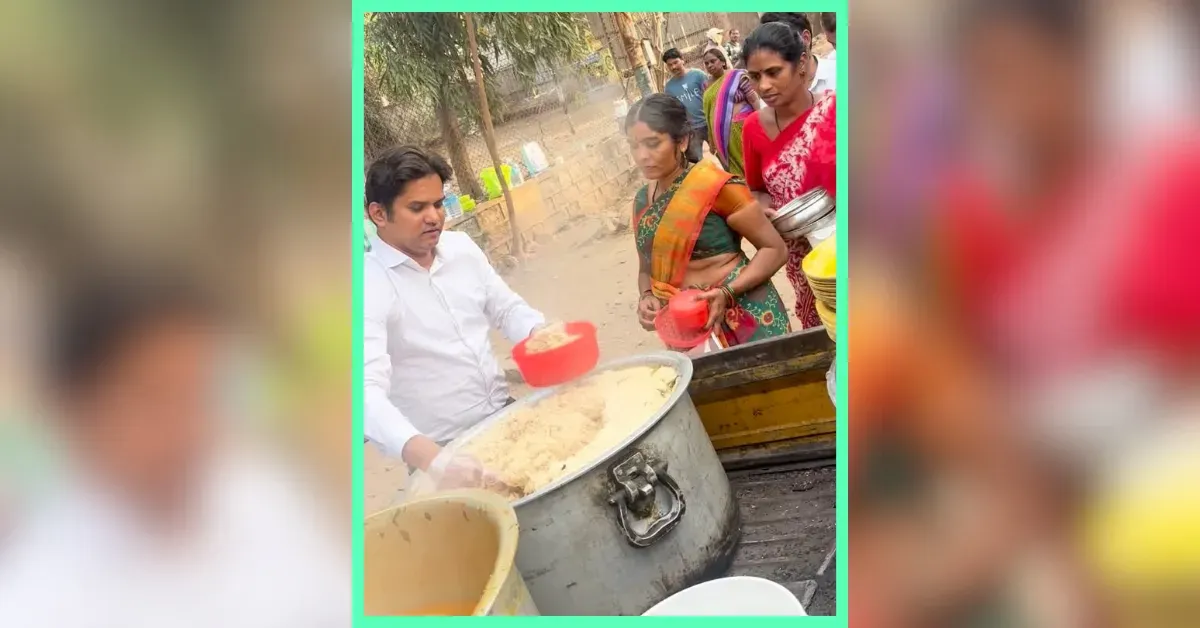
Every morning in Hyderabad's government hospitals, before the corridors fill with doctors and visiting hours begin, one man is already serving hot meals to people who can't afford them. For the past decade, he's shown up before his corporate job to feed 200 to 400 people across the city's wards — patients fighting cancer, kidney failure, heart disease, waiting for treatment they can barely afford, let alone meals.
He's become known as the Foodman. And his routine is simple: arrive early, serve food with dignity, then head to the office.
Government hospitals in India tend to treat people from economically weaker backgrounds. A patient admitted for weeks with a serious illness isn't just managing medical costs — they're managing survival. Their relatives stay bedside, sometimes for months. Food becomes a luxury they can't budget for. The Foodman recognized this gap a decade ago and decided to fill it himself.
We're a new kind of news feed.
Regular news is designed to drain you. We're a non-profit built to restore you. Every story we publish is scored for impact, progress, and hope.
Start Your News DetoxWhat makes his work notable isn't the scale — though 200 to 400 meals daily is substantial — but the consistency. He hasn't missed a day. He hasn't scaled back. He hasn't waited for an NGO to form around him or a government program to take over. He simply shows up.
The Ripple Beyond Wards
Over time, his work expanded beyond hospital gates. He now distributes meals to homeless people living on streets, reaching people who fall entirely outside formal support systems. The distinction matters: he's not just handing out food packets. He's serving meals. The difference is presence, eye contact, treating hunger as a dignity issue rather than a logistics problem.
This matters because it reveals something about how change actually happens in cities. Hyderabad is a thriving tech hub with a growing middle class. But like most Indian cities, it has massive inequality living in the same neighborhoods. The Foodman's work doesn't solve that inequality — one man can't. But it exposes how much need exists in plain sight, in the corridors of public hospitals where thousands pass through daily. His presence there is a quiet statement: this problem is visible, and it's solvable at human scale.
His stated vision is a hunger-free Hyderabad. That's ambitious in a city of 7 million. But what's interesting is that he's not waiting for the vision to become reality before acting. He's feeding people today, not someday. This distinction — between waiting for systemic change and meeting immediate need right now — is where most hunger relief gets stuck. The Foodman chose both: serve today, dream bigger tomorrow.
In a city where acts of kindness are often one-off moments, his decade of routine service suggests something different is possible. Not heroic sacrifice, but sustainable commitment. Not charity that makes the giver feel good, but service that keeps people alive.