

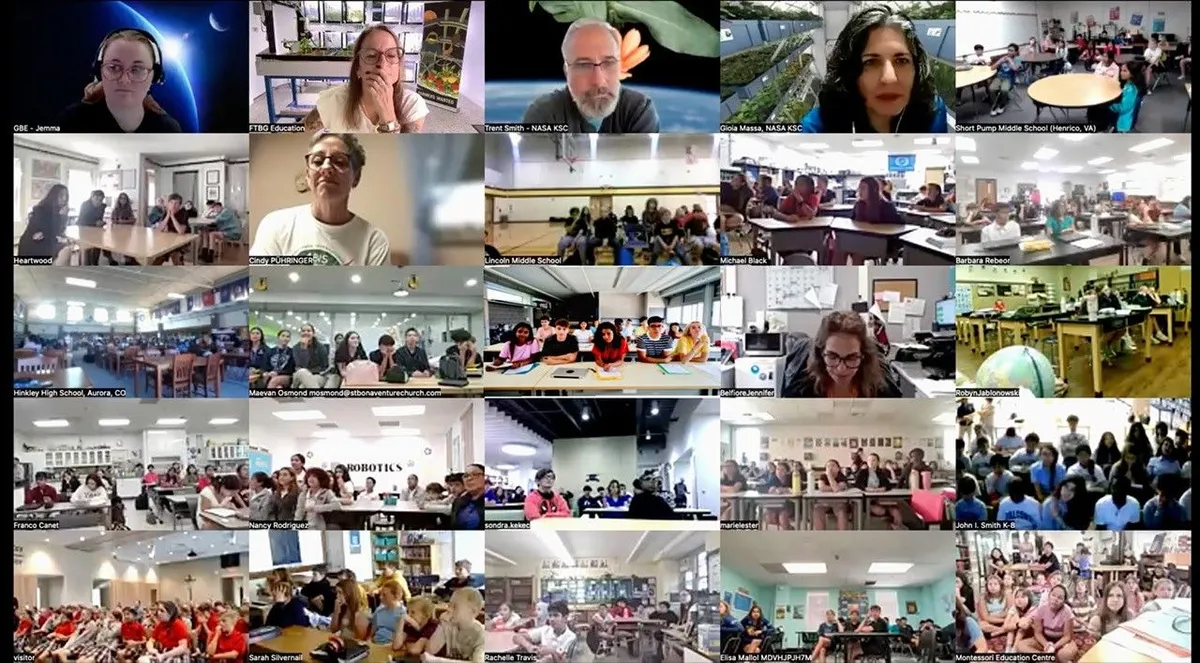
Nearly 1,250 middle and high school students from 71 schools tuned in last month to hear directly from NASA scientists about how their classroom experiments are shaping what astronauts will eat on the Moon and Mars. It's the kind of moment that changes how a teenager thinks about science — when you realize your data isn't hypothetical, it's actually being read by people designing missions.
The live chat connected classrooms with Dr. Gioia Massa and Trent M. Smith, senior leaders of NASA Kennedy Space Center's Space Crop Production team. For the past decade, Growing Beyond Earth — a program run by Fairchild Tropical Botanic Garden in Miami — has been channeling real NASA research directly into schools, letting students test how different crops perform under spacecraft conditions.
Here's what that looks like in practice: Students use specially designed plant growth chambers to simulate the environment an astronaut would face on a long-duration mission. They collect data on how lettuce, peppers, radishes, and other crops respond. That data gets sent to NASA scientists, who use it to figure out which plants are worth growing in actual space habitats. Five crops that students tested in classrooms have already been grown aboard the International Space Station.
We're a new kind of news feed.
Regular news is designed to drain you. We're a non-profit built to restore you. Every story we publish is scored for impact, progress, and hope.
Start Your News DetoxThe numbers tell the story
Over ten years, more than 120,000 students across 800 classrooms have tested over 250 plant varieties. That's not a small science fair project anymore — that's a distributed research network with teenagers as the backbone. One teacher at Hialeah Senior High School put it simply: "We are far, but we are one." Her students weren't just doing a lab exercise. They were part of something that mattered.
What makes this work is the directness of it. Students aren't reading about NASA missions in a textbook. They're growing plants, analyzing results, and then hearing from the actual scientists who will use their findings. "When students see themselves as part of NASA's mission, they realize science isn't something distant," Dr. Massa said. "It's something they can do."
The program is part of NASA's broader Science Activation initiative, which is built on a simple premise: people engage deeper with science when they're doing it themselves, not just consuming it. A classroom in the Philippines can run the same experiment as one in Ohio, and both sets of data contribute to the same research question. That's the kind of connection that doesn't just teach biology — it shifts how young people see their own capability.
As NASA plans longer missions beyond Earth orbit, the food question becomes real. You can't resupply astronauts on a two-year mission to Mars the way you can on the Space Station. Growing Beyond Earth is helping solve that problem, one classroom experiment at a time.



