

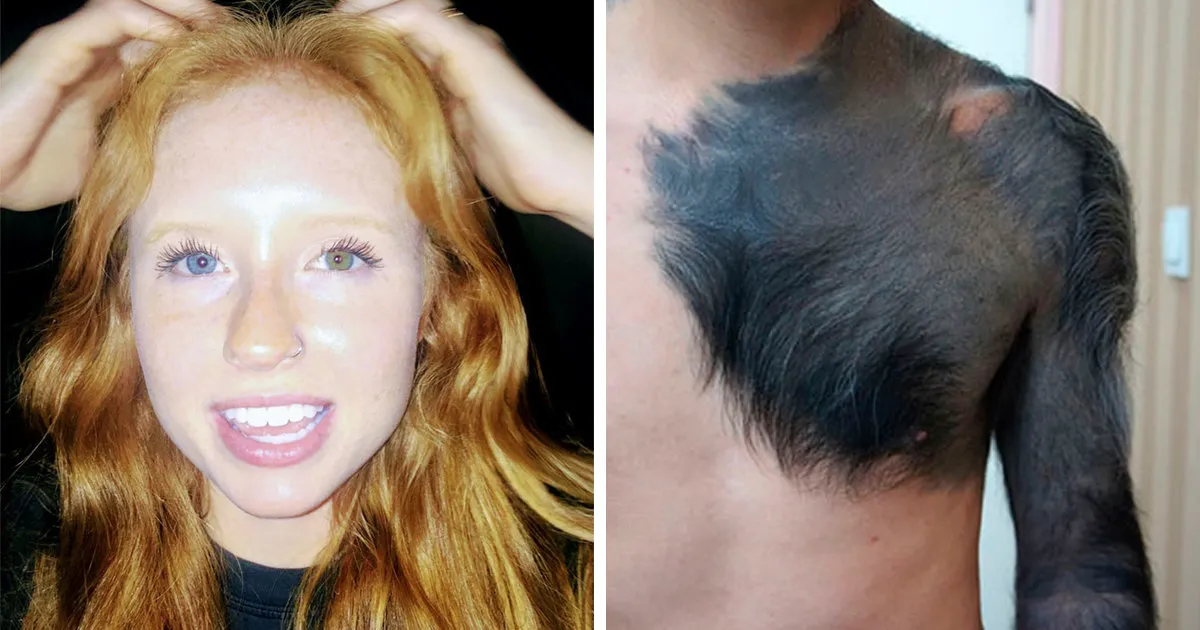
Some people are born with features that stop conversations. A girl whose hair refuses to comb. Eyes split perfectly in half between two colors. An extra finger on each hand. These aren't defects in the medical sense—they're variations that sit at the edges of human genetics, rare enough to be noticed, common enough that they're not alone.
Take Shilah Madison. Around age three, her parents realized her hair behaved differently than other children's. It wouldn't lie flat, no matter how carefully they brushed. By the time doctors identified uncombable hair syndrome (UHS), Shilah was one of roughly 100 known cases worldwide. The condition means her hair breaks easily from the roots. Her daily routine involves minimal brushing, careful washing schedules, and silk pillowcases. But when Shilah's parents shared her story on Instagram, something unexpected happened: around 100 people reached out with photos of their own children, asking if they might have UHS too. What seemed impossibly rare suddenly felt less alone.

Other genetic variations are more common than people realize. Heterochromia—different-colored eyes—affects somewhere between 70 and 140 million people globally. When someone has red hair and heterochromia, the odds narrow dramatically, which is why it feels like a genetic masterpiece. Waardenburg syndrome, which causes mismatched eye colors along with hearing changes, occurs in about 1 in 40,000 people. Vitiligo, the condition that creates patches of depigmented skin, is visible on celebrities like Michael Jackson and model Winnie Harlow, yet many people living with it experience isolation simply because they don't see themselves reflected in everyday spaces.
We're a new kind of news feed.
Regular news is designed to drain you. We're a non-profit built to restore you. Every story we publish is scored for impact, progress, and hope.
Start Your News DetoxSome variations come with practical differences. Polydactyly—having extra fingers or toes—occurs in roughly 1 in 700 to 1,000 births. Research from the University of Freiburg found that people with extra digits often have more agile movement than those without. Albinism, which affects 1 in 18,000 to 20,000 people in the US, changes how light enters the eye, creating striking blue or purple irises. Sectoral heterochromia splits the iris in half, a rarity that typically causes no other symptoms.
What connects these stories isn't that they're medical problems requiring solutions. It's that visibility matters. When Shilah's mother learned her daughter wasn't alone—that 100 other families were managing the same daily challenges—the isolation shifted. The condition didn't change, but the experience of having it did. For traits like vitiligo or albinism, seeing someone like you living confidently in public spaces changes what feels possible.
These genetic variations sit in a quiet space between rare and invisible. Common enough that thousands of people worldwide share them. Rare enough that many people with the same trait have never met another person who looks like them. The internet has begun closing that gap—one Instagram post, one comment section, one moment of recognition at a time.





