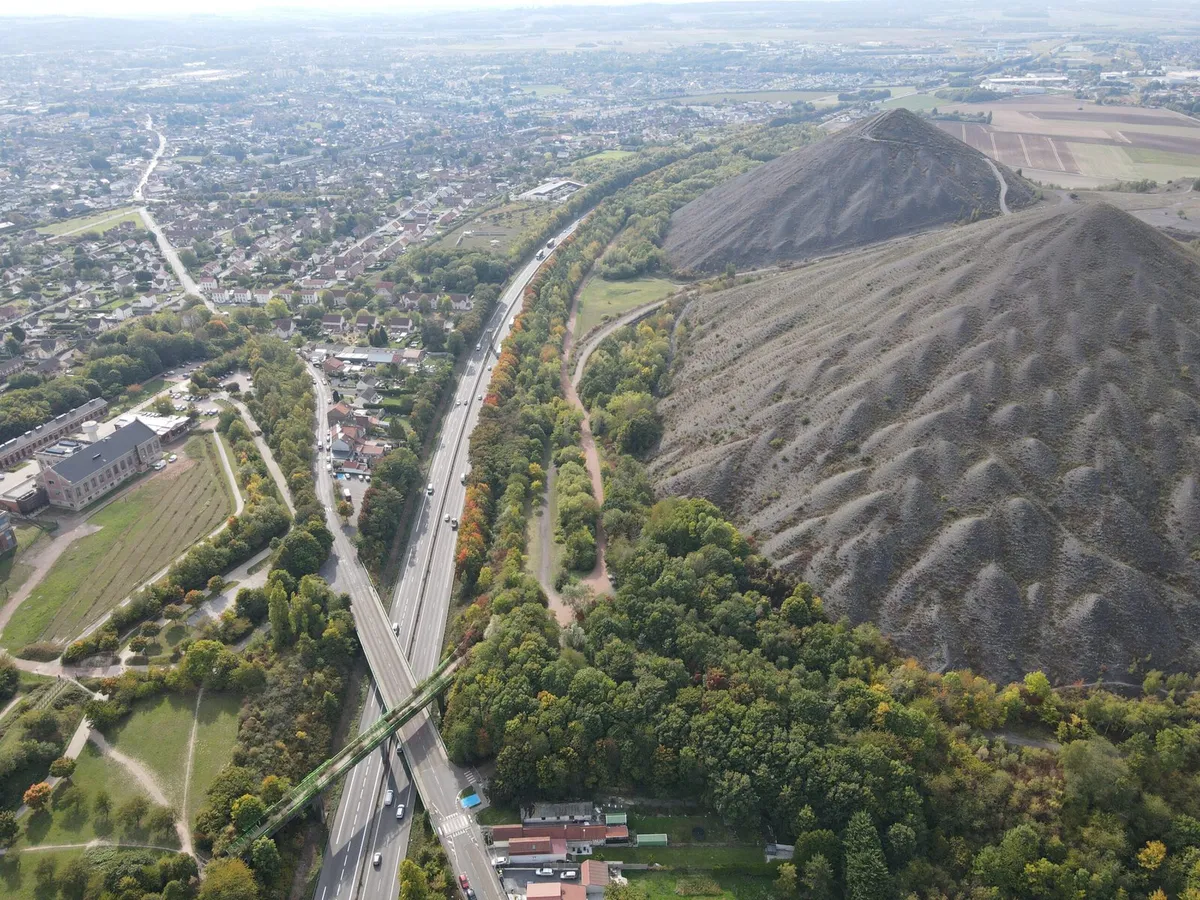
When the mines closed in Loos-en-Gohelle, the identity of this northern French town didn't just disappear — it was deliberately rebuilt. Today, two massive slag heaps that once symbolized industrial extraction now host paragliding, art installations, and a nature reserve where natterjack toads and peregrine falcons thrive.
For over a century, this region of 7,000 people was defined by coal. When the industry collapsed in the 1980s, the existential question wasn't abstract: "What is our use now?" as Antoine Reynaud, chief of staff at Loos town hall, recalls. Other mining towns across Europe tried to erase their industrial past. Loos-en-Gohelle chose differently.
Mayor Marcel Caron, who led the town from 1977 to 2001, rejected the idea of reinvention through erasure. Instead, he kept the slag heaps as monuments to what had been, and built something new alongside them. His motto was simple: "transform without forgetting your roots."
We're a new kind of news feed.
Regular news is designed to drain you. We're a non-profit built to restore you. Every story we publish is scored for impact, progress, and hope.
Start Your News DetoxThe Slow Work of Listening
The transformation wasn't quick. It required something harder than investment or policy: genuine citizen participation. In 1984, Caron launched the Gohelliades Festival, inviting locals to share their stories through performance, exhibition, and feast. This wasn't nostalgia — it was the foundation for reimagining community identity.
When Caron's son Jean-François took over in 2001, he doubled down on this approach. He held over 50 public meetings every year. "It was enormous," says Daniel Florentin, an expert in ecological transition at France's National School of Bridges and Roads. "It showed a way for elected officials to be reachable and accessible, to lower the level of frustration in public meetings. And it really worked."
This openness became the template for everything that followed. The town drafted a Living Environment Charter with residents, addressing urban transit, water resources, energy, and waste. But the real innovation was the "50/50 dispositive" — a mechanism that lets residents propose projects and receive municipal funding and technical support if they take a leading role in implementation.
From Slag to Solar
One project emerged from this framework: Mine de Soleil (Sun Mine), a citizen-led initiative to expand solar power across municipal buildings. Jean-Luc Mathé, part of the citizen committee, describes the process as genuinely collaborative — from naming the project to selecting panel suppliers to managing fundraising. By 2021, 2,600 square meters of solar panels were installed, powering 90% of public energy needs.
"It made us become actors, not just critics," Mathé says. "It takes a lot more time, working with citizens, but it is a much better system."
The economic numbers tell part of the story. The unemployment rate in 2022 was 13.7% — higher than France's national average but significantly lower than other towns in the northern coalfields. But Reynaud and Florentin point to something less easily measured: residents describe a genuine attachment to their town and pride in its transformation.
The model has attracted attention beyond Loos. In 2020, the town founded La Fabrique des Transitions (the Transitions Factory), an organization working to spread its methods nationwide. "The goal is to create a form of doctrine, an alternative model of development that centers on social and ecological transition at the same time," Florentin explains.
What makes Loos' story worth watching isn't that it solved every problem. It's that when an entire economy vanished, the town chose to rebuild not by forgetting, but by listening — and by treating residents as the architects of their own future.