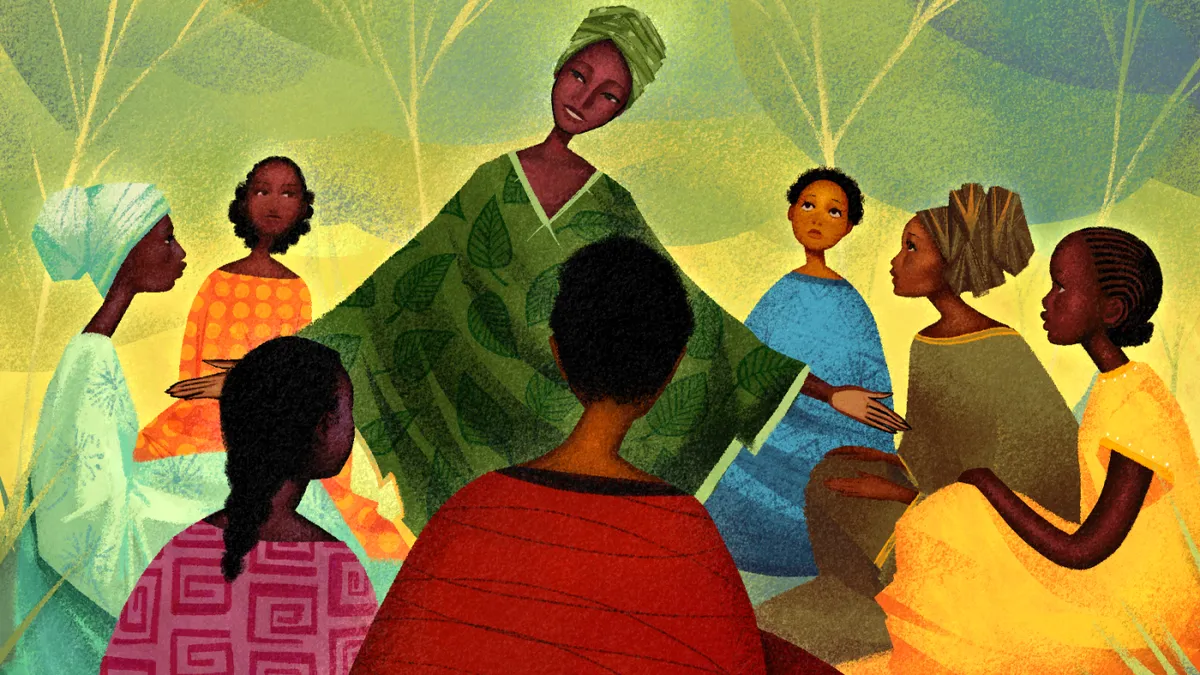
"Let's listen to one another."
That's what toyokana means in Lingala, the language spoken in Kinshasa, Democratic Republic of Congo. At the Toyokana Center, listening isn't just philosophy — it's the entire point. The facility exists for one reason: to help girls who've survived sexual assault, and to make sure they're actually heard.
The center grew out of something concrete. In 2022, a hundred girls and young women from across the DRC and neighboring African countries gathered for three days to talk about what they faced. Ages 13 to 24, they came from different corners of the country. Sexual violence kept surfacing in every conversation — not as a side issue, but as the central one.
"Almost all of those girls were either survivors of sexual violence or they were in very close proximity," says Ramatou Toure, chief of child protection at UNICEF DRC. "I'm talking sister, mother, cousin of a child who had been abused." What struck the organizers wasn't just how many girls had experienced it, but how many had nowhere safe to talk about it. A girl raped by her father doesn't know who to trust — her mother, a teacher, anyone. The fear of not being believed, or not being protected, keeps her silent.
We're a new kind of news feed.
Regular news is designed to drain you. We're a non-profit built to restore you. Every story we publish is scored for impact, progress, and hope.
Start Your News Detox"Creating this kind of a safe space was really the main demand from these girls," says Loa Falone, a social worker at Toyokana. After years working with young survivors, Falone had noticed the pattern: most sexual violence happens inside families. The girls needed somewhere that wasn't family. Somewhere protected.
What Healing Looks Like Here
When girls arrive at Toyokana, they might need immediate medical care for physical injuries. Others carry invisible wounds — depression, post-traumatic stress, anxiety so severe they can barely speak. Some girls are illiterate, which complicates everything: trauma counseling, understanding their rights, imagining a different future. The center offers informal literacy support alongside therapy. One girl learned to read and write there. "This strengthened her," says supervisor Georgette Uma. "Today, she's become a model for the girls who are still on the streets."
The staff are trained to notice what's unsaid. During group sessions, they watch for the girl whose eyes go red, who goes rigid, who withdraws. Falone describes it: "Maybe we notice a girl who reacts differently in that moment... We approach her discreetly and take her to another room where she opens up." The listening isn't passive. It's active, careful, designed to reach the girls too traumatized to speak first.
Since opening, Toyokana's two centers in Kinshasa have supported over 100,000 girls who've experienced or been exposed to sexual violence. That's a significant number in one city. But it's also a drop against the scale of need. Last year, UNICEF recorded more than 45,000 cases of sexual violence against children in the DRC — and that's only what gets reported. The true number is almost certainly much higher.
Uma and her team know what they're up against. "It would be better if our work were widespread," she says, especially in conflict zones where violence accelerates and institutions collapse. But the resources are contracting. Foreign aid cuts by the U.S. and other Western countries halved funding for programs like Toyokana in 2025 — dropping from $18 million to $10 million in a single year. "We have seen a lot of the local programs for sexual violence being disrupted or completely stopped," Toure says.
The larger structural problems — conflict, weak justice systems, the conditions that allow violence to flourish — won't be solved quickly. But Toure doesn't see Toyokana as a band-aid on an unfixable wound. "It's not a hopeless case, on the contrary." One hundred thousand girls have walked through those doors and been heard. That matters. The next phase is figuring out how to expand what works when the funding landscape is shifting.