

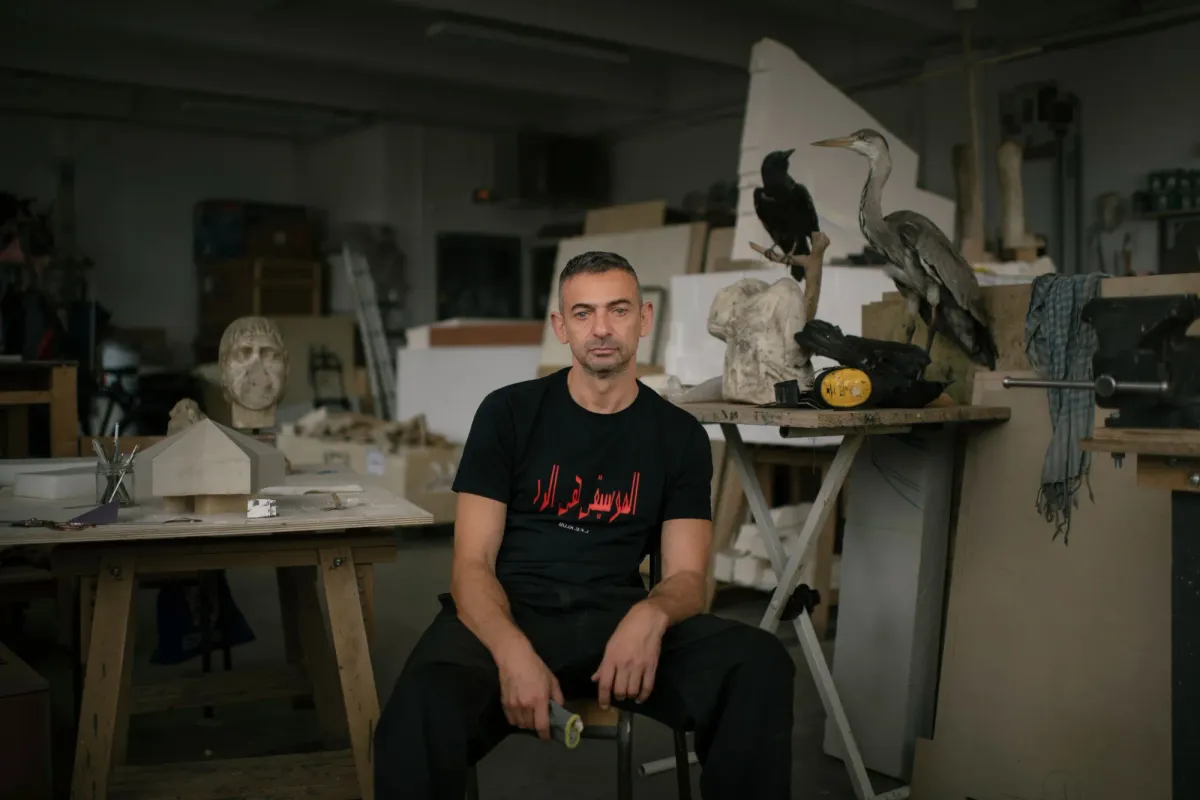
Ali Cherri was born as Beirut's civil war began. Now, more than two decades into his practice, he makes films and sculptures about what violence does to the people caught inside it—not as spectacle, but as a quiet insistence that we stay tender in the face of it.
In his recent short The Watchman, a young man stands rigid for hours at a border that has seen no conflict in 40 years. He's just finished mandatory military service in Northern Cyprus, and Cherri cast him precisely for that lived experience—the particular exhaustion of performing alertness when nothing happens. The film doesn't resolve into meaning. It just holds the weight of his body, the weight of the institution that owns his time.
His follow-up, The Sentinel (2025), the second film in an ongoing trilogy, goes further. A French soldier, gently bent at the waist. A rifle in his mouth. It fires. Whether he dies or dreams, Cherri leaves to you. The ambiguity isn't evasion—it's refusal to let the viewer off easy, to let them decide what mercy looks like.
We're a new kind of news feed.
Regular news is designed to drain you. We're a non-profit built to restore you. Every story we publish is scored for impact, progress, and hope.
Start Your News DetoxThe Set as Archive
At Almine Rech in New York through February 28, Cherri's exhibition "Last Watch Before Dawn" does something he's never done before: it brings his film sets into the gallery as finished work. Visitors watch The Sentinel downstairs, then encounter the objects upstairs—sculptures, stills, and the first watercolors he's publicly exhibited. The objects gain new weight once you've seen them move on screen.
The sculptures are larger than life but made of mud, not bronze. They're exhausted. They're fragile. They suggest impermanence, which is exactly the point. Cherri is interested in how violence alters not just landscapes but bodies, how institutions demand performance, how weakness becomes a form of resistance.
There's a cabaret scene in The Sentinel—a drag performance that Cherri calls "an ode to art itself." The soldier, usually locked in the theater of military conformity, comes alive only here, connecting with another lonely soul who has chosen their own expression. It's the only moment he visibly inhabits his own skin.
Survival as a Lens
For Cherri, born into war, survival isn't abstract. It's the instinct to hold onto life, to find joy in darkness, to insist on tenderness when the world grows harsher. His work exorcises something in order to preserve it—a way of saying: I will not let this erase what it means to be human.
Over 20 years, his films and sculptures have circulated through the Vienna Secession, the Swiss Institute, and earned the Silver Lion at the Venice Biennale. But the recognition matters less than the practice itself: the refusal of moral closure, the insistence on endurance, the belief that art must remain a space where empathy is still possible.



