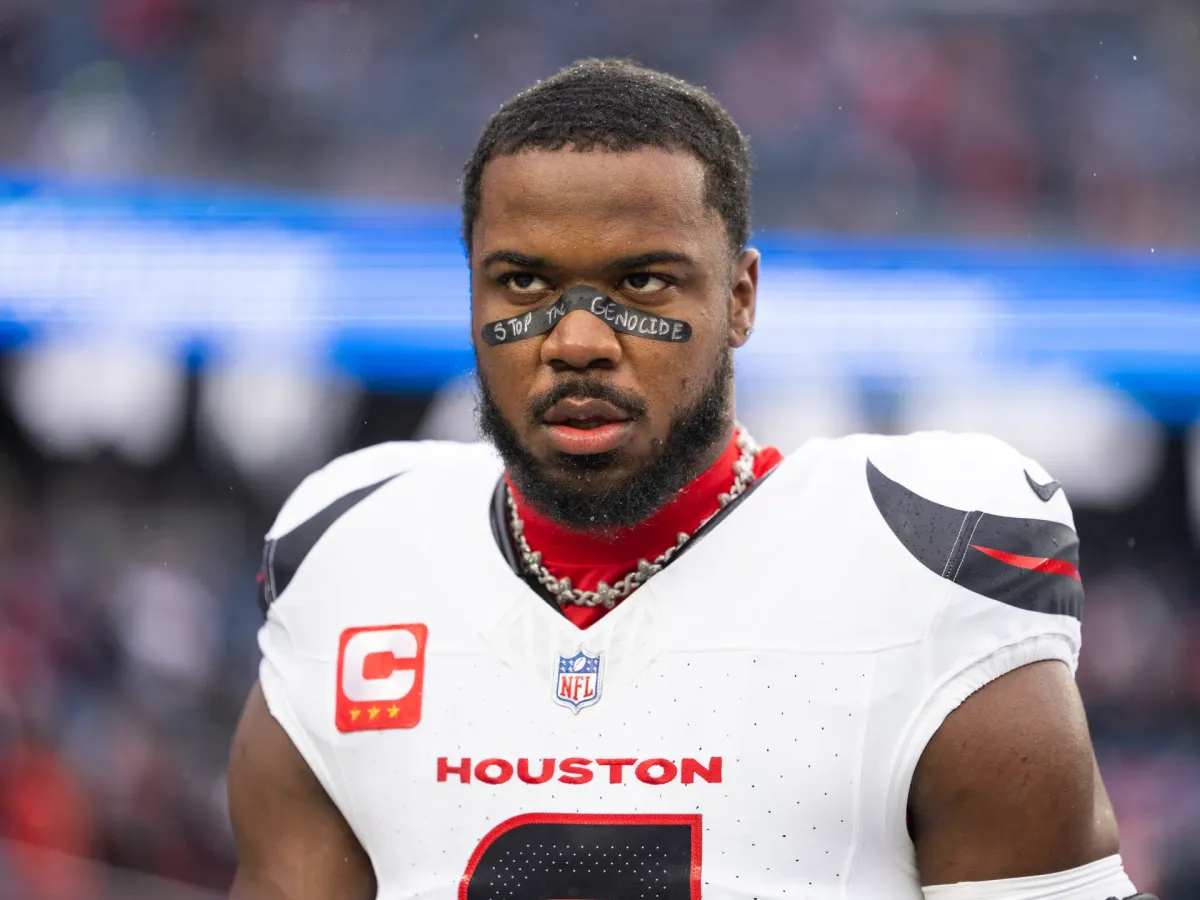
When Houston Texans linebacker Azeez Al-Shaair wore tape across his nose reading "Stop the Genocide" during a pre-game interview, the NFL responded with an $11,593 fine for uniform violations. The community responded differently.
Instead of letting the penalty end the moment, Palestinian rights advocates and Muslim leaders turned it into something larger. Former NFL player Husain Abdullah donated the exact fine amount to the Human Development Fund, which supports humanitarian work in Gaza and Sudan. A separate fundraiser launched by Nimrah Riaz, founder of the sports consulting firm Siraat Strategies, aims to match that donation again.
"If Azeez was going to use his platform to stand up for humanity, and there was going to be a financial consequence, instead of that moment ending in punishment, the community chose to redirect it," Riaz told Al Jazeera. "So we can all collectively raise funds towards Palestine and Sudan for those who actually need it."
We're a new kind of news feed.
Regular news is designed to drain you. We're a non-profit built to restore you. Every story we publish is scored for impact, progress, and hope.
Start Your News DetoxWhat started as a uniform code enforcement became a window into how the NFL handles political speech by its players — and how different messages receive different treatment.
The Pattern Beneath the Fine
Al-Shaair wore the same message on the sidelines the following Sunday against the New England Patriots, but removed it before gametime after being warned he'd be pulled from the game if he didn't. He accepted the financial fine without argument, but the threat of removal puzzled him. Other players have displayed non-sporting messages and faced only fines, not the threat of ejection.
"I knew that that was a fine. I understood what I was doing," Al-Shaair told reporters. "But I was told if I wore that in the game, I would be pulled out of the game. So, I think that was the part that I was confused about."
The distinction matters. It suggests a hierarchy of acceptable dissent — some messages draw money, others draw removal from play. It's a pattern that extends beyond Al-Shaair's moment. In 2016, Colin Kaepernick's kneeling during the national anthem sparked a league-wide policy requiring players to stand or stay in the locker room. Meanwhile, in 2023, several NFL teams held moments of silence for Israelis killed in the October 7 attack, a gesture that went unpenalized despite its own political nature.
Riaz and others in the Muslim community point out that athletes speaking out for Palestinian rights face what she calls "heightened consequences" — an unspoken expectation to remain silent on the issue. Yet the response to Al-Shaair suggests that expectation is being challenged.
The Houston chapter of the Council on American-Islamic Relations (CAIR) issued a statement rejecting the fine itself: "Azeez Al-Shaair's message was rooted in basic human decency and concern for innocent lives. That should not be controversial, much less subject to a fine."
The NFL has positioned itself as politically neutral, a stance most professional sports leagues worldwide attempt to maintain. But critics argue that neutrality is selective — and that Al-Shaair's case reveals the gap between that stated principle and how it's actually enforced.
What began as a penalty has become a test of whether a community can transform punishment into purpose, and whether speaking for humanity costs more in some uniforms than others.