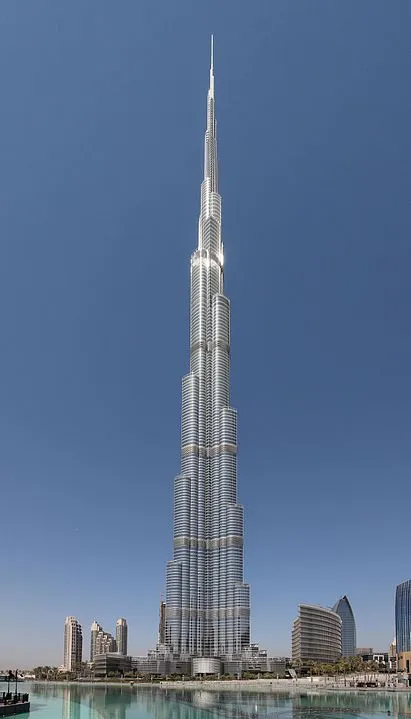
Fifteen years ago today, the Burj Khalifa opened in Dubai and claimed the title of world's tallest building—a crown it has held without interruption ever since. At 2,426 feet, it surpassed Taiwan's Taipei 101 in a single moment of completion, and it's still reigning.
The tower exists because the UAE needed a different story. In the mid-2000s, Dubai's economy was almost entirely dependent on oil. The government wanted out of that vulnerability, so they reimagined the city as a global financial hub. The Burj Khalifa wasn't just a building—it was a declaration. A mixed-use development wrapped around a record-breaking core: apartments, offices, shopping, observation decks. The kind of place that tells the world: we're open for business, and we're building for the future.
Architecturally, the tower is a lesson in problem-solving. Adrian Smith's team at Skidmore, Owings & Merrill (the same firm behind Chicago's Sears Tower) designed 27 setbacks spiraling up the facade, each one narrowing the building's cross-section as it climbs. This isn't decoration—it's engineering. The setbacks minimize wind vibration, and they create outdoor terraces at intervals. At the top, the central core sculpts itself into a finishing spire. Even at its tallest point, the tower sways 4.9 feet back and forth in the wind, a controlled flex that keeps it standing.
We're a new kind of news feed.
Regular news is designed to drain you. We're a non-profit built to restore you. Every story we publish is scored for impact, progress, and hope.
Start Your News DetoxThe design draws from Islamic architecture, a nod to place and culture embedded in the structure itself. Over 3 million square feet of interior space. 154 floors plus 9 for maintenance. The numbers are staggering, but they're also functional—this isn't a monument to excess, it's a functioning city block turned vertical.
Has the diversification worked? Yes. Dubai's economy has shifted. Oil now accounts for less than 5% of the emirate's GDP. The Burj Khalifa itself generates modest direct revenue—the observation decks, some office leases—but the tower's real value was always symbolic. It told investors and workers: this place is serious about change.
Other towers have risen since 2009. The Merdeka 118 in Malaysia climbed to 2,398 feet. Megatall buildings are becoming less rare. But the Burj Khalifa remains the highest occupied floor, the highest observation deck, the highest-reaching structure on Earth. Fifteen years in, it's still the measure by which others are judged.