

When a plant makes a seed or an animal makes a sperm cell, something remarkable has to happen: the number of chromosomes gets cut exactly in half. The egg and sperm each carry 23 chromosomes; when they meet, the total snaps back to 46. It's elegant, and it has to work perfectly. When it doesn't, miscarriages happen in humans. Crops fail to produce viable seeds.
Researchers at the University of Leicester have just figured out a crucial part of how this balancing act stays balanced.
The Crossover Problem
During meiosis — the special cell division that halves chromosomes — each pair of chromosomes needs at least one "crossover," a moment where they physically lock together. Without enough crossovers, chromosomes drift apart randomly. Too many in one spot, and others get left with none. Either way, the cell ends up with the wrong number of chromosomes, and the whole system breaks down.
We're a new kind of news feed.
Regular news is designed to drain you. We're a non-profit built to restore you. Every story we publish is scored for impact, progress, and hope.
Start Your News DetoxThe puzzle was: how does the cell know to spread crossovers evenly? How does it ensure every chromosome pair gets its share without overdoing it?
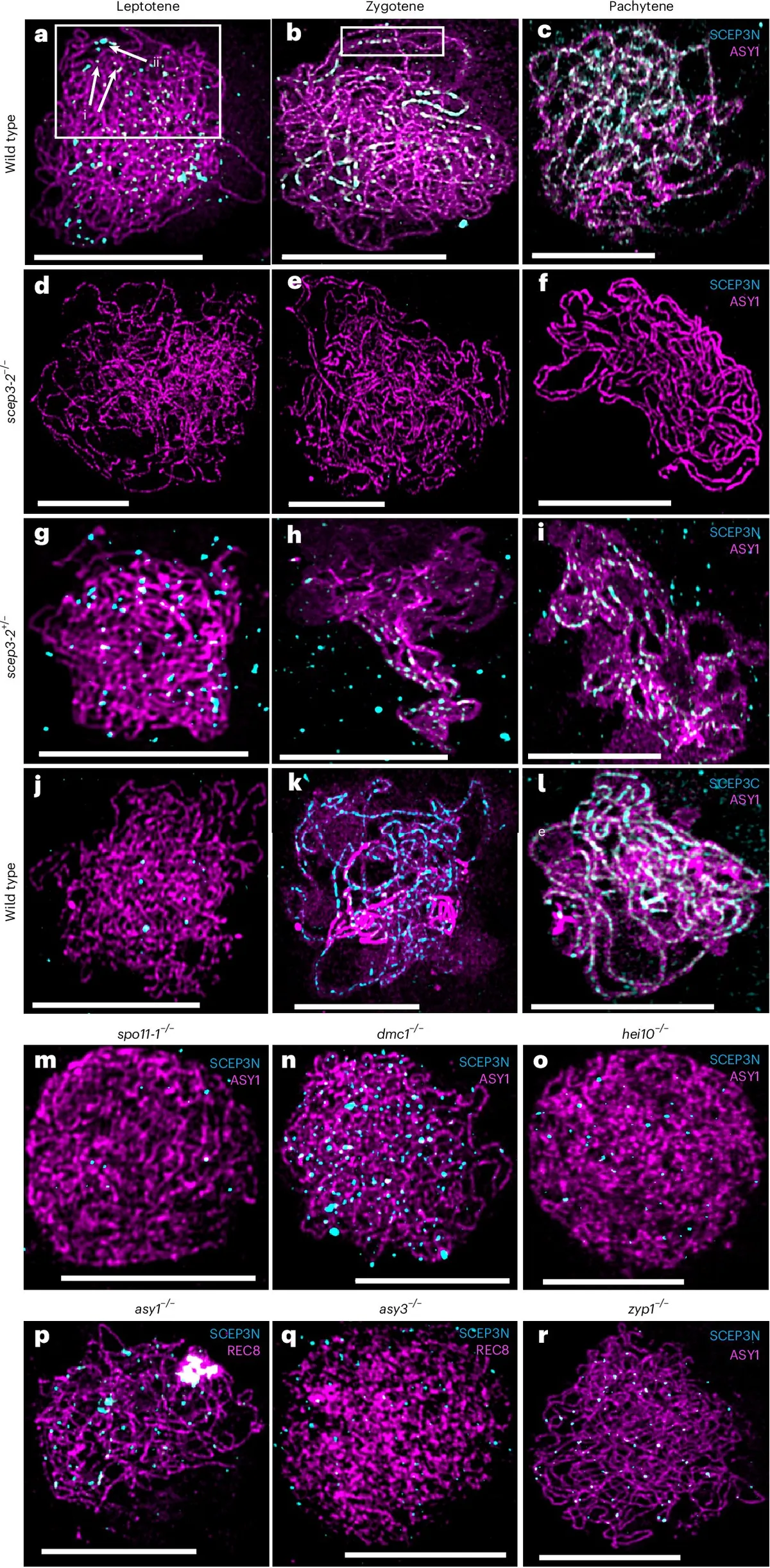
The answer is a protein called SCEP3. In a study published in Nature Plants in 2025, the Leicester team showed that SCEP3 acts like a traffic controller, limiting the number of crossovers on each chromosome pair so there are enough to go around. It's not just regulation — it's fair distribution.
"Crossovers not only ensure that chromosomes are inherited properly from generation to generation, but also exchange DNA between mother and father chromosomes, so that the child has a new, unique combination of genes," explained James Higgins, the lead investigator. That genetic shuffling is why siblings aren't clones. It's also why crop breeders can select for new combinations of traits — better yield, disease resistance, flavor — by working with the natural variation that crossovers create.
The Human Connection
Humans have an equivalent gene: SIX6OS1. The challenge is studying it. When human cells make errors during meiosis, they trigger programmed cell death — a safety mechanism that prevents defective sperm or eggs from surviving. Plant cells, by contrast, keep living even when something goes wrong, which makes them a natural laboratory for understanding the underlying mechanism.
Analyzing SCEP3 in plants strongly suggests that SIX6OS1 does the same job in humans. If mutations in SIX6OS1 disrupt the distribution of crossovers, they could explain some cases of human infertility — a finding that could eventually help researchers develop better diagnostics or treatments.
Meanwhile, the same knowledge applies directly to agriculture. Understanding how to optimize crossover distribution could help breeders create new crop varieties faster, selecting for traits that matter: resilience to climate stress, nutritional density, yield stability. "This knowledge can be used to produce new crop varieties as well as further investigation into human infertility," Higgins noted.
The discovery sits at the intersection of basic science and practical application — the kind of research that starts with a question about how cells divide and ends up reshaping both medicine and food security.



