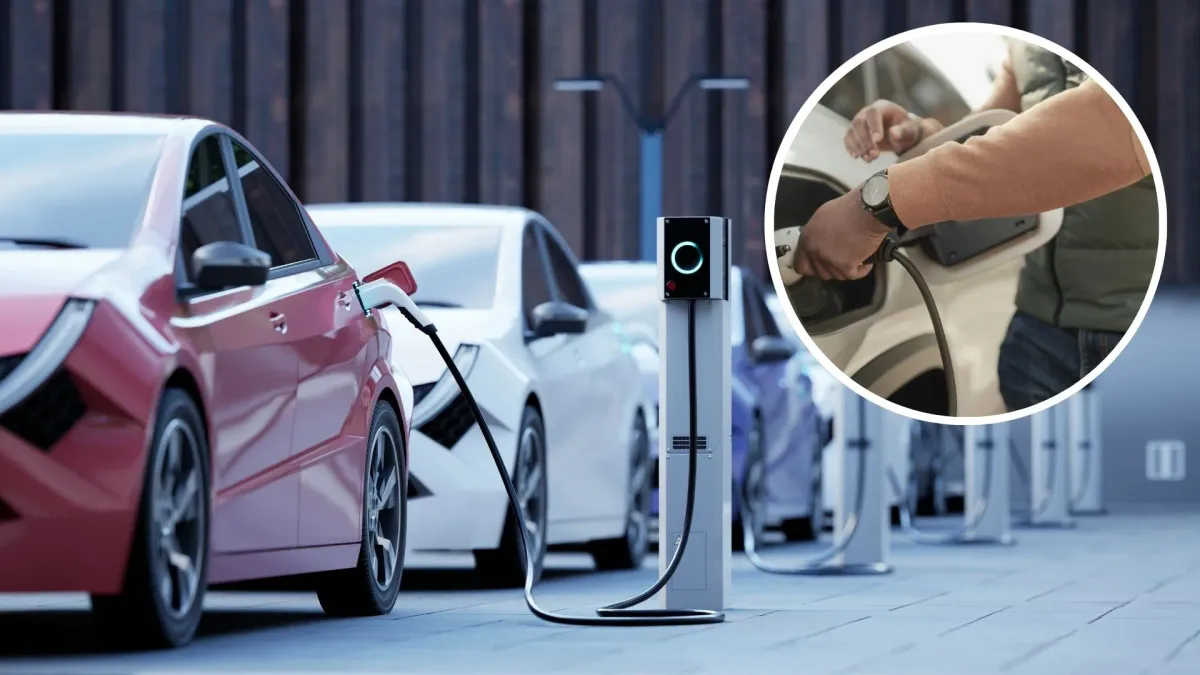
Right now, the biggest reason people hesitate before buying an electric car isn't the price or the driving range — it's the charging time. Waiting 30 minutes at a highway rest stop when a gas fill-up takes five minutes still feels like a compromise. A new research project in Germany is working to change that equation.
Researchers at Dortmund University are leading ODYSSEV, an EU-funded initiative that's testing whether pushing EV charging systems beyond 1000 volts can slash charging times dramatically. The project, which launched in early 2026 and runs for 42 months, is backed by the EU's Horizon Europe program. The name — Optimised Dynamics of High-Voltage Powertrains: Developing Sustainable Systems for Electric Vehicles — is a mouthful, but the concept is straightforward: more electrical pressure means faster energy transfer.
Here's how it works. Higher voltage systems push more power through thinner cables, which saves weight, reduces energy waste as heat, and cuts costs. "High-voltage technologies beyond 800 volts not only enable dramatically shorter charging times, but also lighter vehicles thanks to thinner cables and higher overall efficiency through reduced energy losses," explains Prof. Dr. Markus Thoben, one of the project leads. "This makes electric cars more suitable for everyday use and more attractive to a broad range of buyers."
We're a new kind of news feed.
Regular news is designed to drain you. We're a non-profit built to restore you. Every story we publish is scored for impact, progress, and hope.
Start Your News DetoxBut jumping to 1000 volts isn't simple. The technology pushes conventional silicon semiconductors to their limits, demands new insulation materials, and forces batteries to handle massive energy input without overheating. This is where ODYSSEV's real work begins.
The team is using computer modeling and simulation to test scenarios before building anything physical — a strategy that saves months of trial-and-error. "We contribute our expertise in modeling and simulation to optimize on the computer what will later have to work on the road," says Seyed Saeed Mirsafian, a research associate on the project. "This saves time and costs and makes it possible to test various scenarios before the first prototype is built."
The project spans the entire development chain: new semiconductor designs, high-performance power modules, on-board chargers, traction inverters, and a custom electric motor built for this high-voltage architecture. A reconfigurable battery pack designed to work with the system completes the picture. By late 2029, researchers plan to test a working demonstrator on the LaSiSe test track in Selm, Germany.
If ODYSSEV succeeds, the practical impact is clear: an EV that charges in 15 minutes instead of 30 removes one of the last psychological barriers between skeptics and the showroom. It's not a revolutionary breakthrough — it's engineering solving a real friction point in everyday life.