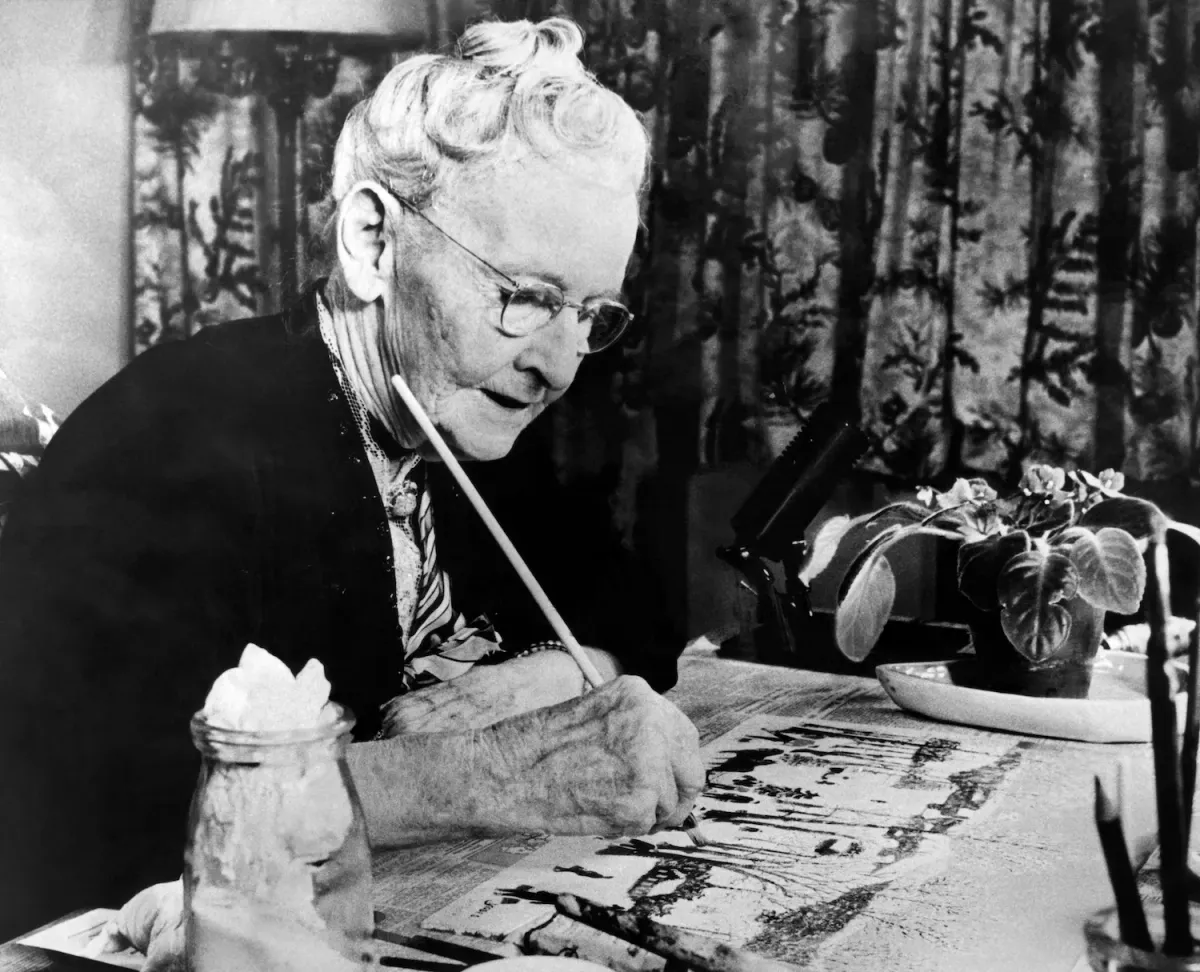
Anna Mary Robertson Moses didn't pick up a paintbrush until she was 78 years old. By the time she died at 101, she'd created over 1,500 paintings that captured something most people didn't know they needed to see: the everyday life of rural America, rendered in vivid detail and warm color, exactly as it was vanishing.
Moses became known as "Grandma" not because the art world called her that, but because audiences did. In the 1930s and 1940s, as America industrialized and urbanized at a pace that left many people disoriented, her paintings offered something like a visual anchor. They showed farmyards and quilting circles, harvest scenes and winter mornings—moments that felt true because they were drawn from her own six decades of farm life in upstate New York. She'd raised five children, run a butter-making business, and watched the world change around her. Then she started painting it.
The art establishment kept her at arm's length. "Primitive" was the word they used, sometimes dismissively. But the public saw something else: a record of a world they were losing, painted by someone who'd actually lived it. During the upheaval of World War II, the Cold War, and the civil rights movement, Grandma Moses's work became a form of comfort—not through denial, but through documentation. She wasn't pretending rural life was perfect. She was saying: this happened. This was real. I was there.
We're a new kind of news feed.
Regular news is designed to drain you. We're a non-profit built to restore you. Every story we publish is scored for impact, progress, and hope.
Start Your News DetoxHer fame eventually surpassed that of many of her contemporaries, a fact that made some in the art world uncomfortable. A self-taught farmer with no credentials, no manifestos, no theoretical framework. Just paintings. Lots of them.
A retrospective looks back
The Smithsonian American Art Museum in Washington, D.C., is currently showing a major retrospective of Moses's work—88 pieces spanning from the late 1930s to 1961, curated by Leslie Umberger and Randall R. Griffey. It's the kind of exhibition that doesn't happen by accident. It's a deliberate act of reclamation, a way of saying: we were wrong to keep her at a distance. The show runs through mid-July before traveling to the Crystal Bridges Museum of American Art in Bentonville, Arkansas, in September.
What makes this moment significant isn't just that museums are finally giving Grandma Moses her due. It's that her work reminds us what documentation looks like when it comes from lived experience rather than theory. In an era obsessed with authenticity, she was the real thing—not performing it, just painting what she knew.