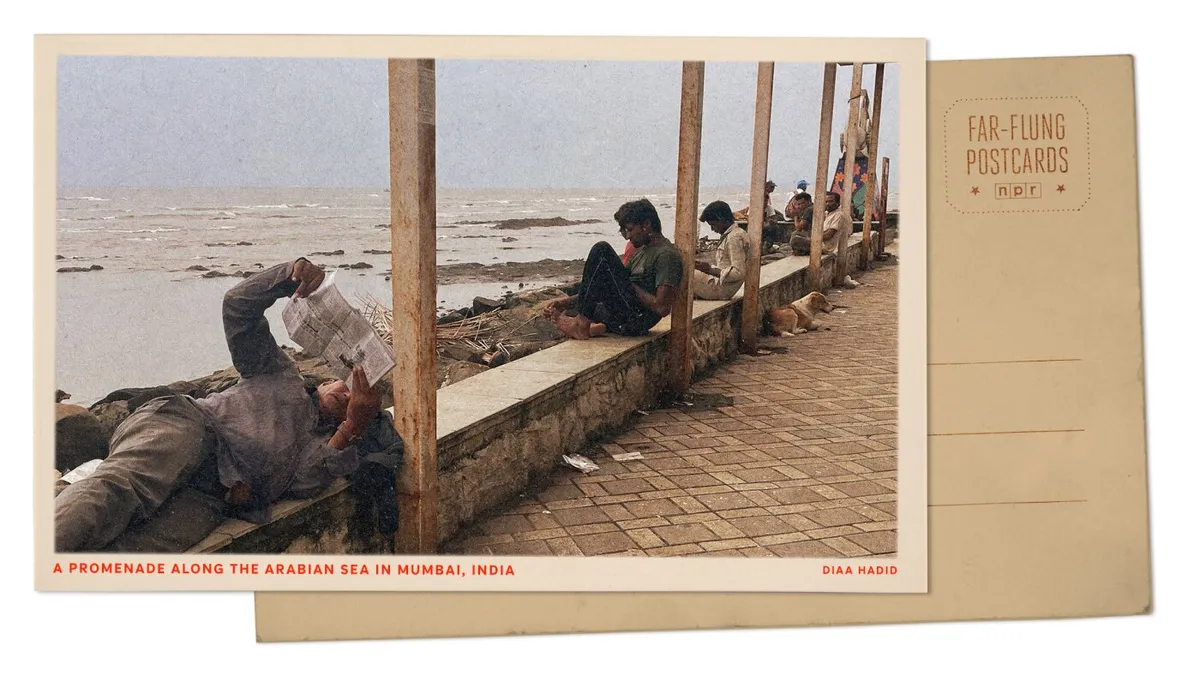
Mumbai is a city of over 18 million people compressed onto a small peninsula, so residents have learned to claim breathing space wherever the city allows it. Often, that means the narrow promenades that edge the Arabian Sea—like the one running along Carter Road, where the late-day breeze offers a few hours of reprieve from the density.
On a recent afternoon, I joined what felt like most of Mumbai doing the same thing: walking slowly, watching the water, letting the air move. What struck me wasn't the crowd, but the texture of it. A man read his newspaper on a bench. A worker slept upright, head tilted back. A mother pushed a pram. A housemaid walked a small, expensive dog. A couple found a quiet corner. A woman in a face veil lifted it briefly to take a photo with a friend. A musician sang—badly, cheerfully—to an audience of one very drunk man swaying nearby.
Each scene felt like a small negotiation with the city: how to find a moment of stillness in a place where stillness doesn't come naturally. The promenades aren't generous with space. They're narrow, crowded, often loud. But they're there, and they're free, and they face the sea.
We're a new kind of news feed.
Regular news is designed to drain you. We're a non-profit built to restore you. Every story we publish is scored for impact, progress, and hope.
Start Your News DetoxIt's true that Mumbai residents deserve more public space than the city actually provides. The math is brutal—18 million people on a peninsula means parks are packed, quiet corners are rare, and the pressure to be productive never fully lifts. And yet, watching this unfolding tapestry of life on these narrow strips of pavement is one of the quiet delights of living in a metropolis this dense. It's not a solution to the city's space crisis. But it's a reminder that sometimes the most human moments happen not in spite of crowding, but within it—in the small gaps where people decide to slow down anyway.