

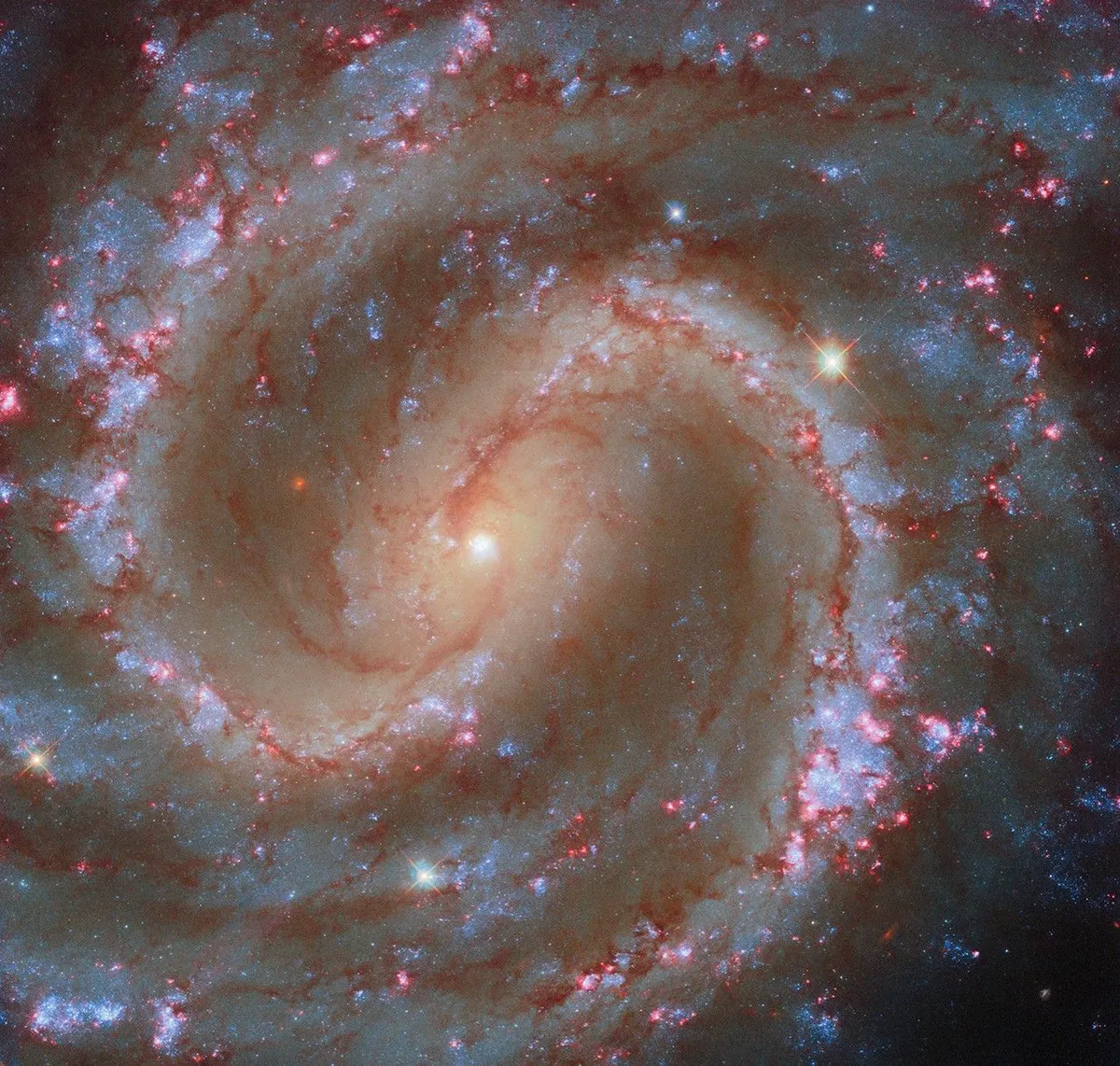
Fifty million light-years away, there's a spiral galaxy so faint that early astronomers called it the 'Lost Galaxy' — it barely registered through small telescopes. But the Hubble Space Telescope, orbiting above Earth's atmosphere with its massive mirror, sees what ground-based observers couldn't: NGC 4535 in vivid detail, its spiral arms traced with brilliant young stars and glowing clouds of gas.
What Hubble is capturing now are the galaxy's star nurseries — regions where new stars are being born. These appear as bright blue clusters dotted along NGC 4535's spiral arms, surrounded by glowing pink clouds called H II regions. The pink glow comes from hydrogen gas being heated and ionized by young, massive stars nearby. These aren't gentle stellar births. The hot young stars are firing powerful winds that shake and compress the surrounding gas clouds, eventually triggering the violent explosions we know as supernovae.

This image is part of something much larger: a systematic effort to catalog around 50,000 H II regions across nearby star-forming galaxies. By mapping where these stellar nurseries are, astronomers are building a clearer picture of how galaxies actually work — specifically, how young stars interact with the cold gas around them. It's the kind of foundational knowledge that sounds abstract until you realize it helps explain why galaxies look the way they do, how they grow, and what shapes their future.
We're a new kind of news feed.
Regular news is designed to drain you. We're a non-profit built to restore you. Every story we publish is scored for impact, progress, and hope.
Start Your News DetoxThe observations come from the PHANGS program (Physics at High Angular resolution in Nearby GalaxieS), which treats galaxies like a detective treats a crime scene: systematic, detailed, and focused on understanding cause and effect. This new Hubble image of NGC 4535 builds on observations from 2021, adding sharper views of the red nebulae surrounding those massive young stars — details that only improve as telescope technology advances.
What's striking is how a galaxy once considered too faint to study properly is now revealing its inner workings in unprecedented detail. As Hubble and other telescopes continue mapping these star-forming regions, we're moving from wondering if we could see these distant galaxies clearly to asking much harder questions about how they work.



