

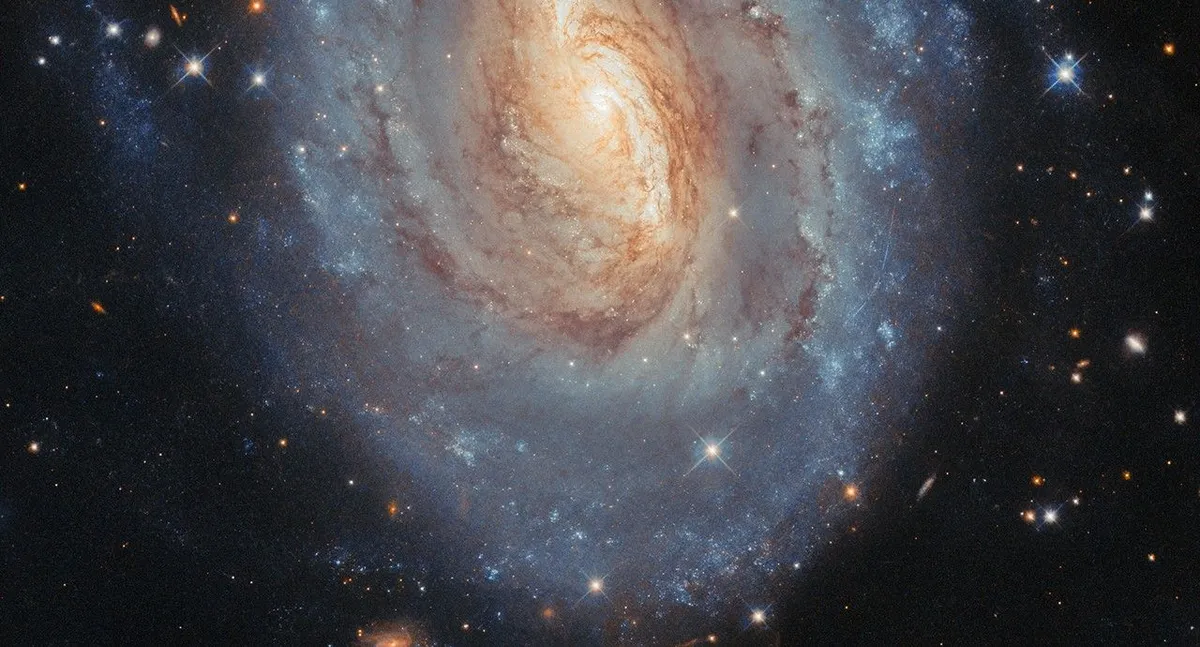
A spiral galaxy 102 million light-years away is showing us something we can't see in our own backyard: what happens when a galaxy grows old.
NGC 6000, nestled in the constellation Scorpius, is a living timeline. Its heart glows yellow—a sign of older, cooler stars clustered together over billions of years. But venture outward along its spiral arms and the galaxy transforms. There, brilliant blue stars dominate, massive and young, burning hot enough to paint entire regions in electric blue. It's the same story told in color: age moves inward, youth spirals outward.
The Hubble Space Telescope captured this portrait while hunting for something more violent: the aftermath of supernovae. NGC 6000 has hosted two in recent memory—one in 2007, another in 2010. Years after those catastrophic explosions, Hubble's sensitive detectors can still pick up their faint afterglow, like embers from a fire that burned out long ago. This matters because those embers tell a story. By measuring how bright they remain, researchers can work backward to figure out what kind of star exploded in the first place—its mass, its temperature, whether it had a companion star orbiting nearby. Each supernova becomes a cosmic puzzle that helps us understand stellar death.
We're a new kind of news feed.
Regular news is designed to drain you. We're a non-profit built to restore you. Every story we publish is scored for impact, progress, and hope.
Start Your News DetoxReading a galaxy like a clock
What makes this image particularly valuable is how clearly it shows stellar age written in color. The yellow core isn't just pretty—it's evidence. Older stars are smaller and cooler, which shifts their light toward the red end of the spectrum. Younger stars are massive furnaces, burning so intensely they emit blue light. By studying these color differences across a galaxy, astronomers can map out where stars formed and when, building a timeline of the galaxy's own biography.
The image also captured an unexpected visitor: an asteroid drifting through Hubble's field of view. The four dashed lines you see—alternating in color—are actually the same asteroid, recorded four separate times as Hubble took multiple exposures using different light filters. It's a reminder that even when we're looking billions of miles away, our own cosmic neighborhood is constantly moving through the frame.
Galaxies like NGC 6000 are becoming clearer with each observation, revealing patterns in how stars live and die across the universe. The more we understand distant galaxies, the better we understand our own Milky Way's past—and its future.



