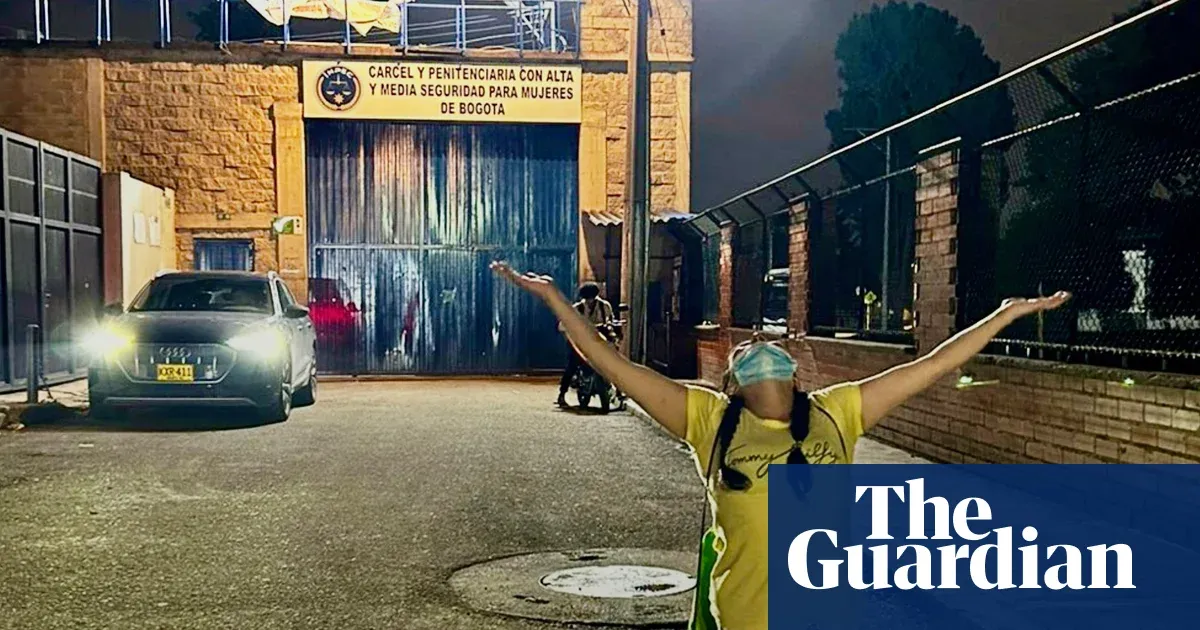
Jennifer Chaparro Pernet heard the commotion before she saw the gates open. It was 6pm on 4 May 2024 when guards called her name at El Buen Pastor women's prison in Bogotá. She walked out with a small bag of clothes while fellow inmates banged, cheered, and stomped — four years into a 12-year sentence, suddenly free.
She was the first woman released under Colombia's 2023 Public Utility law, which allows first-time female offenders who are heads of households to serve their remaining sentence in the community instead. At the prison gates, she fell to her knees. "I was overwhelmed, I could hardly believe it," she told reporters. "God exists, it's a miracle."
Chaparro Pernet had applied three times before her approval came through. She'd learned not to hope too loudly, instead focusing on maintaining a clean record. Her cellmates didn't believe it was real until she was gone.
We're a new kind of news feed.
Regular news is designed to drain you. We're a non-profit built to restore you. Every story we publish is scored for impact, progress, and hope.
Start Your News DetoxThe path to prison
Chaparro Pernet began stealing at 15 when she became a single mother. By 27, gang affiliation earned her an 18-year sentence, reduced to 12 on appeal. She doesn't want to detail her crimes, but her story echoes across Colombia's prisons: more than 6,000 women are incarcerated, roughly half for drug offences. Many turned to the drugs trade out of desperation—a way to feed their families when other options ran out.
Sandra Julieth Cantor was released 10 months after Chaparro Pernet. She'd served five years of a 10-year sentence for drug smuggling. At 20, she became a single mother and turned to sex work. When that dried up during the pandemic, a boyfriend introduced her to smuggling. She planned to stop once she'd saved enough for college, but one more job led to her arrest—carrying 6,055 grams of cocaine. She remembers the exact figure because those 55 grams pushed her into a harsher sentence bracket.
In prison, Cantor shared a cell with five other women, two sleeping on the concrete floor. "My apartment was one of the prettiest cells," she said, describing the curtains she'd hung. But prettiness couldn't mask the lack of privacy, the rotten meat, the gastro issues that followed her out.
For both women, the strongest pull wasn't escaping those conditions. It was their children. Chaparro Pernet lost contact with her two daughters while inside. Cantor's family convinced her nine-year-old not to ask where she'd gone—a lie that nearly cost the girl her life.
A slow start, but a beginning
Since the law took effect, 216 women have been released. No electronic tags, but 20 hours weekly of voluntary service and regular check-ins with a judge. Campaigners who fought for the law call it progress, though not the progress they'd hoped for. Isabel Pereira, drug policy coordinator at Dejusticia, a Colombian think tank, had expected at least half of the 6,000 women—roughly 3,000—to be released within two years. "Two hundred is very disappointing," she says.
Part of the problem is inconsistency. Some judges apply strict criteria, others more lenient. Many women don't know the law exists. And even when released, the real barriers begin.
Claudia Cardona, a former prisoner who runs Mujeres Libres and helped develop the law, sees it differently. "Every woman who is now free and with her family matters. For us, it is significant." But she and Pereira agree on what's missing: integrated support. Women leave prison to face stigma, no job prospects, broken family ties, and ongoing violence. Without coordinated help from justice, education, work, and health ministries, freedom alone isn't enough.
Finding solid ground
Chaparro Pernet found work in a restaurant through a separate Second Chances scheme, but it was temporary. Nearly two years after release, she still has no secure job. What keeps her steady is the Accíon Interna Foundation, a non-profit founded by Johana Bahamón.
Bahamón was a successful actor until 2012, when a prison tour changed everything. She saw women stripped of freedom and dignity. "You can be deprived of your freedom but you don't have to be deprived of your dignity," she decided. She started with what she knew: drama. A workshop led to rehearsals, then a performance of García Lorca's The House of Bernarda Alba. "When I watched these 12 women performing—they had a glow in their eyes, with hope—I thought, this is what I want to do."
In 2016, Bahamón opened Colombia's first prison restaurant open to the public. A woman who left in 2019 told her she wished she could go back because at least she had work there. That sparked the Second Chances programme in 2019, and later, Bahamón campaigned for the Public Utility law itself.
Today, Chaparro Pernet and Cantor attend foundation courses hoping to find stable work. Cantor wants to become a hairdresser. Chaparro Pernet wants "a good job to provide a stable income for my family." Camilo Higuera, the foundation's communications director and himself a former prisoner, watches them fight to leave the past behind. "They are the epitome of why you need to give someone a second chance," he says. "They only think about their family."
The next phase will determine whether 216 releases become 2,000. It depends on whether Colombia's government builds the infrastructure to help women not just survive outside prison, but rebuild with dignity.