

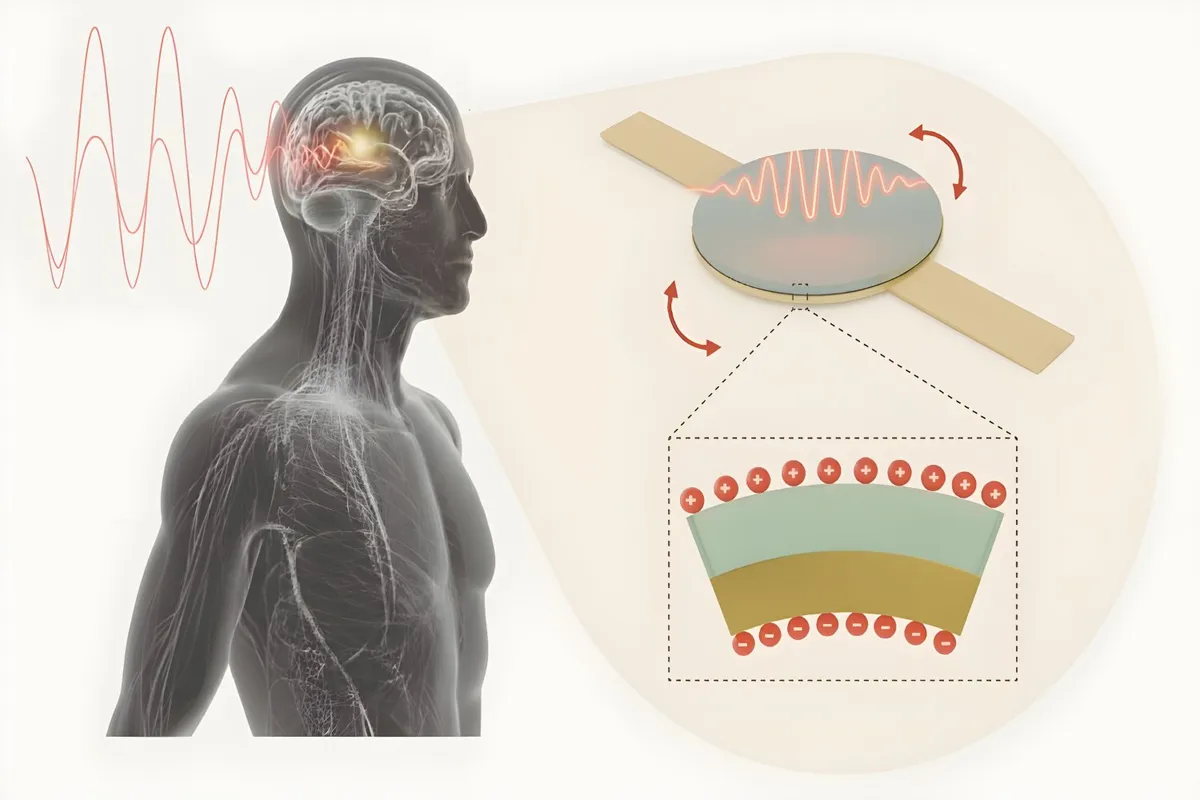
A team at MIT has built something smaller than a grain of sand that might change how we power the medical devices living inside us. This injectable antenna — just 200 micrometers across — can wirelessly deliver electricity to pacemakers, epilepsy monitors, and other implants buried deep in tissue, without the need for periodic surgery to replace batteries or the tissue damage that comes with current wireless methods.
Today's deep-tissue implants face a difficult choice. You can surgically place a battery inside the body, but then you're committing to repeat surgeries every few years when it dies. Or you can use a magnetic coil that harvests power wirelessly — but only at high frequencies, which heats surrounding tissue and limits how much power you can safely send to tiny devices. "After that limit, you start damaging the cells," says Baju Joy, a PhD student leading the work.
A Different Kind of Antenna
The new antenna sidesteps this problem by operating at much lower frequencies (109 kHz) using a clever two-layer approach. A magnetostrictive film deforms when exposed to a magnetic field, and a piezoelectric layer underneath converts that deformation into electrical charge. The result: the antenna transforms a magnetic field into usable power without the heating risk.
We're a new kind of news feed.
Regular news is designed to drain you. We're a non-profit built to restore you. Every story we publish is scored for impact, progress, and hope.
Start Your News Detox"We are leveraging this mechanical vibration to convert the magnetic field to an electric field," Joy explains. The antenna delivers 10,000 to 100,000 times more power than similar-sized coil-based antennas operating at higher frequencies — a massive jump that opens doors for more power-hungry implants.
The external power source is simple: a small patch or pocket-sized device, essentially a wireless phone charger for your implants. Because the antenna is made using standard microchip fabrication, it slots seamlessly into existing electronics. The whole system — antenna plus circuitry — fits through a needle.
Deblina Sarkar, who heads the research group, sees the implications rippling outward. "Our technology has the potential to introduce a new avenue for minimally invasive bioelectric devices that can operate wirelessly deep within the human body." Beyond pacemakers and seizure monitors, glucose sensors already exist that could finally work non-invasively inside the body if they had reliable wireless power. Multiple antennas could be injected to treat large areas, and manufacturing can scale up easily.
The antenna represents a shift in how we think about implants — from batteries that run down to systems that draw power on demand, wirelessly, safely, from outside the body. The first clinical applications are still years away, but the technical hurdle that's blocked this approach for decades just got smaller.



