

Someone just solved a problem

Justin Bieber's producer, Poo Bear, has a live songwriting battle with AI: 'We're always going to need humans'

29 min readGood Good Good
Atlanta, Georgia, United States
Justin Bieber's producer, Poo Bear, has a live songwriting battle with AI: 'We're always going to need humans'
48
...
0

The average TED Talk usually includes a well-coiffed expert, a compelling slideshow, and perhaps a few chuckles from a rapt audience.But at TEDNext in Atlanta, Georgia this week, Jason Boyd — better known by his producer alias Poo Bear — got a little experimental.The R&B and pop hit producer, who is behind titles like Bieber's “Yummy,” and “What Do You Mean?” joined Elise Hu, host of the TED Talks Daily podcast, for a conversation about songwriting in the age of artificial intelligence.Host Elise Hu and Poo Bear speak at TEDNext in Atlanta, GA. Photo: Ryan Lash / TEDBoyd made some points about the need for human artistry to evolve alongside technological advancements, while still maintaining the soul of people-generated creativity.

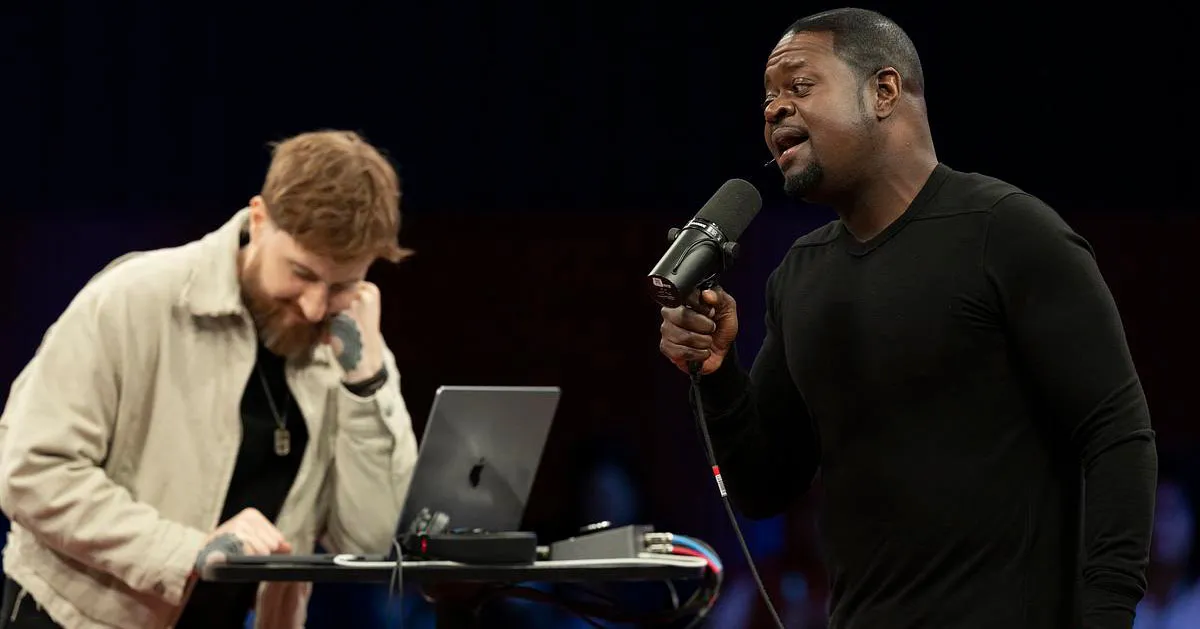
But, ultimately, he found it more compelling to show instead of tell.What followed a sit-down conversation-style TED Talk was a demonstration in which Boyd was joined by a guitar accompanist to battle an AI songwriting platform called Suno, which tells users to “make any song you can imagine.”“I’m going to battle the digital version of myself,” Boyd said. Poo Bear performs at TEDNext in Atlanta, GA. Photo: Ryan Lash / TEDThe producer would make a hook and a post-hook to a pop song and then prompt Suno to make a “Poo Bear hook” of its own.“We’ll see which moves you the most,” he told the audience.

“And if it beats me, that’s fine. I’m OK with it.”Much like an improv show, he asked members of the audience to call out suggested themes for what he’d write about. He landed on the concept of “starting over.”Soon, a hit song seemed to unfold in front of TEDNext attendees’ eyes. Over a simple acoustic chord progression, Boyd began layering a melody, crooning some “oh no”s and “mm”s, followed by the hook: “Are we starting over?

Should we be starting over?” He re-recorded it a couple of times, as the guitar backing played on a loop, and his assistant captured his lyrics with ease.“This is really how it happens in the recording studio, guys,” he told the crowd, followed by directions to “punch up” or take another stab at a phrase in the tune.He continued into the song.“I don’t wanna be let down / you don’t wanna be let down,” he sang, coming up with lyrics on the spot. “Should we take the time and turn this back around?” Just five minutes into the exercise, he was crafting a post-hook, with some “ooh” and “yeah” chants characteristic of a Bieber hit.

His soulful singing voice seemed to surface without any effort at all, but also carried the rasp and imperfection of live performance. In a word, it felt human.He admitted his vulnerability, too, even to cheers and claps from the audience. “This is real time, this is tough, guys. Suno’s in there warming up, doing push-ups in there right now,” he joked about the AI platform, which would soon follow him.Poo Bear performs at TEDNext in Atlanta, GA.

Photo: Ryan Lash / TEDOnce he felt confident in his contribution, about seven minutes into the experiment, he and his collaborator prompted Suno to give listeners a Poo Bear hook about “starting over.”“This was way quicker than what I just did,” Boyd quipped after the computer said it had generated a response under 30 seconds.Soon, a new voice echoed through the room, eerily similar to Boyd’s. It played a slower, sadder rendition of the same “should we be starting over?” lyric, but quickly followed up with some creative liberties: “Chasing what we lost in the clover.”Audience members hooted, some looked around, surprised by how much they liked what they heard.

Poo Bear performs at TEDNext in Atlanta, GA. Photo: Ryan Lash / TED“The cracks are wide but the heart’s still sober,” the AI version of the song sang. “Should we try? / When the echoes don’t lie?

/ Should we be starting over?” Soon, the impressed hoots dissipated into giggles. “That was the digital version of me,” Boyd said. “It didn’t really make a lot of sense, but it’s okay.”Then he asked to “play back the Poo Bear Human Soul Experience.”The audience listened closely, and when he said, “I’ll let you guys decide,” everyone shouted in unison: “Poo Bear!” followed by claps, cheers, and a standing ovation.TEDNext attendee Tracy Egbas was in the crowd.

As a podcast producer, she is familiar with the work it takes to captivate a listening audience. “I was truly shocked at the quality of the AI version. There were even cracks in the voice of the AI version that seemed to simulate emotion. I didn’t expect anything near the level that it delivered,” Egbas told Good Good Good.But — there was still something about Boyd’s version that stood out to her.“In terms of lyrical expression and the actual meaning of the song, it felt a little all over the place,” she said of the AI version, “which is where the really real Jason dominated.

He understood what he was singing and why.”Poo Bear performs at TEDNext in Atlanta, GA. Photo: Ryan Lash / TEDWhat Boyd illustrated in his demonstration, and what it seems other human creatives took away from it, is that AI has a place in creative endeavors, but manufactured perfection can never replace human vulnerability.“I hope this proves that we are still always going to need humans,” Boyd said at the end of his experiment.

“We should be able to adapt. We have to adapt. Let’s not count [AI] out. But let’s incorporate human soul forever.” ‍Editor’s Note: TED Talks and conversations from TEDNext will be released at a later date and will be embedded in this story when they become available to the public.‍‍You may also like: Lucasfilm on AI: ‘We need to use these tools thoughtfully and with the full permission of the talent’‍Header image: Ryan Lash / TED

Brightcast Impact Score (BIS)

36/100Minimal

The article showcases a positive and innovative approach to the integration of AI and human creativity in the music industry. It highlights the need for human artistry to evolve alongside technological advancements, while maintaining the soul of people-generated creativity. The live songwriting battle between Poo Bear and the AI platform Suno demonstrates the potential for collaboration and the continued importance of human input in the creative process.

Hope Impact12/33

Emotional uplift and inspirational potential

Reach Scale12/33

Potential audience impact and shareability

Verification12/33

Source credibility and content accuracy

Limited positive elements

Comments(0)

Join the conversation and share your perspective.

Sign In to Comment
Loading comments...

Get weekly positive news in your inbox

No spam. Unsubscribe anytime. Join thousands who start their week with hope.

More stories that restore faith in humanity

Australia activates 1.6 GWh energy storage facility with 444 Tesla Megapacks
Innovation
2 wks ago
Mark Elder: Building the Future of Spacewalking for Artemis and Beyond
Innovation
3 wks ago
US engineers develop 3D chip that offers order-of-magnitude speed gains, accelerates AI
Innovation
1 wks ago
