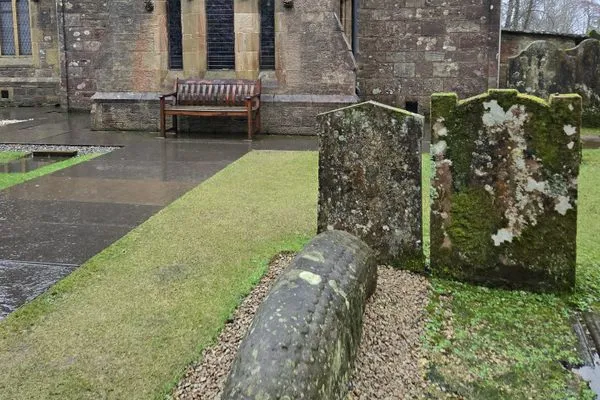
In the shadow of a Victorian church in Luss, Scotland, an 11th-century Norse grave marker sits among weathered headstones—easy to miss if you're not looking for it. The curved stone, known as a hogback, was carved to resemble a miniature Viking longhouse, a "stone hall for the dead" meant to guide a Norse soul to Valhalla. It's one of the few physical traces left by the Viking raiders who once moved through these waters with purpose and fear.
Hogback stones are themselves a mystery. They appear nowhere in Scandinavia, only in Britain—concentrated in areas where Norse traders and settlers left their mark along routes connecting York to Dublin. The Luss stone sits along the Forth-Clyde corridor, a waterway the Norse knew intimately. Whether it was carved for someone who died during King Haakon IV's 1263 invasion (when Norwegian forces sailed up Loch Long and dragged their longships overland to attack settlements on Loch Lomond) or for an earlier Norse settler remains unknown. The stone keeps its secrets.
What we do know is visible in its details. The distinctive shingled roof ridge and faint interlace carvings mark it unmistakably as Viking work—skilled hands shaping stone to honor their dead. After being unearthed in 1926, the stone spent decades slowly disappearing beneath moss and time. A 2015 restoration brought its ornate details back into view. Now raised on a small gravel plinth, it offers something rare: a direct line to a moment when dragon-prowed ships haunted these waters, when Norse culture was woven into the landscape of Scotland.
We're a new kind of news feed.
Regular news is designed to drain you. We're a non-profit built to restore you. Every story we publish is scored for impact, progress, and hope.
Start Your News DetoxThe stone's survival itself feels significant. It's easy to think of Viking history as something distant, recorded only in sagas and place names. But here, in a quiet churchyard, is the actual hand-carved memorial of someone whose name we'll never know, placed with care by people who believed in an afterlife and wanted to mark that belief in stone. That act of remembrance—crossing centuries and cultures—is what makes it worth the moss and the weather.