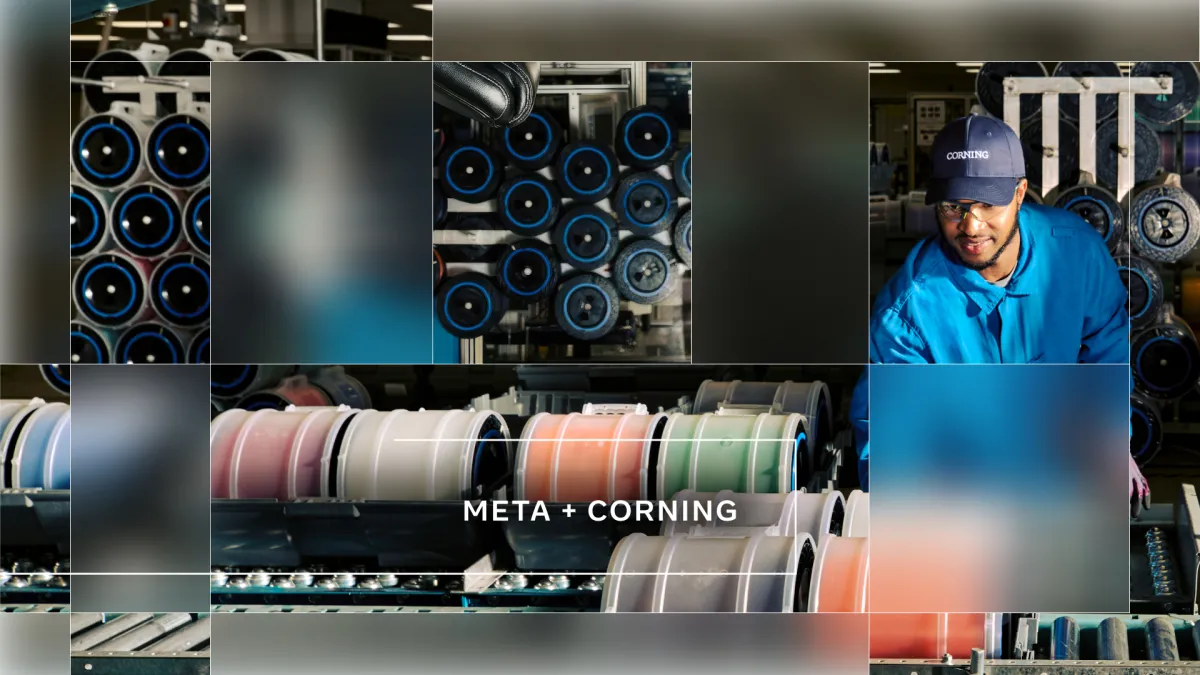
Meta just signed a $6 billion multi-year deal with Corning to supply fiber optic cables for its data centers — the kind of infrastructure decision that usually stays buried in earnings calls. But this one has a ripple effect: Corning is expanding manufacturing in North Carolina, adding 750 to 1,000 new jobs to a workforce that already tops 5,000 across two of the world's largest optical fiber facilities.
Here's why this matters beyond the headline. Data centers run on fiber optic cables — they're the physical threads that move information between servers in near real time, powering everything from AI models to the Ray-Ban smart glasses Meta released last year. Building that infrastructure domestically, rather than sourcing it globally, is a bet on something that's become increasingly strategic: keeping advanced manufacturing rooted in the US.
Corning will expand its operations at the Trivium Corporate Center in Catawba County, North Carolina, one of two major optical fiber manufacturing hubs the company operates there. The company expects to grow its North Carolina workforce by 15 to 20 percent — skilled positions for engineers, production technicians, and scientists, not just assembly line work.
We're a new kind of news feed.
Regular news is designed to drain you. We're a non-profit built to restore you. Every story we publish is scored for impact, progress, and hope.
Start Your News DetoxMeta's data center footprint tells its own story. The company has 26 facilities under construction or already operational across the US. During construction alone, these have supported 30,000 skilled trade jobs — electricians, HVAC specialists, network technicians. Once operational, they sustain around 5,000 permanent positions. Add Corning's expansion, and you're looking at a supply chain that's becoming harder to offshore.
The timing isn't accidental. As AI demand accelerates — healthcare systems, financial institutions, agricultural tech all need fiber connectivity to run — the US is trying to avoid a repeat of earlier tech cycles where manufacturing capacity migrated elsewhere. "Strengthening domestic supply chains" is corporate-speak, but it's also a real constraint that governments and companies are now treating as a competitive advantage.
What comes next is less certain. This deal locks in US manufacturing for Meta's immediate needs, but fiber optic cable is a commodity market. Whether other companies follow Meta's lead, or whether this becomes a one-off partnership, will shape whether North Carolina's manufacturing renaissance sticks around.