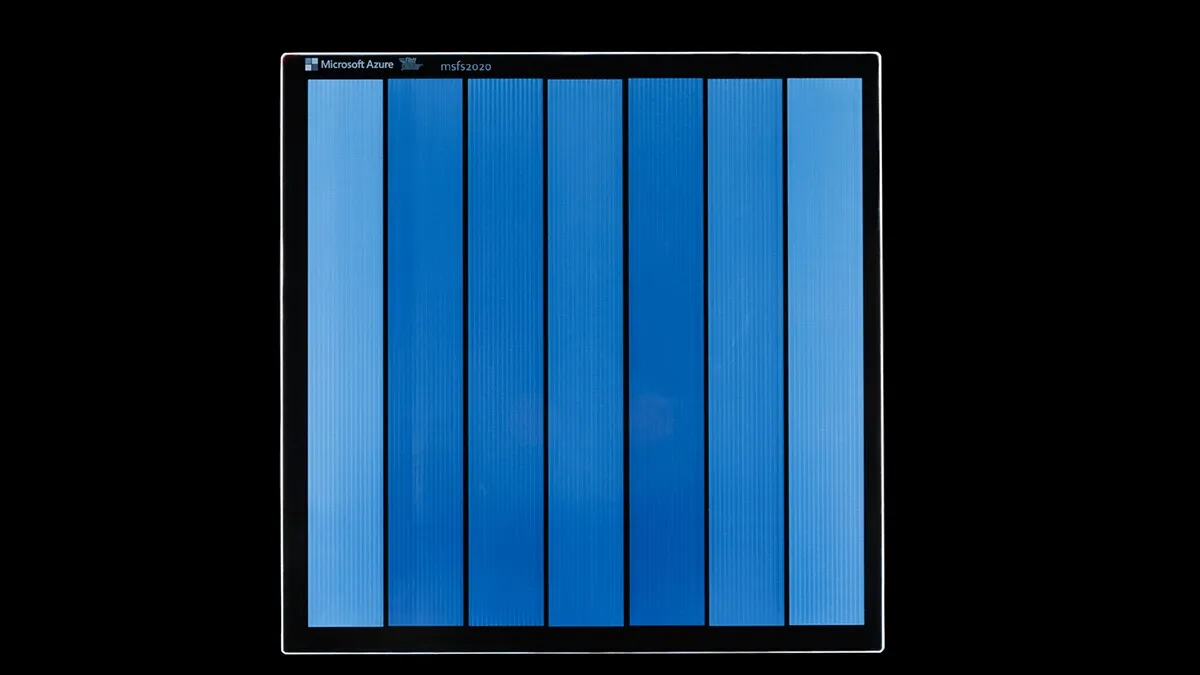
For a decade, Microsoft has been encoding data into glass using lasers and light—a method that preserves information for 10,000 years or more, far outlasting the magnetic tape and hard drives that degrade within a decade.
The breakthrough isn't flashy: they've figured out how to use the same borosilicate glass that lines your oven, instead of expensive fused silica. That shift changes everything about whether this actually becomes real.
Project Silica, as Microsoft calls it, works by using a femtosecond laser to create permanent marks deep inside the glass—tiny 3D pixels called voxels that physically alter the glass structure. Because the data is literally etched into the material itself, it doesn't fade or corrupt. It resists water, temperature swings, and magnetic interference that would destroy a hard drive in minutes. To verify the longevity claim without waiting millennia, researchers bake the glass at 554°F to simulate thousands of years. The data stays intact.
We're a new kind of news feed.
Regular news is designed to drain you. We're a non-profit built to restore you. Every story we publish is scored for impact, progress, and hope.
Start Your News DetoxMicrosoft has demonstrated the concept before: they stored the 1978 film Superman on a coaster-sized glass slide in 2019. By 2023, they'd expanded capacity a hundredfold, from 75 GB to 7 TB. But those earlier versions relied on expensive materials and complex encoding. The latest method, published in Nature this week, changes the approach entirely.
Instead of creating needle-like structures in the glass through a two-step process, the new "phase voxel" method uses a single laser pulse to slightly alter how light travels through the glass. The tradeoff is lower storage density—a 120-millimeter square piece now holds just over 2 TB—but the writing process becomes simpler and cheaper. Machine learning handles the decoding, filling in gaps even when tiny imperfections exist in the glass or the writing process.
The practical advantage matters more than the technical elegance. By using kitchen-grade glass, the cost of manufacturing storage media plummets. The team also engineered the laser to write thousands of dots simultaneously instead of one at a time, and they've built in real-time calibration using the light flashes that occur during writing. These aren't minor tweaks—they're the difference between a lab curiosity and something that could actually scale.
The application space is obvious: medical archives that need to survive centuries, scientific datasets that matter to future researchers, AI training data that shouldn't depend on electricity, media libraries from publishers. Data centers currently rely on tape and hard drives that require power, cooling, and periodic replacement. Glass requires none of that.
Real-world deployment still faces obstacles. The cost of writing and reading data needs to drop further. Finding specific information among zettabytes of data stored in small glass pieces requires new indexing systems. But the shift from exotic materials to ordinary borosilicate glass suggests Microsoft is moving from "interesting research" to "something we might actually use." That's the kind of progress that matters.