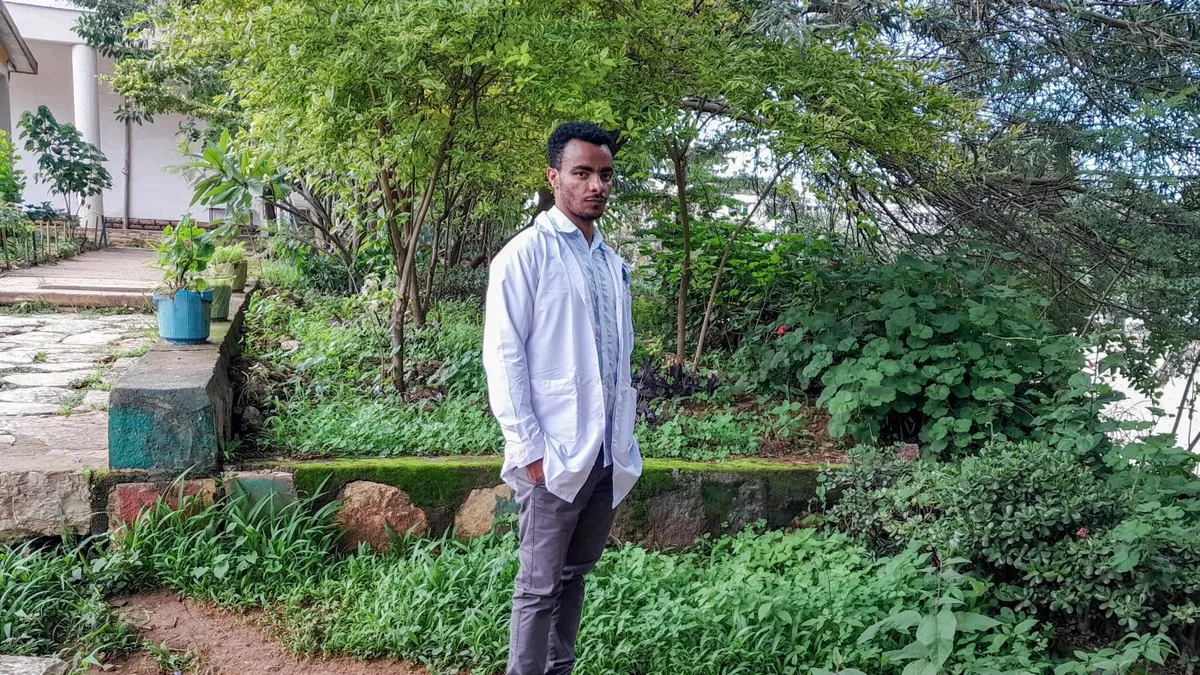
Imagine being ten years old, watching your mother bleed out at home after giving birth, while a traditional birth attendant — with "minimal training," a detail that feels particularly sharp in hindsight — suggests she might just be having twins. That was Dawit Tamiru's reality in Ethiopia. His mother, a street vendor, had delivered his younger sister, but the placenta hadn't followed. The attendant waited. Dawit watched. He prayed.
"She was gasping and having difficulty," he recalls. It's the kind of memory that sticks, the helplessness of a child facing a medical crisis. A cousin finally pushed them to a hospital. The next morning, Dawit’s mother was safe. He asked who saved her. The answer? Midwives.
And just like that, a career was born.
From Crisis to Calling
Dawit Tamiru didn't just feel inspired; he felt a calling. Today, he's an assistant professor of midwifery at Haramaya University and leads its School of Midwifery at Hiwot Fana Comprehensive Specialized Hospital. He now understands his mother was on the brink of death from postpartum hemorrhage, a fate a skilled midwife deftly averted.
We're a new kind of news feed.
Regular news is designed to drain you. We're a non-profit built to restore you. Every story we publish is scored for impact, progress, and hope.
Start Your News DetoxHis story isn't an isolated incident. Research from February 2026 by the World Health Organization (WHO) found a staggering shortage of nearly one million midwives globally. Africa alone accounts for 47% of this gap. Let that sink in: almost half a million missing professionals in one continent. Yet, countries like Ethiopia are fighting back.
Geeta Lal, who coordinates the global midwifery program at the UN Population Fund, points to Ethiopia as a success story. In 2008, the country had just over 1,000 midwives. Today? More than 20,000. "Progress has been huge," she says, noting a "growing conviction" that these models of care actually work. Which, if you think about it, should be obvious when a 2020 study in The Lancet Global Health predicted that enough midwives could prevent 67% of maternal deaths, 64% of newborn deaths, and 65% of stillbirths. That's over four million lives saved annually.
Dawit isn't just teaching; he's campaigning. He plastered posters in high-traffic areas, spoke at schools and community gatherings, anywhere people would listen, all to champion maternal and newborn health and the essential role of midwives. May 5th, International Day of the Midwife, rallied around the theme: "one million more."
Changing Tides, New Challenges
He's seen the shift firsthand. As midwife numbers soared, severe maternal complications became less common in urban hospitals. "The change feels obvious and it is visible," he says. "It is becoming more uncommon to see mothers dying in delivery or because of pregnancy complications." A quiet revolution, if you will.
But the shortage persists, especially in Ethiopia's 80% rural landscape. Many trained midwives gravitate towards cities, leaving remote areas underserved. Dawit believes incentives are crucial to lure them to the harder-to-reach places. Because apparently, saving lives isn't always enough motivation without a little extra push.
And while midwifery is often stereotyped as a female profession, Dawit believes skill, knowledge, and compassion are the only prerequisites. In his current class, it's a 50/50 split between men and women. When he was a student, men were actually the majority. He notes that male midwives face no mistreatment; they're simply seen as medical professionals. Because, you know, they are.
Then came the gut punch: U.S. foreign aid cuts in early 2025. Dawit calls it "very disastrous." Projects were axed, and crucial drugs, like those preventing fatal complications for Rh-negative mothers, became scarce. "It's quite challenging to be honest," he says, a masterclass in understatement given the life-and-death stakes.
When Dawit told his mother he wanted to follow in the footsteps of the people who saved her life, she was overcome with pride. "I believe mothers are the pillar of the house, the pillar of the family and the pillar of the community," he says. It's a belief that anchored him, ensuring he never doubted his path. Which, for the millions of mothers and babies whose lives could be saved, is a pretty good outcome.