
Walk through Modern Art Foundry in Astoria, Queens, and you're walking through the physical history of American sculpture. Since 1932, this place has been quietly essential—the workshop where artists bring their visions to be cast in bronze, where Louise Bourgeois's spiders took shape, where José de Creeft's Alice in Wonderland monument was born before it arrived in Central Park.
Three generations of Springs have run the foundry. John founded it in 1932, passed it to his son Robert, and now Jeffrey Spring—John's grandson—oversees the operation. The philosophy has stayed consistent across all of them: get out of the artist's way. "It's their work, and our job is to move their work to give them what they want, with the knowledge that we have and the services we provide," Jeffrey explains. The team offers thoughts only when asked. This restraint, this respect for the artist's vision, is what built trust.
That trust became most visible through the foundry's relationship with Louise Bourgeois. She became their largest client by volume, working with them continuously from the early 1980s onward. Walk the foundry floor today and you'll still see her work—some pieces in progress, others being repaired. Her presence is woven into the place.
We're a new kind of news feed.
Regular news is designed to drain you. We're a non-profit built to restore you. Every story we publish is scored for impact, progress, and hope.
Start Your News Detox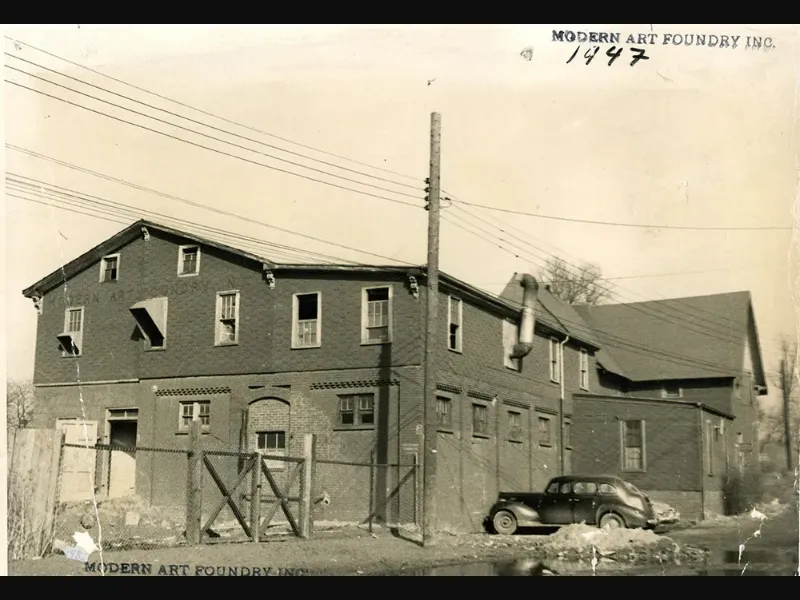 Image: Courtesy Modern Art Foundry
Tradition meets precision
Modern Art Foundry specializes in lost-wax casting for non-ferrous metals, primarily bronze. The process is ancient, but the tools have evolved. 3D scanning and printing have expanded what's possible—artists can now submit fragile originals in terracotta or other delicate materials, which the foundry scans and prints in resin for casting. The original never gets damaged. It's a practical marriage of old technique and new technology.
The foundry works with "European" or "statuary" bronze, a specific alloy that produces a distinct appearance compared to more common silicon bronze. These technical choices—the kind of bronze, the casting method, the finishing—accumulate into the final piece the artist and the world see.
 Image: Maximilíano Durón/ARTnews
Their client list reads like a survey of American and contemporary art: Jacques Lipchitz and Maria Martins from the modernist era, and now Wangechi Mutu, Lynda Benglis, Ali Banisadr, and Leilah Babirye. The foundry has adapted to each generation's needs while holding onto what made it essential in the first place.
When Robert Spring died in 2020, Jeffrey didn't just inherit a business—he inherited a responsibility. In 2021, he established the Modern Art Foundry Foundation to preserve the company's archives and history. He also created the Robert J. Spring Endowment for Sculptors, providing grants to working artists. It's a way of acknowledging that foundries don't just cast metal; they hold the conditions that allow sculpture to exist.
Ninety-two years in, Modern Art Foundry remains what it's always been: the place where sculptors know their work will be understood, respected, and brought into physical form with the precision it deserves.